
In a far-reaching interview with The Imprint in Washington, D.C. Thursday, Assistant Secretary of the Administration for Children and Families Alex Adams described his aim to improve the ratio of foster homes to youth in foster care, and reforms he’s championed in Idaho.
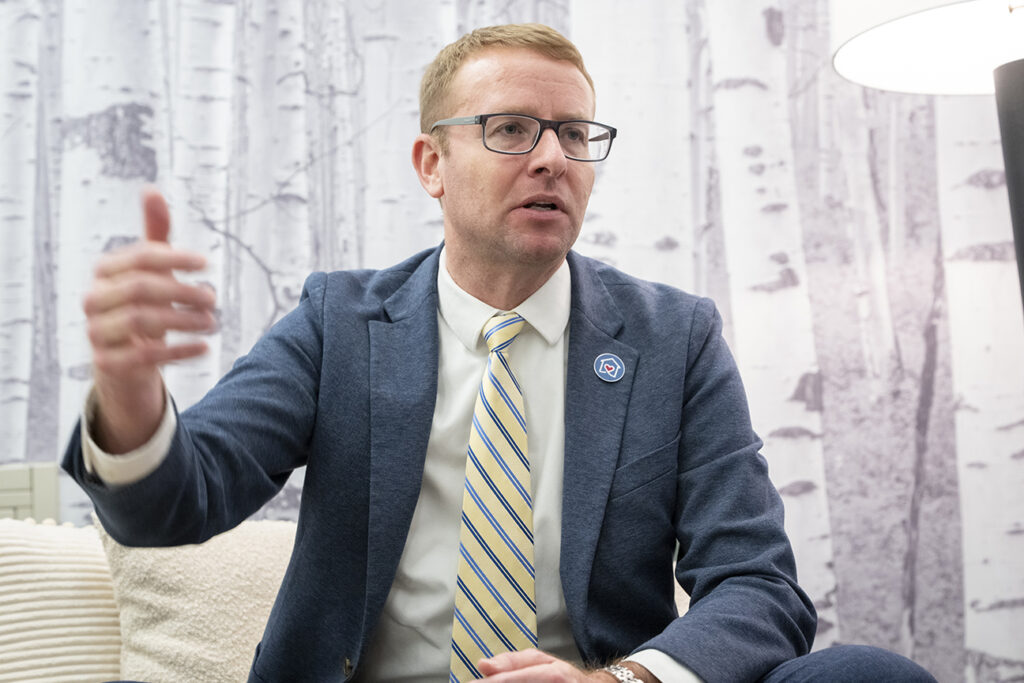
Alex Adams, President Donald Trump’s top official overseeing programs for vulnerable children and families, made his name in Idaho state government as a driven deregulator. Now, as a federal official, he’s promising the same for the agency that oversees this country’s foster care system, cash aid for families, Head Start preschools and care for refugee children.
In an 80-minute interview with The Imprint, Adams was perhaps most animated when describing his goals for cutting red tape. He said he plans to torch significant portions of the Administration for Children and Families’ 43,000 pages of “sub-regulations” that govern much of the nation’s safety net for families.
“We need to barbecue this stuff so that people know what they are actually expected to do,” he said from his Washington, D.C. headquarters. “You’re going to see a bonfire next year. And I would be stunned if anyone misses it because it’s program instructions for yesteryear. It’s grants that haven’t been funded since I was in diapers.”
Prior to becoming assistant secretary of the Administration for Children and Families (ACF), Adams, 40, led Idaho’s child welfare system for 16 months. During that time, he focused on ensuring that a family home, not merely a bed in a group facility, was available for every child in foster care. In the Thursday interview, he discussed his rationale and aims to expand the approach nationwide through his recently announced initiative, A Home for Every Child.
He’s also demanding that states stop seizing foster youth’s Social Security survivors’ benefits to cover their costs in foster care. (When asked about a warning letter sent last week to 39 states, Adams warned that his admonishments “start a little bit more on the honey side of the house, but maybe work up to the vinegar side.”)
But his targeting of states that have rules requiring foster parents to affirm the gender identity of youth in their care have been critiqued by some Democrats.
In October, Adams notified at least five states that their foster care and adoption licensing requirements could be a violation of the potential caregivers’ First Amendment rights, by insisting they comply with rules, such as calling foster youth by their chosen pronouns, even if the caregiver had ideological objections to doing so. Studies have found that close to one-third of older foster youth identify as LGBTQ+, and they are more likely to be sent to group homes and become hospitalized for emotional distress.
Washington Gov. Bob Ferguson called the letter his state received “misleading and inflammatory.” In a recent letter to Adams, Sen. Ron Wyden of Oregon called his demands that states roll back licensing rules protecting LGBTQ+ foster youth “witchhunts.” Wyden also told Adams at his summer confirmation hearing that some Idaho families were “terrified” by his “deregulation-at-any-cost” approach.
Adams addressed both topics on Thursday, describing his moves at the $70 billion agency he now oversees as prudent, and calling himself an “optimized government guy” as opposed to a “slash-and-burn guy.” When asked whether states should do anything specific to protect LGBTQ+ youth from poor treatment, he said that finding foster homes that are a “customized match” is critical, and “care should be individualized to the needs of the child.”
Adams said he will prioritize preventing the need to use foster care. For children who are removed from home, he aims to boost the availability of foster homes and placements with relative caregivers. Adams praised President Trump and First Lady Melania Trump, who he joined for a recent publicity event at the White House announcing initiatives to support older foster youth, expand partnerships with faith-based organizations and modernize the child welfare system’s technology.
What follows are key excerpts from The Imprint’s interview with Adams, lightly edited for clarity. The full conversation is available on the Imprint Weekly podcast.

Your career has included training as a pharmacist; you’ve advocated for chain drug stores, and you’ve overseen the budget of the entire state of Idaho. But I’m curious about the shift you made in 2024 to take over Idaho’s Department of Health and Welfare. You said you wanted to focus on foster care and adoption specifically, even though that agency has a much wider range of responsibilities.
So how did that career shift come about? And what did you know about child welfare before taking that job?
All careers are shaped by elements of pure chance, and I think that’s what makes life fun. When I went to school, I went to be a pharmacist. It was the family business. Dad was a pharmacist. Grandpa was a pharmacist, great grandpa was a pharmacist, so I was following the family path and found out pretty early I probably didn’t enjoy practicing pharmacy.
I felt like pharmacists were trained to do much more than they were actually allowed to do legally. I didn’t practice, and I didn’t have the patience to sit around and hope that practice changed. I wanted to make that change.
So I had to find a path that kind of married those up, and I found a path for it at the pharmacy advocacy world, first in Washington, D.C. It’s where I met my wife — she’s the Idaho native — and suddenly moving to Idaho was a priority that might not have been discussed prior to marriage. But it was a great journey for us.
“We need to barbecue this stuff so that people know what they are actually expected to do. You’re going to see a bonfire next year. And I would be stunned if anyone misses it because it’s program instructions for yesteryear. It’s grants that haven’t been funded since I was in diapers.”
— Alex Adams
I was quoted often in Idaho saying 86% of my budget was Medicaid, but 86% of my problems were child welfare. I was going to spend my 86% of time where my 86% of problems were. We had that vexing problem of the number of kids coming into care going down, but our budget growing logarithmically. I thought it was a very interesting challenge for us to solve. I thought it was a very human challenge that if we made a difference in, it would impact lives positively.
And also, when I started that role, I had a 5-year-old daughter. So it was personal for me. I wanted every kid in Idaho to have the opportunities my daughter had.
Were there any big surprises as you got to know the field?
A number of things. First, I had to forget everything I thought I knew about child welfare financing. Going back to basics, we were able to isolate the three budget variables: How many kids come through the front door is your most important driver.
When they come into foster care, your second budget driver is where you place them. Kinship care is generally your lowest cost, often tied with non-relative care in Idaho — I was paying $16 a day for each. If I did not have a home available for them and they had to come into congregate care, I was paying on average $385 per day. Your third budget-driver is how long they’re in care. You can reunify them, or, if there’s a timely path to permanency, you have better outcomes with a permanent plan to lower cost because of reduced length of stay.
So we basically isolated the three budget drivers: front door, placement setting, length of stay.
We had a lot of people coming to us sincerely saying, you should focus on kinship, you should focus on prevention, you should focus on ombudsman, you should focus on all these things. The center of the square was always the best interest of the child, but the outer wings were very divergent.
“you can get your denominator down by preventing kids from coming in — having credible alternatives that preserve families, keep them together, provide services for the root causes of kids coming into care.”
— Alex Adams
So we as a leadership team said: You know what? What we want to do is, we want to increase our ratio of homes-to-children. And looking at it as a ratio gave us the ability to make progress on both sides of that equation: You can get your ratio up by focusing on your numerator — your numerator is your number of foster homes. You can get your homes up through retention, through faith-based partnerships, through recruitment campaigns, streamlined kin licensure, making it as easy as possible to get kin through the door.
More importantly, you can get your denominator down by preventing kids from coming in — having credible alternatives that preserve families, keep them together, provide services for the root causes of kids coming into care. You can get your denominator down through legal advocacy for children. You can get your denominator down through how you deploy predictive analytics and other things like that.
During your time as budget director in Idaho, you helped advance something known as zero-based regulation. And this work has been celebrated widely in conservative circles. Elon Musk even retweeted a chart showing how many pages of regulations you helped cut in Idaho. He added a heart-eyes emoji, I guess because he loved it so much.
Can you explain to our audience what zero-based regulation is and how it might be applied in child welfare?
Zero-based regulation is the concept that regulations rise like rockets but fall like feathers. The zeal to add regulations and just pile them on top of each other is not met with the same zeal to take some of them off the books.
So in Idaho, what we did is, we constructed a system whereby once every five years, we reviewed regulations and said, ‘Does this still make sense? Do we still need a regulation from December of 1968 spelling out a dress code for the deputy state veterinarian? Do we still need regulations on the books for a lottery game show that never aired since 1983?’
And we started to cull the herd and shrink it to what actually still applies. I do think it is a philosophy that can be applied to ACF.
I would rather empower states. I would rather trust states. I don’t look at states as damsels in distress. I want states to be able to make good, reasoned decisions that are in the best interest of children — and not worry about in August of ’92 if there was a guidance document that has been scanned at a 15-degree angle that looks like an old typewritten page.
I want them to take care of their kids. I don’t want them to spend time thumbing through a mountain of paperwork.
So you could rest assured that we were going to barbecue a lot of sacred cows and we were going to get a lot of the sub-regulatory guidance documents off the books and we’re going to pare back the regulations.
The one thing I would make crystal clear, though, is in so doing, regulations are necessarily a collaborative process. I’m not a slash-and-burn guy, I’m a right-size and optimized government guy.
Your goal, and as you mentioned this earlier, is to achieve a one-to-one ratio of foster homes to foster children. Can you say a little bit more about how you are going to achieve this?
A lot of what we’ve been doing is just raising awareness of the measure of homes-to-children, and why we think that is something that’s useful to look at.
There’s criticisms of the measure. Some think it’s just a recruitment campaign: It is not. Nothing could be further than the truth. You could get lost in the weeds: “Why homes, why not beds?”
But what I saw in Idaho is, having a simple measure that you look at regularly, where you can make progress by focusing on a number of different tactics or strategies: how you define kin, how easy it is to get kin licensed and through your door, how you do recruitment campaigns, how well you retain your existing foster parents.
“I want states to be able to make good, reasoned decisions that are in the best interest of children — and not worry about in August of ’92 if there was a guidance document that has been scanned at a 15-degree angle that looks like an old typewritten page.”
— Alex Adams
You can also focus on preventing kids from coming into foster care in the first place, by having robust family-based supports, robust substance use disorder services, things like that. You can hasten time to permanency by reunifying faster or by having more adoption homes, providing legal advocacy for foster youth or bio families.
President Trump’s recent executive order calls for promoting the involvement of faith-based people and organizations in foster care services. One of them is to address policies and practices that “inappropriately prohibit participation” by individuals or organizations based upon their “sincerely held religious beliefs or moral convictions.”
What is your understanding of what that means, and what is a policy that “inappropriately prohibits participation”?
There’s studies to show that families of faith are more likely to raise their hand and volunteer. So we have to be very careful about the message that we send, and not break the chain at the first link. Too many folks conflate licensing with placement. Licensing is the gateway. Licensing is when a family raises their hand, submits an application, goes through a home study, answers all of the questions, and says “We are willing to take a child in my home.”
Placement occurs when a child enters foster care, and the individual’s child’s needs are matched with the foster family’s capabilities. It is a collaborative process. It is overseen by the courts. The youth have CASAs or guardians ad litem advocating for their best interest and elevating their voice.
Too many people have been conflating licensure with placement. Licensure should be fast – licensing should be easy. You should roll out the red carpet and be as welcoming and inclusive of everybody. Everybody.
And placement should be the customized match of the child’s needs with the demonstrable capabilities of the foster family. When states break that chain at that first link, you will never get the match right. And that’s why you have too many kids sleeping in offices, too many kids in congregate care facilities where you get your worst outcomes at the highest cost.
Do you think it’s important for states to take any proactive steps for LGBTQ+ youth in foster care, to make sure that they end up in homes where they do feel safe and supported in terms of their sexual orientation or gender identity? What are your ideas on how to do that in a way that doesn’t violate the First Amendment?
Care should be individualized to the needs of the child. But the first link in the chain is having a robust licensure network. If you artificially smother licensure, you will never have placement customization, and you will never match the best interest of the child.
One of the things I liked in the president’s executive order is it talked about the use of AI or predictive analytics. There’s a pretty interesting use case about how you might be able to use that to guide the match — the match between the child’s individual needs, at placement, with the demonstrable capabilities of the foster family that you have appropriately licensed.
But if you don’t have a robust network of licensed foster families, nothing else in that chain works as intended.
In 2018, Donald Trump signed the Family First Prevention Services Act. That reform allowed new flexibility for states to pay for services that can help prevent entries of children into foster care. But there is widespread frustration with how little states have spent on prevention through that act. What is your vision for addressing this?
In Idaho, I had 85% of my kids in placement in foster care or congregate care, and 15% in prevention cases. I wanted to flip that script. I thought a lot of what we were handling as neglect could have been kept in the home safely with appropriate oversight, with brokerage or direct delivery of services — most commonly for substance use or mental health.
I thought if we built out our network, we could flip that script and keep kids safe in their homes, at lower cost, and better outcomes for both the child as well as the family.
“I have very little interest in tearing down things that are working, and I’ve seen enough evidence that suggests kin placements work.”
— Alex Adams
I’ve had ups and downs in how I’ve been thinking about this, but I’d like to build out our prevention clearinghouse as far and as wide as we can. And we’re having a lot of conversations: Have we tightened the belt around IV-E prevention too tight as an agency relative to what the framers of Family First intended?
I don’t want to us to have any red tape beyond the statue, and I want us to push as far as we can within the confines of the current statute, so that more states can have more robust prevention plans. I want every state to have a prevention plan and go deep on in-home supports, prevention for mental health and substance use disorders.
I believe in prevention, but you can’t turn the wheel so far in that direction that you forget not every entry into foster care is preventable. There are some that will never be preventable. Sexual abuse always, most likely, is going to need a placement.
Speaking of foster home capacity, the previous administration did implement a rule aimed at making it easier for states to approve kinship caregivers — relatives or family friends who take in a child — while also putting them on equal footing with other foster parents in terms of financial support.
States, including Idaho, have been moving towards establishing that kin-specific licensing. Do you expect that rule to survive the regulatory barbecue that you talked about earlier?
I have very little interest in tearing down things that are working, and I’ve seen enough evidence that suggests kin placements work. It’s better outcomes for the kid, timely permanency, maintains cultural traditions, religious traditions, all of that stuff.
At ACF, we’re a financier and overseer. We’re not the direct service provider. So I will sing from the heavens why I think kin licensure makes sense, but those are ultimately state decisions.
If you’re a non-relative who’s talking about fostering, yes, you can have a long lead-up of licensure. Yes, you can go through 30 hours of training. Yes, you can have an onsite home study and self-inspection and make sure that you’ve got the fence around your pond and that your rabbits are up to date on their vaccines.
Kin is different. You get a knock in the middle of the night saying, “Hey, something happened with your brother. Can you take the kids in?” You don’t have time to then go through those 30 hours of training while the kids are waiting for a placement. We do need to have separate licensing standards.
That said, you also have to ensure safety. The model standards that I’ve seen out there strike that appropriate balance. It requires criminal history and background checks. It looks at abuse and neglect registries, but it doesn’t measure the square footage, or if there’s bunk beds or individual beds.