Alex Adams, confirmed today as Trump’s top official on children and families, slashed “rocks-in-shoes” regulations and boosted spending on foster care prevention.
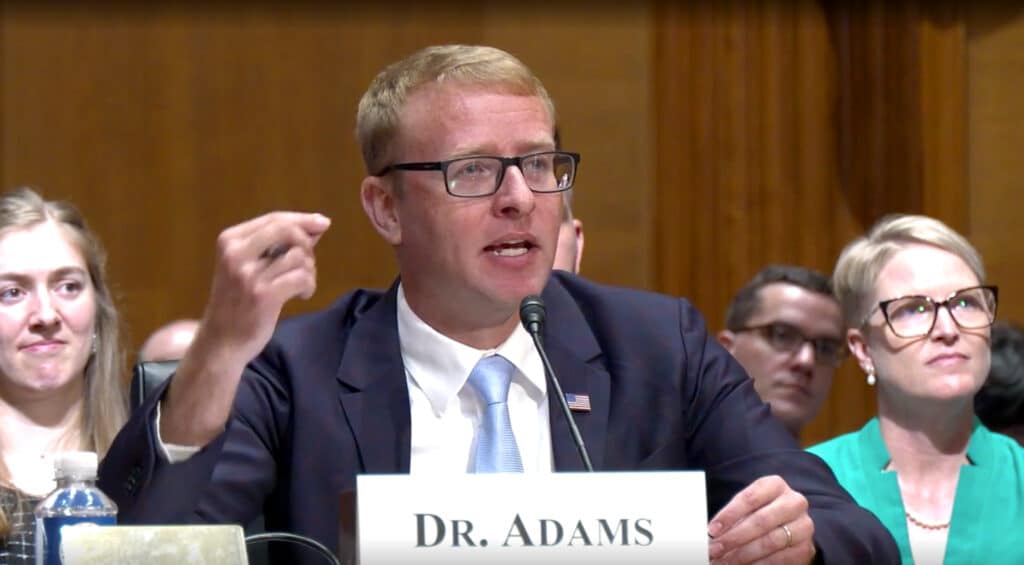
Update Oct. 7, 2025: The U.S. Senate confirmed Alex Adams as assistant secretary of the federal Administration for Children and Families – along with dozens of other presidential nominees – by a vote of 51 to 47.
At a public hearing earlier this year in the Boise state capitol building, President Trump’s nominee to oversee child welfare, Head Start and other family support programs showed hints of how he might lead.
Alex Adams — then-head of Idaho’s Department of Health and Welfare — held his own when confronted by a Republican-led panel of state lawmakers. They demanded answers about $14 million of cost overruns in the foster care program Adams had been overseeing.
“Can you explain to me how that’s gonna be saving us money over the long term, as far as that investment goes?” state Rep. David Leavitt asked.
“You can always sneak out the backdoor, but we’ll catch ya!” quipped the committee chair, John Vander Woude.
Adams, a former vice president for a drug store trade group and state budget chief, quickly won the lawmakers over. He promised the panel a less costly, more orderly child welfare system, one that addresses families’ struggles earlier — before children need to be pulled from their homes. He described a dire need to recruit more foster parents to keep children out of more expensive and ineffective group facilities and last-resort AirBNBs.
“We’re either going to build the fence at the top of the cliff, or you’re gonna pay for more ambulances at the bottom,” Adams said, quoting a colleague.
Underscoring the point further, Adams compared his agency to workers fixing the leaks in their capitol building roof: “We’re either going to refinish the roof to prevent the dripping or we’re gonna put more 5-gallon buckets out — it’s either going to be one or the other.”
Adams got the “refinished roof” he wanted, and won vocal praise from the panel that day.
In April, Idaho Gov. Brad Little approved a more than $20 million boost to his Department of Health and Welfare’s budget for dozens of new child welfare prevention staff members. Adams, who pledged a “shock-and-awe” campaign to improve foster care, also eliminated what he called “rocks-in-shoes” requirements for foster home licensing – such as needing fences around bodies of water – and supported an executive order granting some foster parents paid family leave.
Adams, a pharmacist by training, led his agency for just 16 months before stepping down Sept. 12. He is now President Donald Trump’s nominee to be assistant secretary of the Administration for Children and Families, serving under Health and Human Services Secretary Robert F. Kennedy, Jr. The $70 billion children and families division holds a vast set of responsibilities overseeing the nation’s safety net for its most vulnerable families — from foster care to child support and home heating assistance. The U.S. Senate is expected to vote on the Idahoan’s candidacy as soon as today.
So far, he has received unanimous support from Republicans in Congress — including the chair of the powerful Senate Finance Committee, Idaho Republican Mike Crapo. Adams’ Democratic opponents have criticized his refusal to disavow Trump’s sweeping funding cuts to social safety net programs like Head Start.
In interviews, lawmakers and others who worked with him on state policy said his brief tenure heading child welfare in Idaho shows that Adams took over an agency in turmoil and helped revitalize it with a new leadership team and unprecedented investments. He’s also praised by children’s advocates for waiving adoption fees, supporting an extension of foster care to age 23, and protecting foster youth’s social security benefits. All told, the changes shifted the focus of an agency that long emphasized crisis response — policies some hope Adams will prioritize if confirmed as Assistant Secretary of the federal Administration for Children and Families.
“We’re either going to build the fence at the top of the cliff, or you’re gonna pay for more ambulances at the bottom.”
— Alex Adams
Brian McCauley, a former foster parent, business owner and outspoken critic of the agency Adams ran, said he worked closely with him on the reforms to foster parent recruitment.
He was most impressed by the culture shift he encouraged at the roughly $6 billion Department of Health and Welfare — the state’s largest — that covers everything from birth and death records to child care and Medicaid.
“Alex is a very compassionate person who was able to see the legitimacy of the systemic failure, and he was smart enough to look for different solutions,” he said. “He’s not your typical bureaucrat.”
Marco Erickson, an Idaho Falls Republican representative who is vice chair of the health and welfare committee and a juvenile justice policy reformer, said Adams entered his former department with a long list of legislative allies from his years overseeing Gov. Little’s budget office.

“He had a lot of relationships — he was very popular. He knew what kinds of things they liked and how to get to work his first day, and that was really popular,” said Erickson.
But some advocates — and the state’s outnumbered Democrats — are wary given his prior role in Gov. Little’s conservative administration, which they argue prioritized historic tax cuts benefiting the wealthy and failed to address a chronically underfunded safety net for vulnerable kids.
As Health and Welfare director, they note, Adams refused federal funding for parents with disabled kids and child care subsidies, which seemed at odds with his focus on preventing foster care.
“I heard him say over and over that prevention is the way to treat people humanely and save costs down the road. I hope he would look more broadly at health care and child care,” said Melissa Wintrow, the Boise area state Senate minority leader and member of the state’s Child Protection Legislative Oversight Committee. “And I am hoping and praying that the reason all that prevention funding was appropriated was because he made the case that forcefully — and that he will do that in Washington.”
To date, the Trump administration has appointed Andrew Gradison acting head of the federal agency. Gradison is a veteran policy expert on children and families who previously worked in the House and Senate. The commissioner of the Administration on Children, Youth and Families and associate commissioner of the Children’s Bureau are currently filled by career staffers.
Adams did not respond to requests for an interview made last week through his former state agency and the Administration for Children and Families.
But at his U.S. Senate confirmation hearing in July, he indicated he would prioritize foster care, despite the administration’s far more sprawling portfolio of safety net programs.
“If past is prologue, where I intend to spend disproportionate time and my energy — and a disproportionate amount of my effort — is improving child welfare, specifically the foster care and adoption systems,” he said.
“I heard him say over and over that prevention is the way to treat people humanely and save costs down the road. I hope he would look more broadly at health care and child care.”
— Idaho State Sen. Melissa Wintrow
Adams has a Doctor of Pharmacy degree from the University of Toledo and a Masters of Public Health degree from Johns Hopkins University. He took over at the Idaho Department of Health and Welfare in 2024 after five years leading Idaho’s Division of Financial Management. Earlier, he served as executive director of the Idaho State Board of Pharmacy, after six years with the National Association of Chain Drug Stores.
Nevertheless, his nomination appears consistent across the first and second Trump administrations. In 2018, Trump signed landmark legislation incentivizing states to fund foster care prevention. He also appointed officials who emphasized prevention to system leaders nationwide: former Administration for Children and Families Assistant Secretary Lynn Johnson, and former Children’s Bureau Associate Commissioner Jerry Milner.
In interviews, Milner and Johnson both said they did not know Adams before his nomination and said their conversations with him since have left them hopeful that he shared their priorities.
“It was clear to me that he’d been talking to his child welfare people an awful lot in Idaho who were very prevention-oriented, very family-focused,” said Milner, who now works as a consultant. “But the political pressures that come with the office can be significant, and values and principles like he’s expressed will be all the more important.”
Johnson, who runs a nonprofit devoted to supporting older foster youth, added that she has heard support for Adams from state child welfare directors “on both sides of the aisle,” and was optimistic he would work to help prevent foster kids from poor treatment such as “having 50 moves and 18 years in the system.”
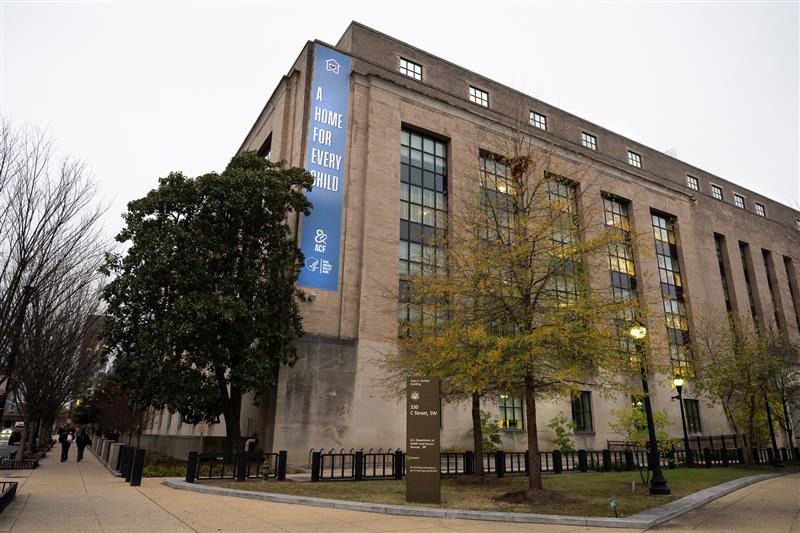
If confirmed, Adams would join a D.C. agency that has been beset by eliminated positions and funding cuts by Trump appointees — at first, business tycoon and former presidential advisor Elon Musk, and later, Health and Human Services Secretary Robert F. Kennedy, Jr. Amid the current federal government shutdown, the administration’s budget director is threatening unilateral mass layoffs.
Meanwhile, scores of social service providers around the country have seen millions of dollars in federal grant awards terminated or delayed and in some cases restored with little explanation. And states are now bracing for unprecedented cuts to Medicaid and food stamps included in Trump’s recently passed signature bill he dubbed “The One Big Beautiful Bill.”
Wintrow praised Adams’ management skills and persuasiveness in her statehouse, where they collaborated on increased funding for child welfare services. But she added that many of her constituents in the health care and social services fields face looming funding crises due to the Trump administration’s safety net shredding, and Adams may have limited influence.
“He’s just one person,” Wintrow said.
In a party-line 14-13 vote this summer, Adams received approval from the Republican-led Senate Finance Committee. Democrats voted unanimously in opposition, and their ranking member on the committee has given no indication he will reconsider in the upcoming full Senate vote.
“Dr. Adams talks a big game about safety and helping families, but a look at his record in Idaho shows otherwise,” said Oregon Sen. Ron Wyden in a statement following the committee vote. “Worse still, he appears to be just another yes-man to help greenlight Donald Trump’s dangerous and destructive agenda.”