The Administration for Children and Families is a three-decade old, $70 billion sprawl of federal programs ranging from heating assistance for low-income people to foster care prevention to unaccompanied migrant youth safety. It quietly oversees services and funding for tens of millions of the nation’s most vulnerable, while remaining mostly unknown to the broader public.
But under questioning from senators today, President Donald Trump’s nominee to run that agency parried attacks on his deregulatory agenda and made clear where he’d put his focus: the child welfare system, especially foster care prevention and foster parent recruitment, which he called “one of the critical things we need to do as a country.”
“If past is prologue, where I intend to spend disproportionate time and my energy, and a disproportionate amount of my effort is improving child welfare, specifically the foster care and adoption systems,” Alex Adams said in a gravel-inflected baritone at his confirmation hearing.
The current director of the Idaho Department of Health and Welfare faced a mostly friendly Republican-controlled panel, led by his home-state Sen. Mike Crapo. He said Adams had “demonstrated a keen eye towards fiscal responsibility” and “reducing regulatory burden.”
“There’s no greater need than to protect the most vulnerable kids, and the most vulnerable kids are those in congregate care settings.”
— ALEX ADAMS
But one of the leading voices on child welfare issues in Congress, Sen. Ron Wyden of Oregon, slammed Adams’ record as an aggressive deregulator. His fellow Democrats pressed the married father of one for his views on the Trump administration’s broader “Make America Healthy Again” agenda, and its dramatic cuts to safety net programs that foster youth and their families rely on.
“My team was told by advocates on the ground in Idaho and across the country that they are terrified about what he has done in his state harming vulnerable children, families, and people with disabilities, and the actions he will be poised to take nationwide should he be confirmed,” Wyden said at today’s hearing. “Dr. Adams is a proponent of deregulation at any cost, what he and other conservative elites call ‘zero-based regulation.’”
Republicans pushed back on that assertion, citing past support from Democratic leaders for his approach to deregulation, which Adams has championed in recent months through conservative channels, including the Manhattan Institute and the Conservative Political Action Conference. The government-wide rollbacks he helped lead as Idaho’s budget director even caught the eye of Elon Musk and Vivek Ramaswamy ahead of their breakneck push for greater “government efficiency” earlier this year.
“We got those silly, outdated, gunky regulations off of the books, so we could shine a brighter spotlight on what remains,” he said today. “You’d be hard-pressed to find a specific Idaho regulation that has resulted in harm because of the approach taken in Idaho.”
Adams has a doctoral degree in pharmacy from the University of Toledo and a Masters of Public Health degree from Johns Hopkins University. He is relatively new to the child welfare field: He took over at the Idaho Department of Health and Welfare in the spring of 2024 after five years leading the state’s budget and regulatory office. He’s also served in leadership roles for the Idaho State Board of Pharmacy and the National Association of Chain Drug Stores.
Adams found some areas of agreement with the Democrats, including on the need for greater oversight of residential programs for troubled youth. Last year, Senate finance committee staff issued a damning report on the topic, titled Warehouses of Neglect: How Taxpayers Are Funding Systemic Abuse in Youth Residential Treatment Facilities.
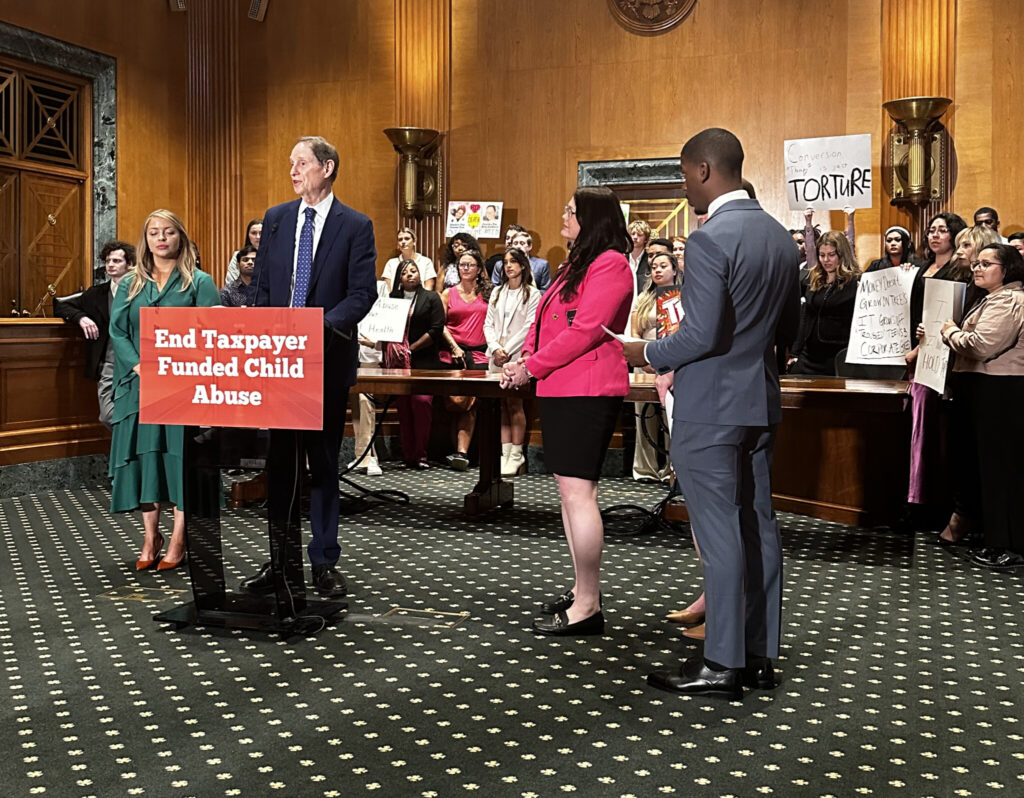
“What are you gonna do specifically to stop kids in residential treatment facilities from getting hurt?” asked Wyden.
“I think it’s an area where you and I have a lot of thoughts that align,” Adams responded. He said his state took action in response to the Senate report’s findings.
“We went from one announced inspection a year, to two inspections a year, including one unannounced,” he said. “We now randomize the inspectors in Idaho, and the reason we do that is there’s no greater need than to protect the most vulnerable kids, and the most vulnerable kids are those in congregate care settings.”
Adams added that Idaho reduced its congregate care placements for foster children last year from 268 to 173, a 35% drop.
But pressed by Wyden on the need for specific protections for LGBTQ+ youth, Adams demurred. Wyden said his staff has documented more than 100 personal stories of verbal and physical abuse from those living in group care facilities.
“You are very articulate,” said Wyden, “but it’s really hard to understand what you stand for and what you would do.”
Adams responded: “My operating principle in Idaho has been, when there’s a fork in the road, I’m going to do what’s in the best interest of the child.”
Other Democratic senators, including Maggie Hassan of New Hampshire and Raphael Warnock of Georgia, pressed Adams on his position on the early childhood education program for low-income families, Head Start, which faced widespread funding uncertainty and delays in the early months of the Trump administration, prompting lawsuits. In response, Adams offered some signs of support for the beleaguered program.
“I’d reiterate what Secretary Kennedy said, which is his intention is to make Head Start better and brighter by the end of this term,” Adams said. He repeatedly emphasized his grandmother-in-law’s work as a Head Start program leader in its earliest days in the late 1960s.
Adams also highlighted research findings that suggest Head Start’s comprehensive wraparound services for low-income families can help them avoid involvement with the child welfare system. In Idaho, he campaigned publicly with Gov. Brad Little for a boost in funding to hire dozens of new state employees in order to expand foster care prevention services in the state.
“I agree with President Trump when he said ‘The best foster care system is one that is not needed in the first place,’” Adams said in his opening statement, mentioning support for the Family First Prevention Services Act, which President Trump signed in his first term and aims to keep kids out of the system and institutional homes.
Asked by Sen. James Lankford of Oklahoma to describe his plan for the Office of Refugee Resettlement, which handles home placements of unaccompanied migrant youth, Adams praised the Trump administration and dinged Biden’s, which he said prioritized “speed over safety. We will prioritize safety over speed and ensure that the best interests of these children are front and center in every decision that’s made.”
Adams has received strong praise from some advocates for foster children for steps he took in Idaho to stop withholding federal benefits from foster youth as reimbursement for their care. At today’s hearing, he highlighted his recent bipartisan work with Idaho’s Legislature to extend support for foster youth up to age 23, streamline licensing for kinship caregivers, and make “record investments” in foster care prevention. When he was first appointed in Idaho, Adams also set an ambitious goal of doubling the rate of foster homes per foster child.
“When I started in my role in Idaho, I had too few foster families, and as a result, we had kids sleeping in Airbnbs, short-term rentals, and other non-traditional settings,” he said. “Through retention and recruitment efforts, last November, we got every kid out of a short-term rental, and I said: ‘We’re never, ever going to do that again.’”