
Months before Savannah Mitchell was about to age out of the child welfare system, her social worker dropped by her foster parents’ home in Big Lake, Minnesota, carrying a clipboard and some paperwork to fill out.
They sat on the bed in her basement bedroom and talked about Mitchell’s plan for life after high school. Had she thought about a job? The social worker asked. Did she know what she would do for transportation?
After that meeting, Mitchell never heard from that social worker again. No one from the child welfare system followed up to make sure she graduated from high school that spring in 2018. No one checked in to see how she was doing after she started college that fall.
Mitchell, now 25, spends her days trying to make sure students have what she didn’t while attending college — someone looking out for them. In between pursuing a master’s degree in education at Minneapolis’ Augsburg University and a substitute teaching job, she works in a unique support program designed for students who grew up like her.
The Augsburg Family Scholars program provides financial, academic and social support to any student who has spent time in foster care. But beyond basics that other college students might take for granted, the program offers constancy and community to those coming from backgrounds shaped by upheaval and uncertainty.
“It’s been really rewarding helping people go to college and helping them struggle less than what I did when I went to college,” said Mitchell, who works as a graduate assistant in the program.
The campus-based Augsburg program is believed to be the only one of its kind in the state, said Ariana Chamoun, director of systems change at Foster Advocates, a St. Paul-based nonprofit.
Chamoun said Foster Advocates has been so impressed by Augsburg’s efforts that the nonprofit recently modeled a pilot program after it. Launched last spring at three Minnesota community colleges and Minnesota State University, Mankato, the pilot offers mentors, career-building workshops and group outings to students with foster care backgrounds, said Elena Leomi, managing director of movement building with the advocacy group.
“We want more campuses to do it,’’ Chamoun said. “We’re hoping that by planting this seed, another institution like Augsburg can do the same thing.’’
The Augsburg program, which began with only nine students in 2022, currently has 38 enrollees. It layers its comprehensive support on top of existing financial aid programs available to foster youth in the state.
The program was devised by a group of students whose sociology professor, Tim Pippert, challenged them to brainstorm ways to support fellow students coming out of a system that typically leaves young people to figure out college and their futures on their own.
To make students feel at home on the campus, gift cards for dorm supplies are doled out as soon as they arrive, and guaranteed year-round housing is provided for students who live on campus. And once classes begin, faculty mentors keep tabs on students through academic alerts so that they can help them navigate any challenges they encounter with their studies.
“They’ve done the hard work to get here,” Pippert said. “We’re just going to try to help support them in any way we can.”
The short-term hope, Pippert said, is that students will enjoy their college experience and eventually obtain their degrees. The long-term goal: Being able to show that the program has led to higher retention and graduation rates, and inspiring other institutions to launch programs of their own.
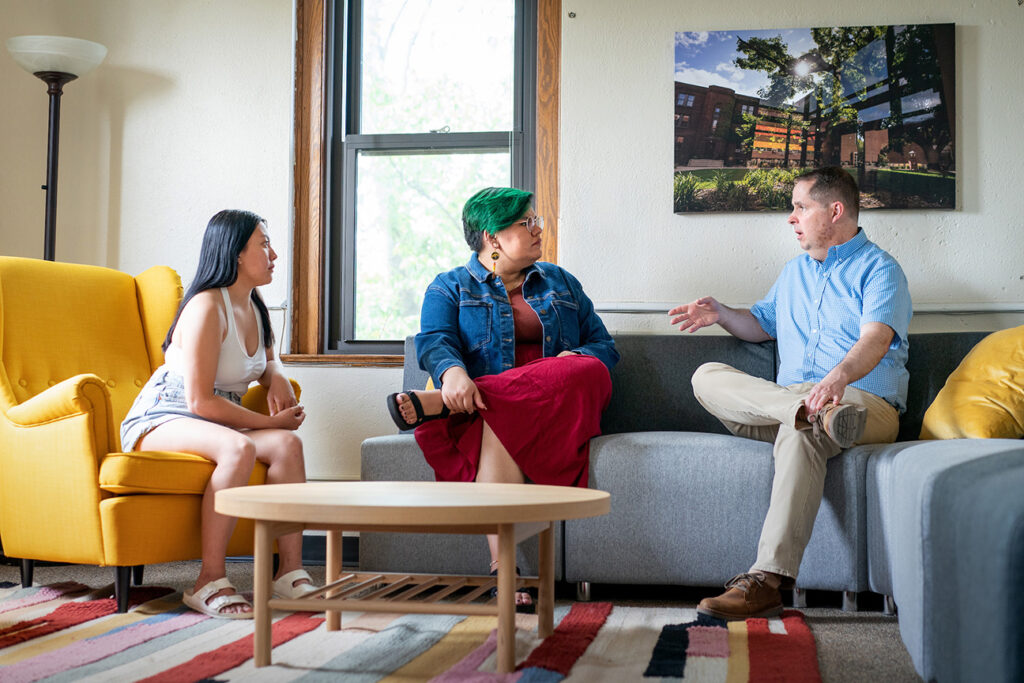
The Augsburg program’s homey lounge is where students can snag snacks or a spot on the couch for between-class naps. Evenings and weekends might include a group dinner or social outing.
Mitchell’s job is to connect the former foster youth to resources and make sure they know they can depend on her.
She will walk students experiencing a mental health crisis over to the school’s counseling center herself, and has helped others secure food stamps. During office hours, they might stop by to chat about their day or confide in her about a recent breakup. She’s been amused and bemused by students who have sought her advice for even the most mundane things, like the one who handed her their menu at a restaurant and asked what they should order.
“This is a little ridiculous,’’ she recalled telling the student, “like, just what do you want to eat?”
But it was also a sign of the trust and connection she’s built, something so often missing in the lives of young adults raised by the state.
Pippert, who serves as the executive director of Family Scholars, said he considers Mitchell’s presence an essential part of the program. When the hiring committee heard her story as a former foster youth, they knew she was a “perfect fit.’’
“The students feel more validated in their experience knowing that one of the people that is trying to help them has been through it too. It just comes off differently,” he said. “I just don’t have that lived experience, and so it’s really invaluable.”
‘I really needed a lot more support’
Mitchell entered foster care in 2016. But her interactions with Child Protective Services began years before that.
She remembers once being called to the main office while attending middle school in Wisconsin. Someone had noticed “wounds and welts” on her body while she was changing in a school locker room, she said. After being ushered into a conference room, she was seated across a table from a woman who asked her a lot of questions.
“I didn’t answer or lied about, like, half of them, because I was really nervous she was gonna come to the house,” Mitchell said. “And then I’d be outed for talking to someone.”
But at 16, Mitchell decided it was time to speak out, and she told a school guidance counselor about what was happening at home. Things moved fast after that. Within hours, she was in the back of a police car headed to her siblings’ middle school. They were all in foster care by the end of the day.
Mitchell aged out of foster care a couple of years later. Like many former foster youth, she found taking care of herself while attending college to be difficult.
“I really needed a lot more support,’’ she said. “I needed financial support and housing support and food resources, and stuff like that. I didn’t know how to get car insurance, I needed my own phone plan, a bunch of things like that.”
While recent studies have found that college enrollment rates for foster youth range from 29% to 64%, only 8% to 12% earn a post-secondary degree, five times less than the general population, according to a comprehensive 2025 review of studies on educational outcomes in the child welfare system. Unstable housing and financial support, and limited adult guidance are some of the obstacles that prevent foster youth from enrolling in or finishing college.
During Mitchell’s undergraduate college years, she struggled to cover her expenses despite two summer jobs and financial support from state aid for former foster youth.
“It’s pretty much impossible to go to school full-time and work full-time without burning yourself out,” she said.
Finding the tools for academic success
Pippert said his research into the overlap between foster care and homelessness was what motivated him to ask his senior seminar class how they could turn observations into action.
“I kind of got tired of being a professor who talked in my family sociology class about the problems of the system and hoped my students would go do something,” he said. “I just wanted to stop ignoring that and see what we could do as an institution.”
In 2022, the program received a $53,000 grant from the Sauer Family Foundation, support which has continued along with other sources.
Creating a sense of community was paramount to the program’s design, Pippert said. As a professor, he knows that a feeling of belonging on campus is essential to academic success.
He credits the Family Scholars program with recently helping to convince three students who had previously dropped out to return to Augsburg and try again. One is expected to graduate this year.
“Many of them are absolutely smart enough, but have been to multiple high schools, haven’t had a consistent educational background, so don’t have maybe all the tools to find success academically,” Pippert said.
Mitchell had recently graduated from the University of Hawaii when she learned of the Augsburg program from a nonprofit coordinating college financial aid for foster youth from Minnesota.
“If you want to go to graduate school,” Mitchell recalled the email stating, “there’s this great position in Minnesota that’s looking for foster youth.”
“I got that email, and something just came over me,” Mitchell said. “I hadn’t even applied to it yet, but it just sat with me and I was like: ‘No, that’s it.’”
Mercey Morgan, a former foster youth who is pursuing a double major in creative writing and theater at Augsburg, said the Family Scholars program has been a “lifeline” and that she looks up to Mitchell, even though Mitchell is younger than her.
Both of Morgan’s adoptive parents have passed away, and many of her friends have not attended college, and so she has had to navigate higher education without anyone to ask for advice, she said.
She visits the program’s office at least once a week to catch up with Mitchell, whom she credits with recently helping her to figure out how to drop a difficult math class. The program also helped her secure emergency housing earlier this semester.
“If I didn’t have them, I don’t think I would be continuing school,” Morgan said. “I probably would have dropped out.”
Morgan, who, at 33, is going after her undergraduate degree later in life than most, said she draws inspiration from what she calls Mitchell’s “success story.’’ It’s a reminder, she said, for those in the Augsburg program that, “you can’t let things that are out of your control, like circumstances, dictate how you live your life.”
“Or,’’ she said, “where you go in life.’’