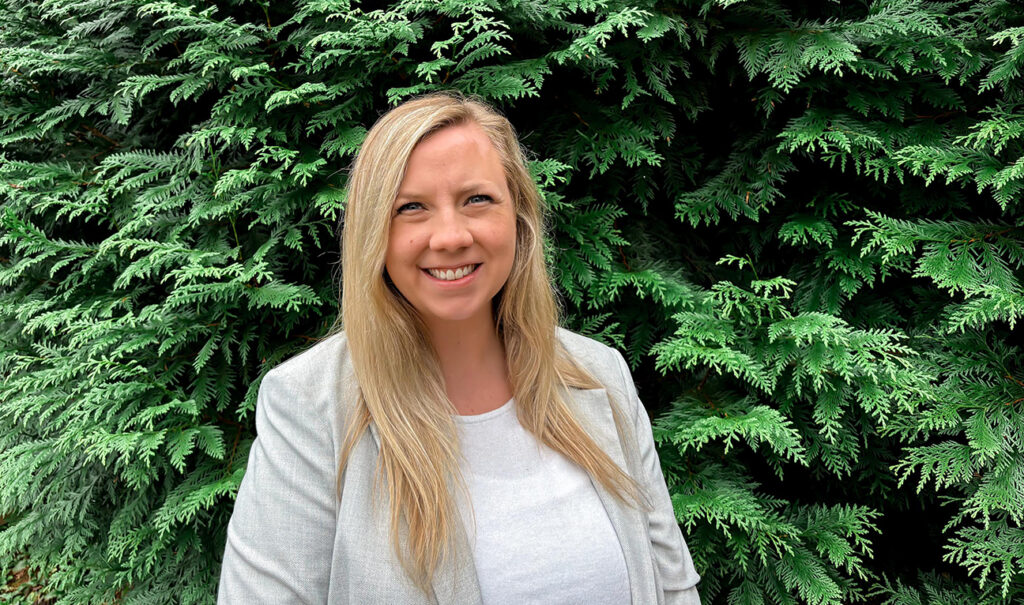
Evin Winkelman Richardson knew she wanted to dedicate her career as a researcher to studying families and couples. But investigating the ways these relationships play out in foster homes didn’t come to mind until she heard about her friends’ struggles as first-time caregivers.
“Just hearing them discuss the things that were hard, not that they were regretting it in any way — they loved being foster parents — but the challenges they were experiencing, it just got my brain churning,” she said.
That’s where her pursuit to understand the ways foster caregivers navigate their marital and co-parenting relationships began. As a researcher at the University of Georgia’s Couple and Relationship Enrichment Lab, Richardson has led first-ever studies in this area. Her research has established that the strength and quality of couples’ relationships can directly affect how well they cope.
Her most recent study surveyed roughly 80 caregiver couples across Georgia and found that the stronger their relationship, the more likely they were to continue fostering. The trend held true regardless of length of marriage or time fostering. Couples had been married between two to 52 years, and their experience fostering ranged from a month to 24 years. They reported having between two and 15 children in their home in a 12-month span.
With roughly 400,000 children in need of foster homes nationally, Richardson believes these insights are critical to understanding how to recruit and retain strong caregiver families.
Her first survey on the subject, published in 2018, established that child welfare workers also understand the importance of relationships in foster parent households and believe that providing relationship education could better support caregivers. Gaps in such resources remain, but Richardson has worked to fill them.
“Foster caregivers report that they don’t really have time for themselves or their relationship — it gets put on the back burner at times.”
— Evin Winkelman Richardson
Since 2016, her “Elevate” workshops have taught relationship skills to hundreds of couples who foster in Georgia. She recently received $6.2 million in federal funding to expand the evidence-based program, which focuses on conflict management, communication, mindfulness and other coping skills. The curriculum will reach at least 1,275 adult couples over five years.
Despite this work, Richardson told The Imprint in a recent interview that there’s still a lot more to learn about the thousands of families who open their homes to children in foster care.
This interview has been lightly edited for length and clarity.
Your studies are among the first to explore the unique relationship dynamics among couples who choose to foster. Can you talk about what has been missing in past research and why?
There’s very, very little in the existing literature about couples who foster, and there hasn’t been any that looks at how foster caregiving can impact the couple relationship — our research is the only I’m aware of.
One reason is when children are in a foster care home, it can be so temporary, so it’s really hard to plan a study to measure some of those outcomes.
What do we know about people who choose to foster?
There’s some data on race. It’s mainly white families who foster, and there’s a lot of concern about the disproportionate number of Black children in the foster care system who are being placed with white families. There’s been a lot of pushback on that.
For a long time, there hasn’t been any national data on the marital status of foster caregivers. I’ve looked and looked. The last time I saw something was from 2007, which showed around 60% of foster caregivers are married. But that’s so old I don’t even cite it anymore.
What are unique stressors caregiver couples face in their home lives and relationships?
With foster caregiving, there’s a lot of strength and joys that come with it. There’s also a lot of challenges.
Children who are in foster care are more likely to have experienced trauma, so they are also more likely to have behavior problems due to that trauma. They are often provided with a lot of different therapies, which is wonderful. They need all of those things, but it takes a lot of time and effort to manage. Foster caregivers report that they don’t really have time for themselves or their relationship — it gets put on the back burner at times. Foster caregivers talk about time constraints, financial constraints and not knowing or feeling capable to deal with the behaviors they experience.
Then there’s just issues with the child welfare system in general, feeling like communication is lacking, or feeling like they’re left out of decision-making. They don’t feel like they have any say whatsoever, and they want to be a partner in the child’s well-being. Those are things we probably hear the most.
“We know reunification is the goal of foster care, but you can’t help but fall in love with these kids and form a strong relationship with them.”
— Evin Winkelman Richardson
In what ways does the child welfare system equip foster caregivers for those challenges?
What we do hear from foster caregivers is they don’t feel prepared for the toll that it’s taking on their family, their partnership and their biological children, if they have those children in the home as well. I do think the training is a bit lacking in preparing foster caregivers to manage the stress, together, as a couple.
Research shows an estimated 47% to 62% of caregivers quit each year. Can you break down why it’s important to not only recruit but to retain them?
The child welfare system pays a lot of money to recruit and train foster parents. And then it disrupts placements. If a foster caregiver decides they no longer want to foster, the child has to make another move. We know with every move comes more trauma, so that’s a really big deal. We don’t want to add more disruption to a child’s life.
One of your studies delves into the emotional risks of caregiving — highly dedicated foster parents are more likely to experience higher levels of grief after a child leaves their home. What does your research say about the unique sense of loss that caregivers can feel in the fostering process?
There’s an emptiness when the child leaves their home because for a time, that child is part of their family. So it is a very unique type of loss and grief. They are told: “You knew this was going to happen.” There’s not as much sympathy from the child welfare system or family or friends. Not everybody finds this type of grief acceptable, so that can take an additional toll on the parents.
We know reunification is the goal of foster care, but you can’t help but fall in love with these kids and form a strong relationship with them.
My research found that strong couple relationships can serve as a buffer against that grief. It just goes back to equipping caregivers with the skills they need to have a healthy relationship and manage stress together in a healthy way.
Can you tell me more about your most recent study, which showed a direct connection between the strength of a couples’ relationship and their desire to continue fostering? This trend was especially apparent in the women you surveyed.
One of the questions we were curious about is this gendered effect. We know foster mothers are generally much more responsible for the daily care of children. They’re the ones going to the appointments, meeting with the caseworkers. They’re really taking on the majority of that –– not that the dads aren’t involved. There’s a lot of diversity around how parents handle these caregiving tasks, but in this sample, only 33% of the women were employed outside of the home.
So when they are not happy in their relationship, they don’t feel like they have the support they need from their partner to carry on with fostering.
“There’s an emptiness when the child leaves their home because for a time, that child is part of their family. So it is a very unique type of loss and grief. They are told: ‘You knew this was going to happen.’”
— Evin Winkelman Richardson
Are there other aspects of foster couple relationships you would still like to explore? What questions still linger in your mind that your studies haven’t answered, or fully answered, yet?
It would be really interesting to look at differences between couples, whether that be married and unmarried couples, heterosexual and same-sex couples. We did have to drop same-sex couples from the study we just did because our sample was not really big enough. We had less than a dozen same-sex couples in that data set, so we weren’t able to run separate analyses for those couples. But that is one of the areas of research we want to expand on.
In that study, we asked couples, ‘Do you intend to continue fostering in 12 months?’ But we didn’t really measure if they were still fostering 12 months later. It would be very interesting to see how somebody answers questions about their relationship, and whether that actually impacts their choices later. Eventually, I’d love to look at child outcomes, but that’s down the road.
How do foster couples serve as relationship role models for children, and how can they influence children’s views on relationships later in life?
We see in the general research literature that children whose parents have a healthy relationship are much more likely to have a healthy relationship themselves. They see how it’s modeled. They see how communication is worked out. They see how respect is shown. There is no other relationship you’re going to learn more from than your parents’ relationship, in most cases.
If children are in a foster care home where conflict is not managed in a healthy way, there’s not affection or love between partners, it can just make them feel even more unsafe and unstable. Modeling a loving, warm and respectful household can have a huge impact –– the child may have never seen that before. It can be very healing.
What tips or advice would you give to foster parents, or those interested in fostering, on how they can maintain a strong, healthy relationship as a couple?
It’s important to really talk about expectations. A lot of resentment can build up, especially in challenging situations. Talking about how we can work together to meet each other’s needs and the division of labor. Like, “These are ways I can be supported. I need a break one night,” things like that. It’s about having a plan and then checking in with your partner to ask, “OK, we’ve tried this, is this working?” That’s where couple relationship education can be really helpful because those can be very difficult conversations, even outside of a fostering relationship.
The other advice I would give is to really try to find a support community, whether that be through a faith community, a local organization or a foster parent support group, where you have that place to vent, but also get helpful advice. Therapy can be expensive, but there are free resources, they’re out there. It’s just a matter of finding out what they are.