
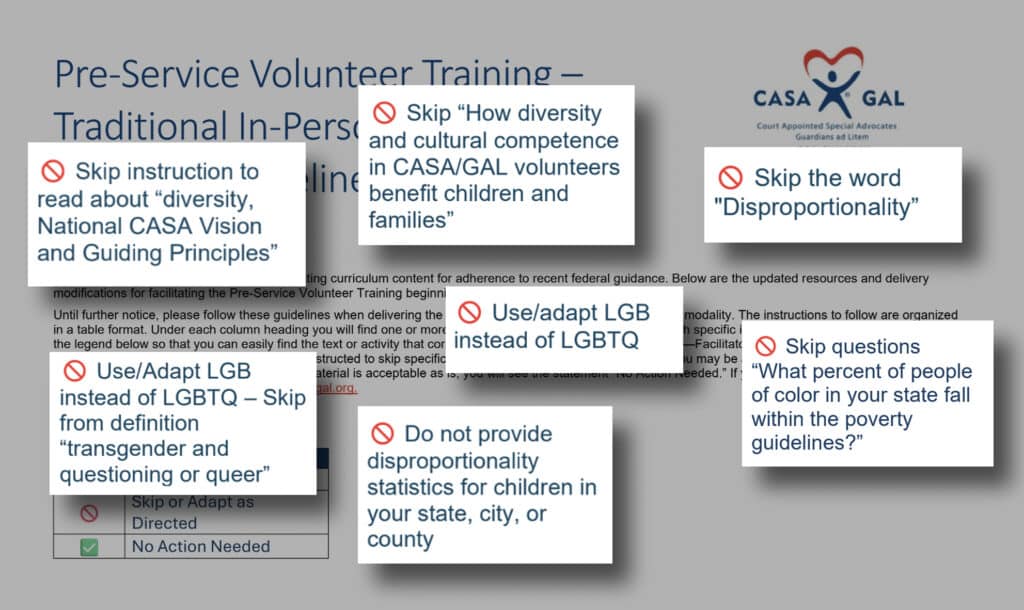
Earlier this month, the charity overseeing a popular network of volunteer advocates for foster children announced it had successfully appealed the Trump administration’s April cancellation of tens of millions of dollars in federal grants. The reversal came months after the nonprofit National CASA/GAL Association for Children instructed its affiliates nationwide to “skip” references to race, class and gender diversity in training materials, according to documents obtained by The Imprint.
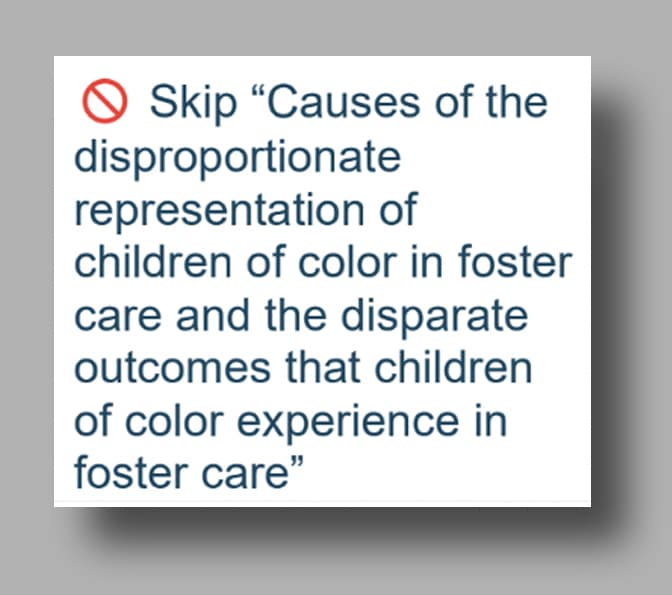
The 26-page internal guidance instructs training facilitators for Court-Appointed Special Advocates and Guardians ad Litem to no longer discuss “inequalities and prejudice in law, healthcare, education, the welfare system, sports, entertainment” as risk factors for child abuse and neglect. Another change eliminates a line asking volunteers about their understanding of “the root causes of disproportionate representation of children of color in the child welfare system and the disparate outcomes children of color experience.”
Trainers were also told to no longer mention “disproportionality statistics,” or that “ethnic and cultural background influences an individual’s attitudes, beliefs, values and behaviors.” Similarly, language was stricken stating: “No cultural group is homogeneous; within every group there is great diversity.”
It’s not clear how many of the more than 900 state and local CASA affiliates received or implemented the training material changes, which listed a start date of May 15. Each group is an independent nonprofit or local government agency, and many have adapted their own training guidelines. It’s also not clear whether the updates helped convince the Trump administration to restore the organization’s grant funding — or whether it contributed to the April termination.
But the development followed months of reports on federal agencies demanding that grantees stop using dozens of common words and phrases associated with diversity, equity and inclusion. It represents the latest surprising turn of events for the 40-year-old Seattle-based organization that spent more than two years under scrutiny for its use of public funds.
Publicly, the National CASA/GAL Association for Children has stated only that its national funding has been restored, while sharing few details on why.
In an Aug. 6 web posting, Deputy Chief Executive Officer Sally Erny said her organization had successfully appealed the grant termination notice sent in April by the Department of Justice, its primary funder for decades. Erny’s statement quoted from the Justice Department, stating in part that after “a thorough review,” the federal government had determined “the award activities do align sufficiently with the Department’s priorities, including protecting American children.”
Erny declined to answer follow-up questions sent last week, and instead provided a short statement from the organization’s CEO, Tara Lisa Perry, that echoed the online announcement.
On Monday, a press release from Georgia’s democratic Sen. Jon Ossoff touted his role in pressuring the Trump administration to restore the group’s funds, along with child welfare advocates across Georgia.
“The Trump Administration should never have paused this funding in the first place,” Sen. Ossoff said in the statement. “I will continue my oversight to ensure that vulnerable foster children in Georgia and nationwide receive the support Congress directed to them.”
The Justice Department did not respond to requests for comment.
“National CASA/GAL is in the process of updating curriculum content for adherence to recent federal guidance. Until further notice, please follow these guidelines when delivering the sessions through the traditional, in-person modality.”
— Pre-Service Volunteer Training Update
Court appointed special advocacy is one of the most visible volunteer opportunities in the child welfare field, and has received vocal support from presidents, senators and public figures like NFL quarterback Brock Purdy. After at least 30 hours of training, CASA volunteers are tasked with making high-stakes recommendations to judges about the best interests of foster children. Over the past two decades, the national entity that sets standards for independently run CASA affiliates across the country has been awarded more than $300 million in congressionally authorized, competitive grants from the Justice Department. In 2021, the funds amounted to 86% of National CASA’s roughly $16 million in total revenue, tax records show.
The Justice Department was scrutinizing that funding even before President Donald Trump took office for a second time in January. The organization furloughed much of its staff in 2023 after federal financial monitors labeled it a “high-risk grantee” and froze all its funding.
National CASA leaders maintained there was no financial wrongdoing. But before having its funding restored last fall, the organization made extensive changes to internal accounting systems and returned more than $270,000 for what justice officials called “unsupported, unallowable” spending of taxpayer funds.
A new jolt came on April 22, when the CASA association was one of hundreds of other charitable groups that received notice that its roughly $48.9 million in federal grants had been cancelled by the Department of Justice — among the largest targeted for cuts.
By mid-May, internal documents show, the National CASA/GAL Association had told local programs to skip certain lines in its training materials designed for prospective advocates for foster youth across the country.
But the document shared with a reporter that National CASA used to update its “Pre-Service Volunteer Training” offers rare detail into what the Trump administration’s directives have required of charitable operations nationwide. To comply with these directives, CASA leaders instructed programs to have trainers “Skip or Adapt as Directed” dozens of sentences from slide decks, a volunteer manual, handouts and a training facilitator guide, beginning May 15, 2025.
“National CASA/GAL is in the process of updating curriculum content for adherence to recent federal guidance,” its introduction states. “Until further notice, please follow these guidelines when delivering the sessions through the traditional, in-person modality.”
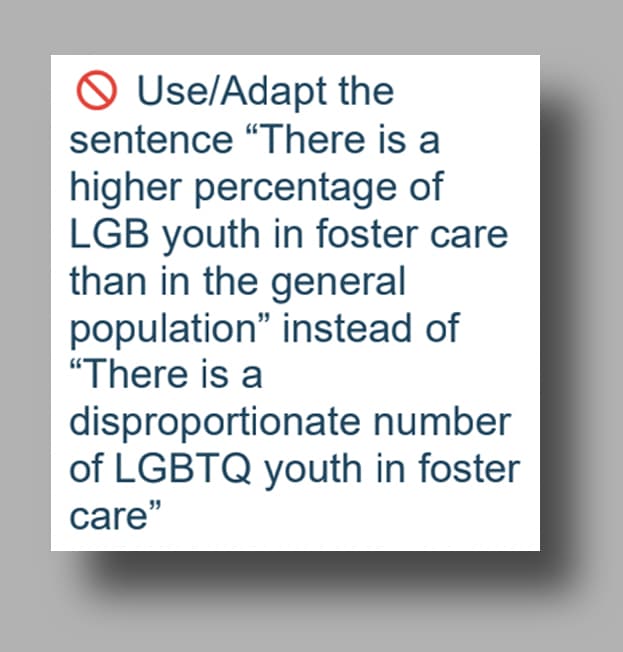
Sections marked “Skip or Adapt as Directed” include a red-circled prohibition symbol. In the volunteer manual for example, CASA trainers are told to skip a self-evaluation checklist item on whether each volunteer: “Understands and demonstrates self-awareness to eliminate the influence of personal biases and values when working with diverse groups.”
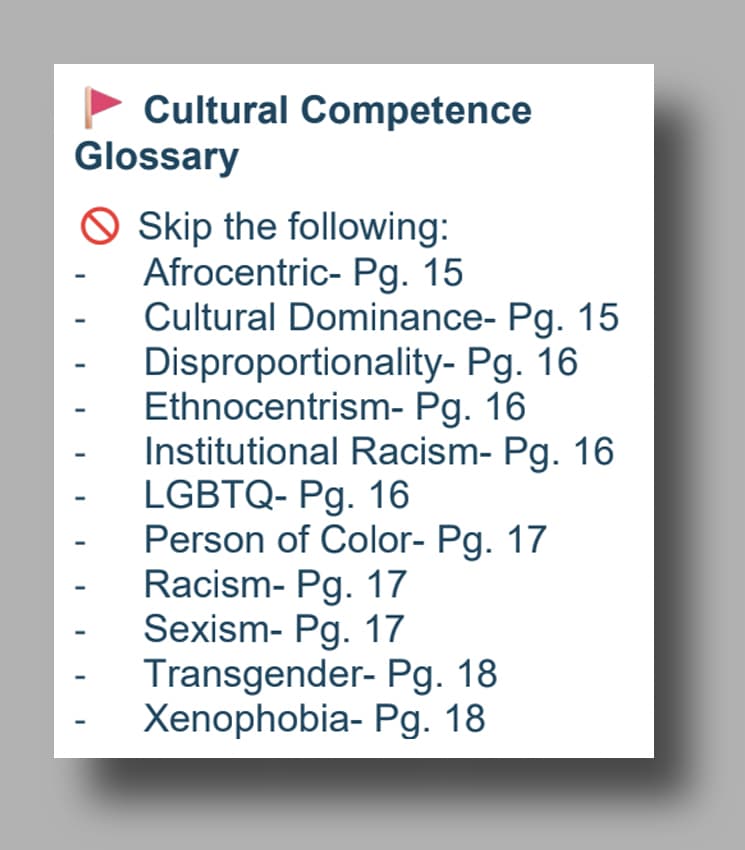
A disproportionate number of foster children are Black and Native American, and more than 30% of older foster youth identify as LGBTQ+, studies have found. Yet while training volunteers to serve these children, CASA’s facilitators may skip “Cultural Competence” glossaries that include “gender identity,” “transgender,” “racism,” “sexism,” “xenophobia,” “ethnocentrism,” or the word “Afrocentric,” according to the update. CASA trainers are also steered away from discussing “the extent to which cultural institutions and values may oppress, marginalize or alienate some individuals or groups and create or enhance privilege and power of others.”
The national association’s 2021 survey of 772 state and local CASA organizations found “little diversity existed in age, gender and race among active volunteers,” 77% of whom were white. But those organizations have now been told to skip over language in a handout stating that “it is in the best interest of children to have volunteers who reflect the characteristics (i.e., ethnicity, national origin, race, gender, religion, sexual orientation, physical ability and socioeconomic status) of the population served.”
The one adaptation recommended is a small, but notable acronym tweak throughout the documents: “Use/Adapt LGB instead of LGBTQ.”
Some child welfare experts who were told of the change reacted with alarm to the erased mentions of transgender and queer or questioning youth.
“CASA has had a wonderful reputation to be the voice of young people when nobody else was speaking on their behalf,” said Gerald Mallon, a professor of child welfare at Hunter College’s Silberman School of Social Work in New York. “Are they just not going to be able to serve those children? How are they going to be the voice of all children and kind of eliminate certain groups?”
The leading scholar of LGBTQ+ foster youth issues said both government pressure and advocacy groups like CASA’s revisions represent a setback for vulnerable groups.
“It’s a shame,” Mallon added. “But as much as I’m critical of them, I understand this is what people are being forced to do — in order to get the money, they have to make these major changes. And I don’t think we’ve seen the last of what’s going to happen. We’ve made transgender young people scapegoats.”
Seven current and former National CASA employees and state and local CASA program leaders reached for this story declined to speak on the record about the updated guidelines, with most citing the continued uncertainty over federal funding. Two former National CASA staff members who left for other jobs in related fields said they faced funding cuts by the Trump administration at those jobs as well.
One current state CASA program leader noted that some affiliates in Republican-controlled states cut language associated with diversity, equity and inclusion, or DEI, from their trainings even before this year, due to local political pressure.
“It’s a shame. But as much as I’m critical of them, I understand this is what people are being forced to do — in order to get the money, they have to make these major changes. And I don’t think we’ve seen the last of what’s going to happen. We’ve made transgender young people scapegoats.”
— Gerald Mallon, professor of child welfare at Hunter College
Groups providing everything from preschool education to prevention of human trafficking and research on Native American boarding schools have had grants delayed or cancelled this year, since Trump took office and early on appointed billionaire executive Elon Musk to oversee a widespread slashing of federal spending through the new Department of Government Efficiency.
Through executive orders, federal agency memos and lawsuits against scores of state governments and private institutions, one goal has been paramount: quashing efforts to support diversity, equity and inclusion in the nation’s private and public sectors. Even as lawsuits have slowed many of the administration’s unilateral funding cuts, schools, nonprofits and businesses have scrubbed their websites of references and initiatives designed to help immigrants, racial and ethnic minorities and transgender people.
On July 29, U.S. Attorney General Pam Bondi issued a nine-page list of “practical recommendations” for Justice Department grant recipients, which warned that diversity, equity and inclusion programs could qualify as “discriminatory practices” under federal anti-discrimination laws.
“The use of terms such as ‘DEI,’ ‘Equity,’ or other euphemistic terms does not excuse unlawful discrimination or absolve parties from scrutiny regarding potential violations,” it reads. The memo adds that even “facially neutral criteria” like “cultural competence,” or “lived experience,” could violate federal law.
One former National CASA researcher who grew up in foster care reacted to the organization’s scaled-back training materials with ambivalence.
Roughly two years ago, Alfred Pérez took the weeklong training with other recent hires — before the recent updates were distributed. As a gay Afro-Latino man, he said even then he felt the discussions of race, gender and the foster care experience were superficial.
He wasn’t certain they would have a positive influence on the adults who enlist as CASA or GAL volunteers. He also felt the training glossed over older foster youths’ practical needs and legal rights.
Pérez, who has a Ph.D. from the University of Chicago and a long career in research and advocacy for foster youth, said he shared his critique of the training materials with colleagues at the time.
“The excuse was ‘We need this in response to George Floyd,’” he said. Referring to the racial reckoning that followed Floyd’s murder and the Biden administration’s prioritization of DEI initiatives, it “seemed like they were trying to catch up.”
Still, Pérez — who left the organization in 2023 — said he was nonetheless dismayed to learn about the language dropped from CASA’s training materials in May. He described it as yet another example of the increasingly hostile political climate for LGBTQ+ people and communities of color in this country, and the chill on discussing the distinct needs of diverse groups in foster care.
“Now, it seems like they aren’t going to try at all,” he said.