
In response to a recent refusal by the U.S. government to participate in a global review of its human rights record, youth and their advocates gathered at the United Nations on Wednesday to call for better protection of children and families in government custody.
At the event, organized by the nonprofit Children’s Rights, panelists spoke on a variety of issues, including U.S. immigration policies, zero-tolerance school discipline and the harm caused by racial inequities in the foster care system.
A second panel discussion featured child welfare advocates, parents and former foster youth who spoke out against family separation and injustice perpetuated by child maltreatment investigations.
Panelists came together in response to what they view as a concerning pullback of U.S. participation in the protection of human rights on a global stage. In August, the federal government announced it would withdraw from the Universal Periodic Review — a nearly two-decade old program created by the U.N.’s Human Rights Council (HRC) that calls for a peer review of human rights records for all 193 member states.
According to Reuters, a U.S. state department official said participating in the review would imply endorsement of the council’s “persistent failure to condemn the most egregious human rights violators” and that the U.S. would not be “lectured about our human rights record by the likes of HRC members such as Venezuela, China, or Sudan.”
Global advocates denounced the U.S. decision to back out of the review, which occurs roughly every five years. Reports are reviewed by other members who offer non-binding recommendations. The U.S. was due to submit its report this November but has until July 2027.
Youth advocates consider the decision a signal of federal officials’ increasing apathy about the futures of vulnerable young people.
“They know that this is a review that will highlight the violations that are happening daily,” Jamil Dakwar, director of the American Civil Liberty Union’s Human Rights Program, said about the federal government.
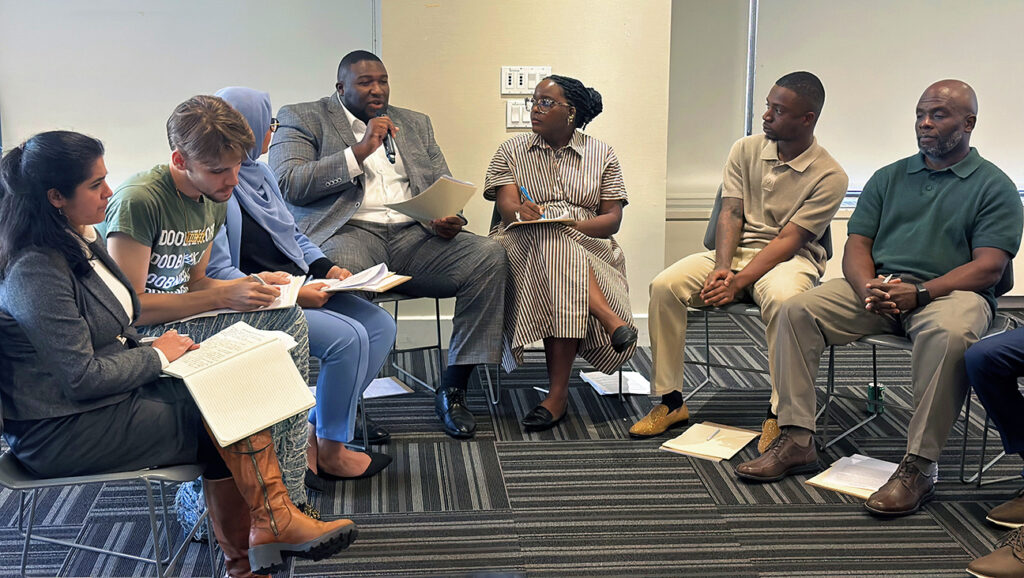
Dakwar serves on a prominent New York based civil rights panel that advises the U.S. Commission on Civil Rights. The group released a first-of-its-kind report last year demonstrating persistent discriminatory treatment of Black families in the state’s child welfare system, and asked Congress to implement certain changes.
Panelists came together Wednesday to demonstrate their unwillingness to allow these issues to be ignored, despite the government “doing everything in its power to circumvent accountability,” activist Joyce McMillan said.
“We have to hold them accountable and bring the human rights recommendations to them and push for the changes, whether to change the laws as they stand, abolish some of those laws that are really harmful and to enact ones that are consistent with international human rights law,” Dakwar added.
Domestic injustice also addressed
Although the global role of the U.S. prompted the gathering, domestic concerns drove the discussions.
Former foster youth on one panel described a culture of loneliness, abuse, and lack of mental healthcare access in foster care.
“Our stories carry the evidence that policies alone can’t capture — the fear of a knock on the door, or the loss of your child without due process.”
— Activist Tatiana Rodriguez
Youth advocate Jasiyah Gilbert, 24, spoke about the trauma he endured when he was separated from his family and placed in a group home. His mother struggled with housing and mental health issues, which the child welfare agency classified as neglect.
“It was a very carceral, jail-like environment where they’re told when to eat, when to use the bathroom,” Gilbert said of his and other foster youth’s experiences in congregate care settings. “Often, their education is sacrificed.”
Foster children frequently run away and end up homeless after being separated, he added. Solutions to the problem should focus on strengthening families by providing housing vouchers, cash assistance and other community services, he said.
Activists April Lee from Philadelphia and Tatiana Rodriguez of Massachusetts emphasized the importance of sharing parental perspectives regarding CPS investigations and foster care with policy makers.
“I also survived the system as a third generation foster youth and a parent being investigated, and I eventually lost my son,” Rodriguez shared. “Our stories carry the evidence that policies alone can’t capture — the fear of a knock on the door, or the loss of your child without due process.”
Panelist and attorney David Shalleck-Klein called the harms caused by the child welfare system “one of the most important civil rights issues of our time,” and pointed to a history of “illegal” practices by child welfare agencies in New York. Last year, he was part of a team that filed a class-action lawsuit defending the rights of parents under a child maltreatment investigation.
It’s easy for attorneys to identify that Fourth Amendment rights are violated when government agents enter homes without court orders, Shalleck-Klein said, or when “children are torn from parents” without judicial oversight.
“The hard part,’’ he said, “is understanding: How do we use the tools that we have as advocates to end up at a place where that stops happening?”