
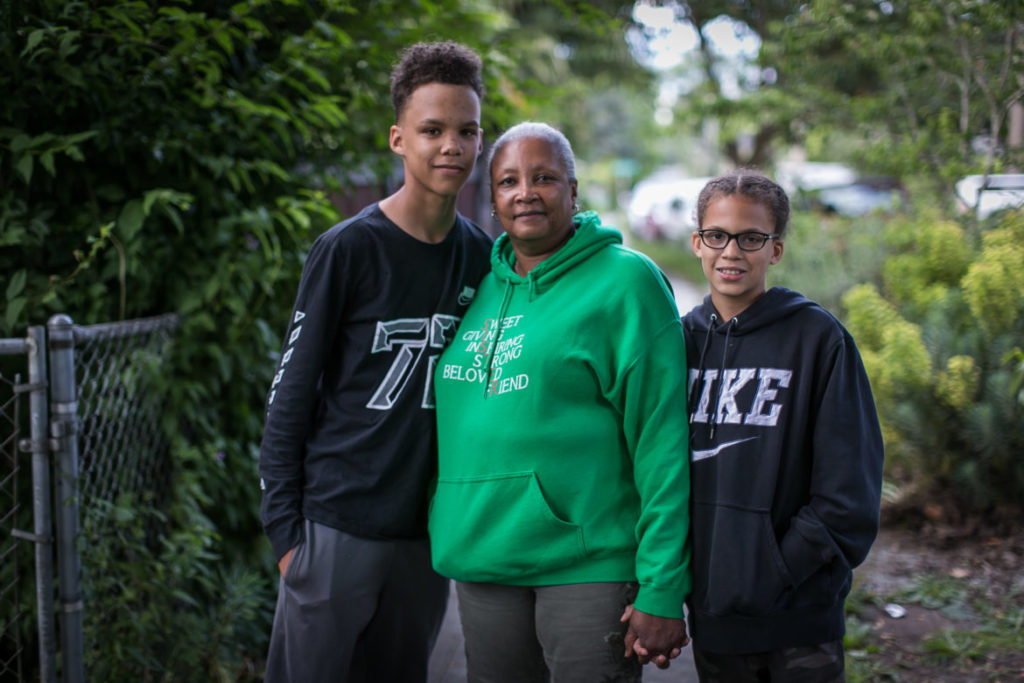
Relatives taking in family members’ children from Washington’s foster care system now have an easier path to become licensed caregivers.
The newly streamlined process for kinship caregivers, launched in July, opens access to financial assistance, counseling, respite and other resources to assist relatives raising children who’ve experienced abuse and neglect at home.
The revised application system involves 50% less paperwork to become a licensed foster parent, simplified home studies, and no training requirements for most applicants, said Ruben Reeves, who heads the licensing division at the Department for Children, Youth, and Families.
It also eliminates some of the barriers that have kept relatives from tapping into support from the child welfare system. To date, prospective foster parents have been required to have extra bedrooms in their homes and to meet a minimum-income requirement, which disqualified many well-intentioned but low-income kin, authorities found.
Jeanine Tacchini, deputy assistant secretary for the state’s child welfare agency, said the goal is to make it practical for relative caregivers to get licensed as foster parents so the household receives vital support.
“Caregivers are thinking, ‘I’m just trying to take care of my niece or my grandchild, I don’t need to sign up to become a foster parent,’” Tacchini said. But now, with a reduction in cumbersome paperwork and intrusive home study interviews, “they’re able to see that it’s worth going through, and that they do get support that they otherwise wouldn’t get.”
Licensed foster parents receive monthly stipends of between $722 and $2,915 per child each month, depending on the age and need of the child. Without a license, relatives might be eligible for kinship cash benefits through the Temporary Assistance for Needy Families program, but the benefits are far lower and require seeking child support payments from the children’s parents, something many relatives are not willing to do.
The monetary help is essential for many, Reeves said, so the department wanted to reduce all possible barriers. Relatives often take children in with little notice. And unlike foster parents who have time to fill out forms and undergo training, they have to balance the licensing to-do list with meeting the child’s immediate needs.
“So for us, as an agency, to have high expectations that they’re going to go through all these other steps really became burdensome on that family,” Reeves said.
His licensing team collaborated with tribes and kinship care providers in the state to develop the new, better-tailored standards. That has led to a reduction in requirements: Previously, relative caregivers had to comply with 75 rules. Now there are 35 requirements that more accurately reflect the circumstances of adults providing care to young relatives. They also no longer have to complete foster parent training unless they need or request it.
With changes like that, the state child welfare agency “is doing a good job of addressing many of the challenges that prevented caregivers in the past from seeking licensure,” said Shelly Willis from Family Education and Support Services, a local nonprofit.
What hasn’t changed, licensing staff said, are safety standards.
Prospective caregivers will still have to pass a background check. There will still be home studies and family assessments, but these will be more tailored to the children they’re taking in — so if a teenage niece is moving in, they won’t be required to baby proof, for example. The resulting license will only apply to those particular relative children; if they want to foster unrelated kids in the future, they’d have to obtain a traditional foster parent license.
Caregivers will also still need to commit to providing affirming care for children who identify now or in the future as LGBTQ+: “We want to make sure that when kids are placed in our kinship homes, that they’re not going to get kicked out if they come out,” Reeves said.
Shrounda Selivanoff, an advocate and child welfare professional who is raising her 7-year-old grandson King in Seattle, said the changes sound “appropriate and right on the money.”
Selivanoff said she didn’t struggle when going through the kinship licensing process years ago. She knew where she could turn to for help and tapped her professional network to get the services she needed for her growing family.
But she’s spoken to many other kinship care providers who needed more support. Common challenges were lack of legal representation, no access to respite care and poor support from social workers: “They felt somewhat like an island,” Selivanoff said.
“Over time, the state’s gotten a little bit better with that,” Selivanoff said. “But I think initially they struggled a bit to just kind of recognize that kinship caregiving has its own hurdles and challenges.”
The changes in Washington align with a long-standing, research-backed paradigm that extended family members are the next-best option for kids who can’t live with their parents. Kids in kinship care do better emotionally and developmentally, retain stronger ties to their community and culture, and avoid the frequent disruption of moving from one foster home to the next.
“They’re able to see that it’s worth going through, and that they do get support that they otherwise wouldn’t get.”
— Jeanine Tacchini, Washington State Department of Children, Youth, and Families
Washington’s new process follows federal policy change in recent years aimed at increasing the number of foster children living with relatives. In 2023, the Biden administration enacted a new rule that allows states to create alternative licensing standards for kinship caregivers. This enables states to use federal funds to pay monthly stipends and to cover costs for other support.
“We encourage agencies to place as few burdens as possible on kin, consistent with the safety and well-being of the child,” then-Secretary of Health and Human Services Xavier Becerra said at the time.
In the two years since that change took effect, 13 states and five tribes have implemented kin-specific licensing pathways. Another five states are awaiting federal approval on plans to do the same.
Washington, in particular, has taken a series of steps to increase the percentage of foster youth living with relatives, starting with promoting a “kin-first culture” within its ranks and educating social workers on the benefits of keeping kids within families, Reeves said. In 2022, the state passed a law that prevented caseworkers from removing children from a safe and stable kinship placement — something that could happen when reunification failed and permanency plans changed, for example. In 2023, they began offering an initial, temporary license so caregivers could start receiving payments within 10 days while they worked on licensure.
The result: As of May, 59% of Washington foster youth live with relatives, well above the national average of 38%. Nearly 70% of those relatives are licensed caregivers, according to state data.
Willis said that even with the new standards, there are some families who will still choose not to pursue a license. Many find it easier to navigate parenting and family life with less state involvement, she said.
And Selivanoff wants to see more mental health support for the grandparents, aunties and uncles taking on this role in their family.
“The dynamics between a biological parent and a kinship caregiver at some points can get quite strained, so I would love to be able to see us provide mental health support or support groups,” she said. “If you don’t have the proper mental health supports, it can seem really overwhelming.”