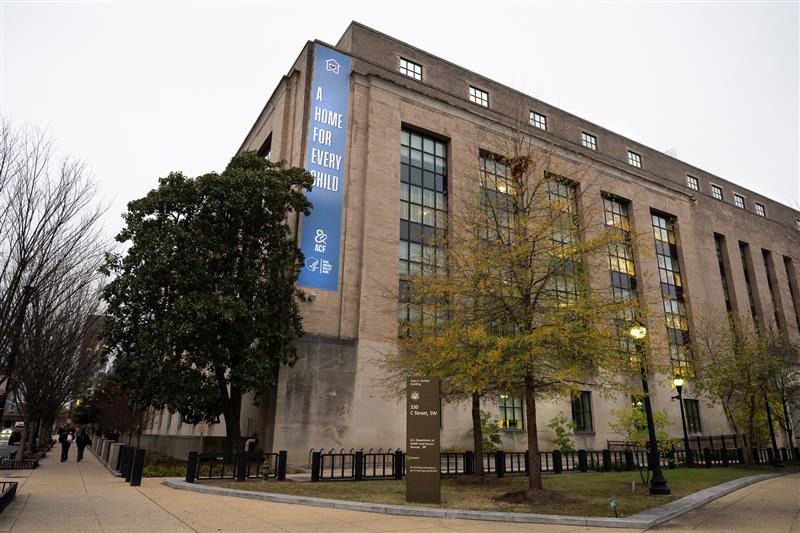

Labeled a “high-risk grantee” for more than a year, the Seattle-based National CASA/GAL Association for Children received new federal awards this month, funding that comes with “special conditions,” according to the U.S. Department of Justice.

The Department of Justice has lifted a funding freeze it imposed on a national nonprofit overseeing court-appointed volunteers for foster children and recently renewed the popular charity’s funding. But the National CASA/GAL Association for Children has returned more than a quarter-million dollars in “unsupported, unallowable” spending of taxpayer funds as it enters its 19th month as a “high-risk” grantee, The Imprint has learned.
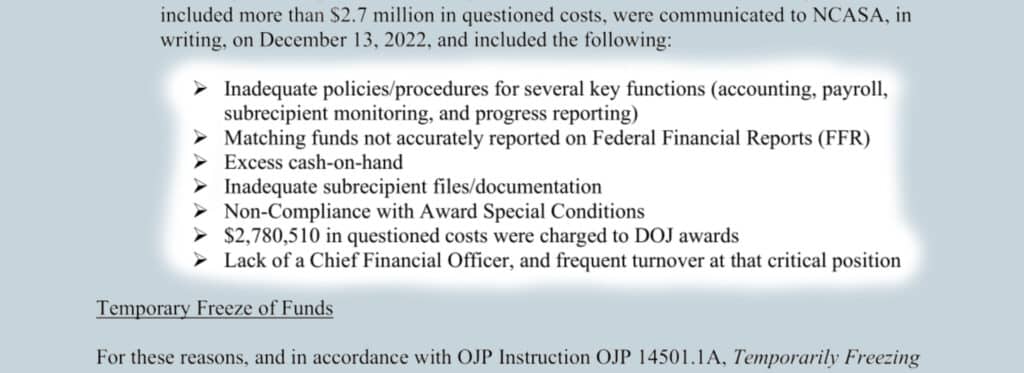
The Seattle-based organization’s current status stems from a federal financial review that initially questioned more than $2.7 million in expenditures and identified “inadequate” accounting practices and high turnover of chief financial officers. The information appears in letters sent to the association in December 2022 and March 2023, and obtained by The Imprint through a Freedom of Information Act request.
READ THE JUSTICE DEPARTMENT’S MARCH 29, 2023 LETTER HERE |
The organization has since “remedied” the issues identified by the Justice Department, an agency spokesperson said, and in April it returned a total of $273,132.68 to the government.
CASA leaders dispute this figure, insisting through a representative that the returned amount was $219,905.28, and that it was not a result of “misspending.” A spokesperson said the larger $2.7 million in “questioned costs” were “areas of inquiry — not accusations,” and the association worked efficiently to resolve them.
“The last 18 months were a challenging time for our organization,” Tara Perry, the nonprofit’s chief executive officer, said in an emailed statement. But she added that her association, which sets standards for nearly 1,000 local Court-Appointed Special Advocate and Guardian ad Litem programs across the country, is “now moving forward, stronger than ever.”

Perry’s statement highlighted the $25.3 million in grants awarded to the group this fall by the federal Office of Juvenile Justice and Delinquency Prevention (OJJDP). The association, which had total revenue of roughly $17 million in 2022, has also hired a new chief financial officer with decades of experience in financial management.
“This grant funding reflects OJJDP’s confidence in not only our organizational progress, but also in our ability and expertise to execute on the important work of ensuring every child who has experienced abuse or neglect is safe, has a permanent home, and has the opportunity to thrive,” Perry said. “To get to this point, National CASA/GAL implemented new and robust financial systems, all the while maintaining our core services and support to our state and local affiliates, thus ensuring minimal disruption of services to the network.”
Perry also stated that she expects the “high-risk” designation to soon be lifted, because her organization has met “every requirement” of the federal government.
The Justice Department’s scrutiny has only been focused on the national membership association and not the hundreds of programs it supports — from a statewide nonprofit in New Hampshire to local groups in Spearfish, South Dakota and Los Angeles, California.
Still, some insiders reacted with alarm to the new details about the federal agency’s findings.
Over the past year, The Imprint interviewed 22 current and former employees, affiliates and former board members of the national association who expressed concerns about transparency and fiscal management. Many declined to be named for fear of professional retaliation, or of harming the broader mission of court appointed advocates. Five other professionals who were major donors or served on the CASA board did not respond to requests for comment.
“What happens at National CASA greatly impacts the entire network,” Mari Christopherson, chief executive officer of the Illinois Association of Court Appointed Special Advocates, said in early October. “Their reputation is ours, and so it’s critical that they uphold the highest standards, and the standards that they hold all of us to.”
Helping kids, courting debate
More than 900 independent organizations in 49 states receive support from the national association to match foster children with a special advocate or guardian ad litem. The affiliated groups operating in family and juvenile courts across the country have their own staff, boards and local fundraising efforts.
The CASA network has prominent supporters — from celebrity television host Dr. Phil to the former FBI director James Comey and his wife Patrice. For decades, tagged by the familiar CASA logo of outstretched arms forming a heart shape, the charity has attracted volunteers seeking to assist some of this country’s neediest kids.
Once trained, advocates are appointed by judges. They submit written recommendations to the court on a foster child’s “best interests,” topics such as where they should live and go to school, and whether they should reunify with their families once they leave the child welfare system. The national group’s data show volunteers are typically white, college-educated professionals or retirees, advocating for children, nearly half of whom are Black, Latino or biracial.
CASA programs nationwide inspire grateful testimonials from foster youth and judges. Many argue the closed and secretive family court needs the independent supervision that volunteers provide. Last fall, for instance, a Georgia teenager tearfully recounted to a U.S. Senate committee how she was overmedicated and neglected by her caseworkers — until a CASA volunteer intervened.
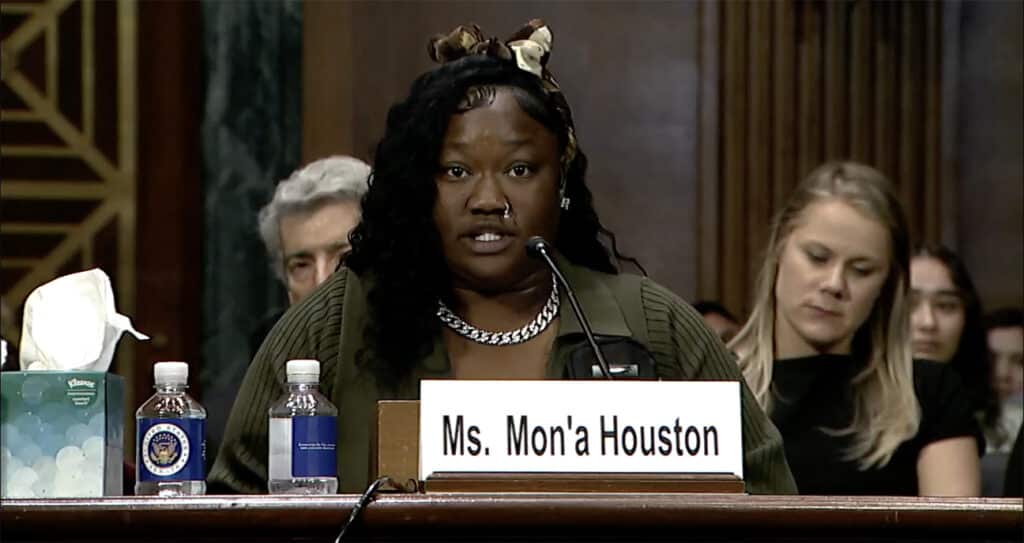
Mon’a Houston testified that she was 17 when she was first appointed a CASA, and that she was “the first adult who listened to me. She would regularly fight to get me what I needed.”
The volunteers’ impact, while highly regarded, has also been controversial among some child welfare researchers and professionals, The Imprint reported in an in-depth analysis published in January. Some of the largest recent studies of the program have thrown into question proponents’ claims about the evidence for volunteers’ overwhelmingly positive benefits, such as shorter stays in foster care.
Outside experts weigh in
The funding freeze that began in March 2023 for the 40-year-old National CASA group overseeing the larger network has left many wondering what went wrong.
Three experts in nonprofit administration read the Justice Department’s 2022 and 2023 financial reviews of the charity at The Imprint’s request. All three provided comment, aware of the fact that funding has been restored while the high-risk designation remains.
They emphasized that nonprofits can and do make the types of accounting mistakes the federal agency identified, particularly when they are newly established or receiving federal grants for the first time. Those problems can be remedied with willing leadership, the experts said.
But they added that for a group that has received hundreds of millions of dollars from the same source for decades, the accounting issues the Justice Department flagged indicated the possibility of more serious problems at the time of the review.
“Best-case scenario, someone was asleep at the wheel,” said Brian Mittendorf, professor of accounting at the Ohio State University’s Fisher College of Business.
Mittendorf said he didn’t see indications of “ill intent.” But despite the recent $25.3 million in new grant awards, the problems the federal government initially identified “could have been remedied earlier if the organization was carefully minding its financial processes.”
Another expert, who received justice department grants as the former longtime chief financial officer for the Field Museum in Chicago, shared Mittendorf’s observations.
“It says a lot about the CEO and the board not paying attention to some basic management requisites, and how to run an organization,” said Jim Croft, who has served on the board of Chapin Hall at the University of Chicago, a leading child welfare research center. He added that for CASA’s leaders, “this should be a wake-up call.”
Laura Otten, a consultant who led The Nonprofit Center at Philadelphia’s LaSalle University for decades, was surprised to learn the Department of Justice had recently awarded National CASA substantial new grants, despite issues the agency had identified and the charity’s continued high-risk designation.
“I don’t know what DOJ is thinking by awarding them a grant of that size despite their long-standing negative designation,” Otten said in an email. “If DOJ wanted to try to reinstate CASA, then give a much, much smaller grant as a test and see how things go. What is DOJ thinking?”
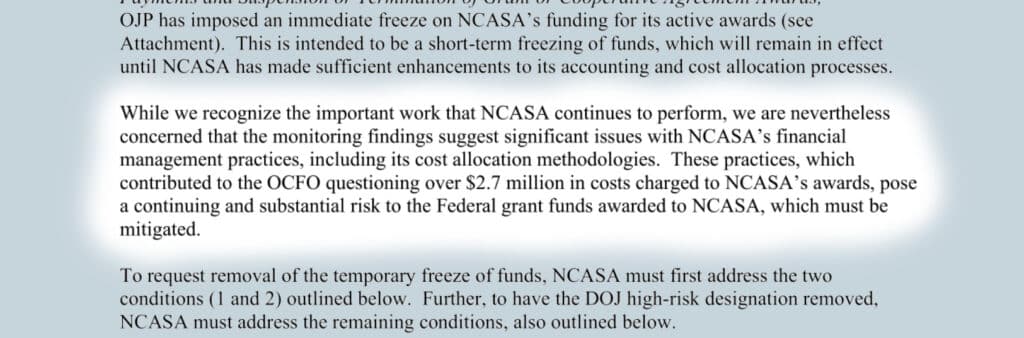
“While we recognize the important work that NCASA continues to perform, we are nevertheless concerned that the monitoring findings suggest significant issues with NCASA’s financial management practices.”
— Ralph E. Martin, federal Office of Audit, Assessment and Management, referring to the National CAsA/Gal Association for children on 3/29/23.
Alex Bloom, an executive of the Washington, D.C-based political strategy and public relations firm SKDK, emailed statements to The Imprint on behalf of the CASA association. SKDK has represented clients from Democratic presidents to TikTok and the Canadian firm behind the Keystone XL oil pipeline.
Responding to written questions about the concerns raised by the Justice Department and the experts, Bloom stated: “There is nothing in the documents you reference that identify ‘financial problems,’ nor is there evidence that the National CASA/GAL board ‘failed to prevent the financial problems.’” He added that the organization “communicated extensively” and provided “dozens of updates” to affiliates and donors on the status of work with the federal funder.
Bloom’s email also included statements from CEO Perry, who has led the CASA association since 2016, and James Rishwain, Jr. a prominent Los Angeles real estate attorney who became board chair in January 2023.
Rishwain said, “National CASA/GAL’s Board of Directors has been informed throughout the process and closely engaged” with justice officials. Along with the new chief financial officer, Thomas Hoover, there is a new accounting team working “to implement the new policies and procedures.” He also praised Perry’s “significant expertise, achievements, and recognition in the field.”
Problems escalate in 2022
The Justice Department has been the National CASA association’s largest funder, awarding it more than $300 million in federal grants since 1994.
In October 2022, however, the department sent its Office of Justice Programs staff for a site visit. Within months, the feds froze the group’s funding and declared it a high-risk grantee. That was soon followed by widespread staff furloughs — some of which continue today.
To learn more about the Justice Department’s funding freeze, The Imprint filed a Freedom of Information Act request late last year. The department provided a series of letters it sent the nonprofit following its 2022 visit.
In a March 2023 letter, the department concluded that the national association had “inadequate” policies and procedures for its “accounting, payroll, subrecipient monitoring, and progress reporting.” The association also had “excess cash-on-hand,” and matching funds were “not accurately reported on Federal Financial Reports,” justice officials reported.
A Dec. 13, 2022 letter itemized a series of possibly “unallowable,” “unsupported” and “unauthorized” costs. Those costs included $1.14 million spent on office lease and storage payments in Seattle, Atlanta and Washington, D.C.; roughly $765,000 paid to a Las Vegas public relations firm for a “2021 Media Campaign,” and more than $298,000 for “recruitment fees and legal services for trademarks.” Even some mundane purchases raised concerns, including a $4,099.81 expense for a “Back-order Sofa.”
In describing the “numerous administrative, programmatic, and financial concerns” related to four grants awarded to the association — referred to as NCASA — Ralph E. Martin, director of the federal Office of Audit, Assessment and Management mentioned the importance of the group’s service mission, for the network’s nearly 90,000 court volunteers.
“While we recognize the important work that NCASA continues to perform,” Martin stated, “we are nevertheless concerned that the monitoring findings suggest significant issues with NCASA’s financial management practices.”
The organization was given a high-risk designation, which the Justice Department’s website states can result from “unsatisfactory performance, financial instability, management system or other internal control deficiencies.”
But after working with the association over several months to conduct further reviews, according to a Justice Department spokesperson this month, “national CASA provided subsequent supporting documentation that resolved all but $273,132.68 in questioned costs that were determined unallowable under the grant award.”
The temporary funding freeze that began in March 2023 has also ended, because the organization made “essential enhancements” to its financial accounting over the past year, and is now “current on all reporting requirements, and has operated in compliance with award special conditions.” The spokesperson added that the federal government “will continue to monitor National CASA financial and programmatic activities closely to ensure they remain on track,” and new funding will be dispersed on a “partial release basis.”
Ultimately, the funds the association returned included expenses such as staff recruitment, rent payments, office redesign during the pandemic, and legal fees for trademark matters, National CASA’s spokesperson Bloom confirmed. He also emphasized that the Justice Department had reviewed a total of $61.8 million in federal grants given to National CASA between 2018 and 2021. Less than 1% of those funds needed to be returned, with the rest of the questioned costs “responded to and resolved, ultimately in favor of National CASA/GAL,” he said.
CASA national leaders also report that a “majority” of staff members are back to work full-time. They did not answer questions about exactly how many staff had left the organization since the funding freeze began 19 months ago, how many remained on furlough and why the turnover of chief financial officers was so high.
CASA past staff and board weigh in
In April, eight CASA leaders from different state organizations announced a new national entity — the Court Appointed Advocate GAL Network — in part due to what an email from the group described as “concerns about the solvency and sustainability of National CASA/GAL Association.”
Coral Edward, who worked for the national organization for 23 years, retired as a grants manager in the finance department two months after federal employees visited the Seattle office in late 2022. She said she wasn’t surprised the Justice Department found “questioned costs,” and expressed concern for the dozens of CASA affiliates that saw federal pass-through grants from the national association delayed last year.
“It was stressful, working at National CASA. The burden I was feeling was for our network of members who pay dues every year,” Edward said. “I was worried about them because after I left I heard they weren’t getting their pass-through grant funding for months — everything stopped. And it’s not fair to them.”
A former board member said he left in 2021, in part because he felt management problems were being downplayed by CASA leadership. Former treasurer Adam Liff, who served on the National CASA/GAL Association for Children’s board for nearly a decade, said he stopped making an annual five-figure donation this year due to the lack of information he received.
“I felt it was disingenuous at best to continue to fundraise and continue to portray that everything was hunky dory, when there were extensive rounds of furloughs and departures,” said Liff, a private investor and executive who has worked in industries such as banking, steel and recycling. “I just lost confidence in the board and CEO when they continued to portray things as if it was just fine.”
Tom Mitchell, who was chief financial officer of the national association from 2017 until late 2019 and now has a similar job at Seattle’s Frye Art Museum, said from his vantage point “written policies and procedures were not a strength when I was there.”
“It’s a great organization that has a lot of positive things, and its mission is critical — they take it very seriously, ” Mitchell said, adding: “If I was a board member, I’d ask why the turnover rate was so high.”