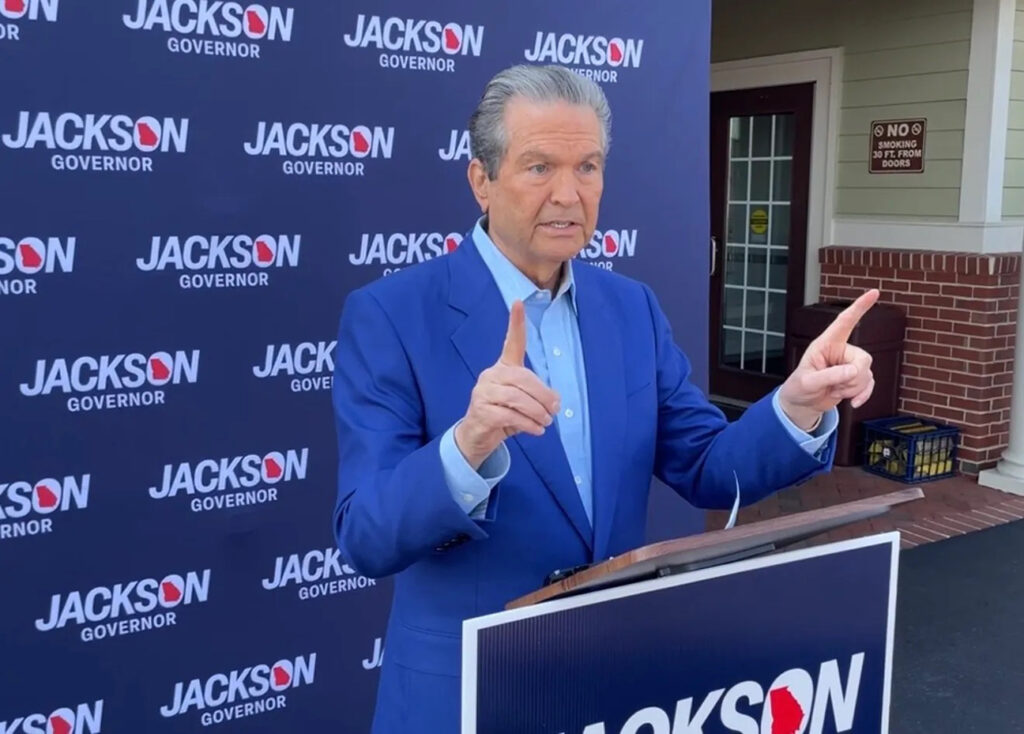
The messaging is everywhere these days in Georgia. On billboards, online and in newspapers, gubernatorial candidate Rick Jackson sums up his life story in a few words: “Foster care to billionaire.”
Since making his political debut in February, Jackson, the septuagenarian CEO of a multibillion-dollar healthcare company and former foster youth, has quickly established himself as a powerful, dark horse candidate. Reportedly infusing more than $50 million of his personal wealth in the race, Jackson has consistently outpolled his seven Republican competitors, most of whom hold positions in the Georgia government. The May 19 primary is Tuesday.
His foster care backstory is a unique campaign pillar that he is leaning on heavily to win over Georgia voters. Jackson has touted his role in the passage of a 2022 law allowing Georgians to direct their tax dollars to organizations serving foster youth as one of his biggest advocacy wins.
In a March Instagram video, he hugs a foster mom of nine during an election rally, calling it “one of the best moments of the campaign so far.”
“Foster parents are true heroes, but most of them don’t have a checkbook big enough to buy influence,” Jackson wrote in the post. “Those are the Georgians I’m fighting for.”
His supporters also highlight his background. Jackson “is a remarkable business leader who was a foster child and has spent years helping foster children,” former House Speaker Newt Gingrich said on X in February.
Yet to date, Jackson has not outlined specific policy ideas or reforms related to Georgia’s child welfare system. He and his campaign did not respond to multiple interview requests from The Imprint.
During a live televised debate in April, neither Jackson nor any of the other seven Republican gubernatorial candidates discussed child welfare issues or the recent, highly publicized $85 million budget crisis within the Division of Family and Children Services. Director Candice Broce faced heavy scrutiny for scaling back contracted services for foster youth and families in response to the emergency. Lawmakers, who had to allocate extra state funds to patch the hole, later passed bills seeking more oversight of the agency’s finances.
“Work brings dignity, purpose, and independence. If you want to sit on your butt, binge watching Netflix and eating Cheetos, do it with your own money.”
— Rick Jackson
On his campaign website, Jackson broadly pledges to “audit every government program for results and effectiveness.” But more prominent have been his promises to cut state income tax in half and freeze property taxes and tuition at public universities.
He has also aligned himself with policy ideas synonymous with the MAGA base, including targeting “woke ideology’’ and calling for stepped-up deportations of undocumented immigrants. Having donated $1 million to a pro-Trump super PAC just before entering the gubernatorial race, he recently promised to be “just like” the president “with a southern tone.’’
A section labeled “Protect the Children’’ on his campaign website states that as governor, Jackson would “ban ideological indoctrination” in schools. He also vows to ensure that boys do not compete in girls’ sports or use girls’ bathrooms or locker rooms, in keeping with MAGA policies aimed at trans youth. Georgia does not publish data tracking this population. But one 2019 study from California found that about 30% of youth in foster care identify as LGBTQ+ — and 5% as transgender. Those figures compared to 11 % and 1% of children not involved with the child welfare system.
Jackson also seeks to end “endless dependency programs” and “tie public assistance to work or job training for able-bodied adults,” according to his website.
“When I’m governor, if you can work, you will work,” Jackson posted to Facebook recently. “Work brings dignity, purpose, and independence. If you want to sit on your butt, binge watching Netflix and eating Cheetos, do it with your own money.”
Republicans in Congress share that view. Last year, they eliminated a work requirement exemption from the Supplemental Nutrition Assistance Program (SNAP) for young people who have aged out of foster care.
In contrast, FosterClub, a prominent national advocacy group, argues that unemployment and underemployment rates among former foster youth are “substantially higher” than their peers, due to “a long history of systemic disinvestment, instability and trauma.” And the new SNAP rules could worsen their prospects, according to the advocates.
Along with the Republicans Jackson will face off against next week, seven Democrats are also vying for the office. Keisha Lance Bottoms, former mayor of Atlanta, is the leading Democrat in the polls.
Lt. Gov. Burt Jones is endorsed by President Donald Trump and is Jackson’s most formidable opponent in the crowded Republican race. The two candidates have tossed barbs throughout the campaign, including tussles about Jones’ past praise of Jackson’s foster care advocacy, which was later used against Jones in an attack ad.
Jones was then quoted in The Atlanta Journal-Constitution saying Jackson was “willing to do anything to get a vote, even using vulnerable foster children as a political prop to garner support.”
A childhood in foster care
The story Jackson has told about his tumultuous childhood is the stuff of country ballads — a father who walked out when he was a baby, a mother who struggled with alcohol and a “pull yourself up by your bootstraps” ethos.
In fact, he did set that tale to song in a campaign music video featuring a guitar-slinging crooner who juxtaposes Jackson’s hardscrabble upbringing against the suited, successful version of him today.
In a 2024 podcast appearance, Jackson said he grew up “in the slums in Atlanta,” more specifically, Atlanta’s Techwood Homes. Considered the country’s first federally funded public housing project, it was eventually demolished.
Jackson has said he entered the child welfare system at 13 and cycled through five foster homes and a now-shuttered “orphan’s home.”
“Most foster kids do grow up faster than most people, unnecessarily so, but they have to because they’re faced with things that they shouldn’t be,” Jackson said on the Knowledgecast podcast. “It was very difficult just to survive, but it created a foundation of independence and control that probably has impacted my career, my life, for a long time now.”
After aging out, he attended college but dropped out when it became unaffordable, he said on the podcast. His ascension as one of the country’s leading business moguls began with commission-based sales jobs, then small business ownership, and then a string of entrepreneurial ventures. From the late 1970s through the 1990s, he “started, built and flipped” a slew of hospitals and other healthcare companies, he said.
Those eventually evolved into what is now known as Jackson Healthcare, one of the country’s largest healthcare staffing companies, totaling $3 billion in revenue annually and operating in all 50 states, according to Jackson’s campaign website. Jackson Healthcare also owns USAntibiotics, which says it is the country’s sole manufacturer of two widely used antibiotics.
Jackson’s influence in Georgia
While positioning himself in the governor’s race as a political outsider, Jackson’s vast personal wealth has allowed him to access and influence state political circles for years.
He has donated to national GOP figures such as Jeb Bush, a former business partner who also sits on Jackson Healthcare’s advisory board, and a long list of Georgia Republicans, including current Gov. Brian Kemp.
His major achievement in child welfare advocacy is the passage of the Fostering Success Act in 2022.
The law gives Georgia taxpayers a 100% credit for donations made to state-certified organizations that provide wraparound services for foster youth aging out of the system. On his campaign website, Jackson says that he “led the charge” on the bill, which received unanimous approval from state lawmakers.
Afterward, Jackson founded a nonprofit to distribute the funds. The Fostering Success Act Inc.’s website states that all donated money goes directly to foster youth for college-related expenses including housing, counseling, transportation and food, and that overhead costs are covered by an unnamed “outside donor.”
According to its most recent publicly available tax filings, Fostering Success Act Inc. reported revenue of more than $11 million in 2024.
While positioning himself in the governor’s race as a political outsider, Jackson’s vast personal wealth has allowed him to access and influence state political circles for years.
During his candidacy announcement in February, Jackson told a story about a lawmaker who once told him he had never heard anyone bring up foster care at the state Capitol before Jackson.
“Right then, I committed to doing everything I could to help those without a voice,’’ Jackson said. “And together, we passed a bill that today helps 500 people who aged out of foster care to go to college. Now they have a real chance to break the cycle of dependency and poverty.’’
At times, though, Jackson’s policy pursuits and business dealings have drawn controversy.
In 2014, he advocated for a contentious bill that called for dismantling the state’s child welfare system and privatizing foster care. He set up a special session to educate lawmakers about Florida’s decision to privatize after being rocked by high-profile child deaths.
“Georgia’s foster care system is certainly not the mess that Florida was, but we know that private, local care can produce much better outcomes and prevent the kinds of tragedies that Florida experienced,” Jackson testified before senators at the time.
The proposed legislation would have put out for bid most child welfare services — including adoptions, foster care and family reunification — to community-based providers. Since 2008, Jackson has been a board member and “investor and partner” of one of those Georgia-based providers, FaithBridge Foster Care Inc., which claims to be the state’s largest Christian-based foster care and adoption agency. He currently serves as the nonprofit’s board chairman. In February, FaithBridge was listed as one of 35 Georgia organizations that receive funds from the Fostering Success Act tax credit.
Ultimately, the privatization bill did not pass. Some lawmakers and child welfare advocates called the proposal a rushed effort, and argued that outsourcing services could end up being a costly endeavor that wouldn’t necessarily provide better services for children.
Democrat Rep. Mary Margaret Oliver said at the time that privatizing hundreds of millions of taxpayers dollars would be a mistake when lawmakers didn’t have “any real vision of what’s going to be accomplished.’’
More recently, Jackson’s political ties have raised questions about his having benefitted financially from contracts with the state government: An analysis in February by the nonprofit news site Healthbeat Atlanta found that Jackson’s companies have been paid nearly $1 billion by state agencies since 2020. Those deals include a lucrative COVID-era contract under which his company supplied healthcare providers to over 50 hospitals and 80 nursing homes across Georgia, according to the Georgia Recorder. At the time, critics questioned the lack of a bidding process.
The recent scrutiny prompted Jackson to tell The Atlanta Journal-Constitution in March that if elected, he would “work responsibly to unwind any existing contracts” between the state and Jackson Healthcare.