

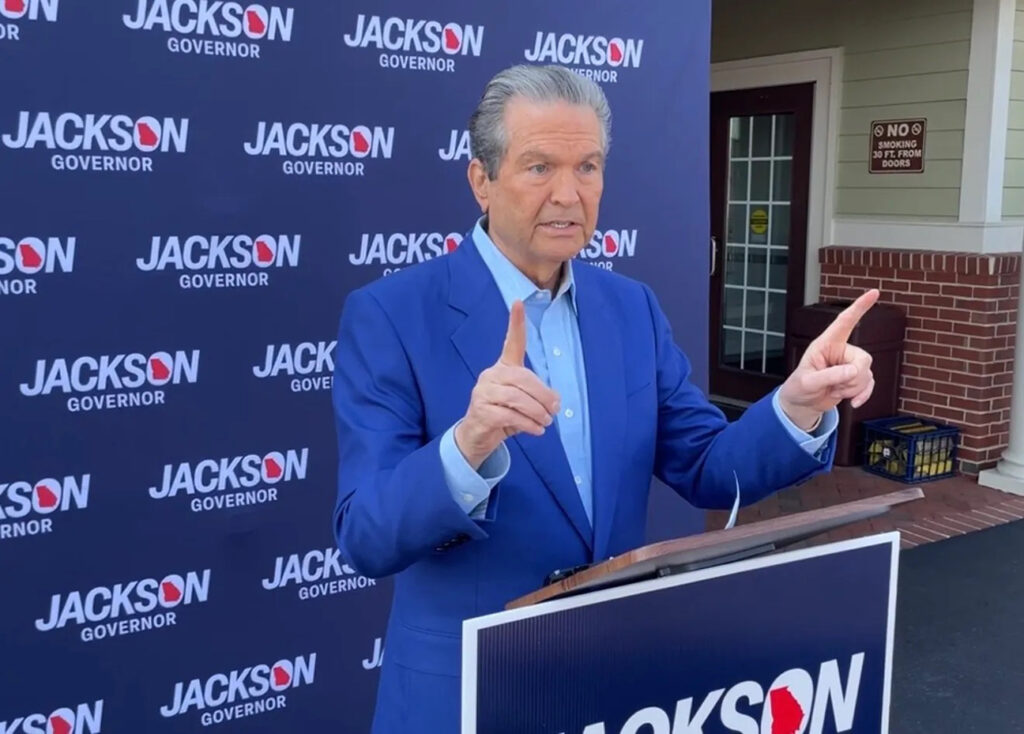
Rick Jackson, the Georgia billionaire raised in foster care, secured the Republican nomination for governor in a runoff Tuesday, following a fiercely competitive race.
Jackson was a late-entering candidate in the race, but quickly became a formidable opponent after outspending his more established conservative rival. On Tuesday, he beat Lt. Gov. Burt Jones who has a long political record in Georgia. Jones was also endorsed by President Donald Trump, and more recently, current Gov. Brian Kemp, who cannot run this year, after serving two terms.
Jackson earned 52% of the vote.
“Tonight, we did more than win a runoff,” Jackson told supporters in his victory speech. “Tonight, we proved the people of Georgia are in charge.”
Jackson will now face off against former Atlanta mayor Keisha Lance Bottoms, who swept the Democratic primary race in May. If elected, Bottoms would become the nation’s first Black woman governor. Bottoms’ campaign promises include expanding Medicaid access, lowering the cost of living, repealing state abortion restrictions, creating guaranteed pre-K access and defying MAGA policies.
Jackson wants to cut the state income tax in half, freeze tuition at public colleges and technical schools, end government diversity initiatives, eliminate “wasteful spending” with AI and tie public assistance to work or job training for able-bodied adults.
The general election is scheduled for Nov. 3.
The battle for the gubernatorial seat has garnered nationwide attention. Jackson brought a unique backstory to the race — a former foster child who established himself as a billionaire business executive. He is the CEO of Jackson Healthcare, which provides health care workers and technology nationwide and claims $3 billion in revenue annually. Though he has never held political office, his wealth has allowed him to access and influence the state’s political circles for years.
Jackson has funneled more than $100 million into his campaign according to Atlanta Journal-Constitution reporting, transforming the 2026 Georgia primary into one of the most expensive in the nation’s history. Jones, who comes from a wealthy family petroleum business, has reportedly spent $20 million.
The pair’s ruthless exchange of attack ads and lawsuits defined the race. Jackson has characterized Jones as an entrenched member of the political establishment.
But Jones leaned on his “proven” political record, with his ads characterizing Jackson as a “fake Trump conservative” who is trying to buy the governor’s seat.
Despite their bitter rivalry, the candidates have run on similar platforms. Both aligned themselves with Trump’s policies and promised tax reductions, hardline immigration enforcement and opposition to “woke” ideology.
While Jackson built his campaign on his foster care background and past work establishing one of the state’s largest faith-based foster care agencies, he has not outlined policy reforms specific to the child welfare system.
Georgia’s Division of Family and Children Services recently endured a highly publicized $85 million budget crisis and its director, Candice Broce, faced heavy scrutiny for scaling back contracted services for foster youth and families in response to the emergency. Lawmakers had to allocate extra state funds to address the deficit and later passed bills seeking more oversight of the agency’s finances.