
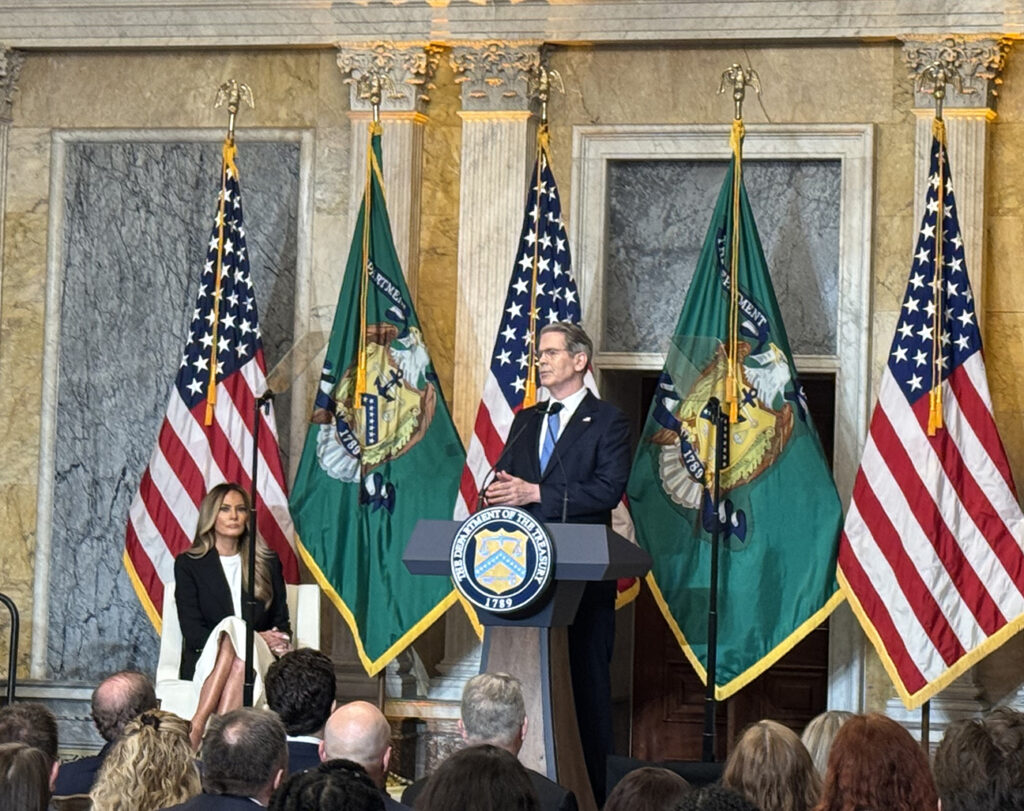
First Lady Melania Trump and Treasury Secretary Scott Bessent announced a new effort Thursday on behalf of foster youth that expands their access to “Trump Accounts” — a new savings and investment vehicle for all children that they say aims to break intergenerational cycles of poverty.
Reading a speech in front of elected officials, federal agency leaders and former foster youth assembled in the U.S. Treasury building, the first lady urged governors and business leaders to fund foster youth’s accounts— which will be specially dubbed “Fostering the Future Accounts.”
“Together, we can make sure foster youth enter adulthood with assets, opportunity and a stronger path to independence,” she said at the Washington, D.C., gathering. “We should aspire to raise a generation of builders, creators, entrepreneurs and leaders whose futures are shaped by their ambition, not their circumstances.”
Trump Accounts, created by Congress last summer and launching July 4, must be invested in certain stock funds that track indexes like the Standard and Poor’s 500. Nothing can be withdrawn until the child turns 18. At that point, the accounts become more like traditional Individual Retirement Accounts, or IRAs. Annual contributions max out at $5,000. Thursday’s event aimed to address concerns about access for foster youth, a population that often enters adulthood with little income and no assets.
Two former foster youth listened in as the first lady spoke. They described beginning their work lives around age 13. Cameron Lewis of Arizona washed dogs for $20 a day. Caitlyn Eccles of Ohio tended pumpkin farms for $6.95 per hour. Both said they worked throughout their teenage years, but plunged over financial cliffs when they left the system with new basic living expenses that foster care no longer covered. They said Trump Accounts could have made a difference.
“A down payment for an apartment is essential, and I think these accounts would be specifically helpful for housing,” said Lewis, 22, who is now a caseworker for foster youth. “I would have prioritized squirreling away more with a Trump Account.”
Eccles said her savings were “depleted” when she entered college after years of hard work. “I had to figure out how to find things myself – like the doctor, the hospital; how to get deodorant, how to eat — groceries for my dorm — how to pay for my dorm because even though I was in care, my county wasn’t paying for that,” she said.
“It is meaningful to see fosters named in federal asset-building policy for the first time. (But) the moment of greatest financial cliff for a foster is the day they age out, not retirement. That structure does not cover rent, transportation, childcare, or emergencies, which is what fosters leaving care actually need.”
— Osahon Akpata-Tanious, Foster Advocates
The Trump Administration has highlighted the possible nest egg that will await 18-year-olds whose families make the maximum annual contributions of $5,000 starting at birth: more than $300,000, assuming typical index fund returns. The U.S. Treasury will also deposit $1,000 in the accounts for all babies — including foster youth — born between 2025 and 2028. Computer magnate Michael Dell and his wife Susan are donating more than $6 billion for the effort, or $250 to each of the millions of low- and medium-income families estimated to be eligible for Trump Accounts.
Critics argue they mainly benefit children from affluent families who can afford the $5,000 annual maximum contribution. According to The Wall Street Journal, tax advisors are also recommending other investment vehicles for children, such as 529 accounts for education savings, or traditional stock brokerage accounts, both of which come with better tax benefits.
Democrats have pitched similar asset-building ideas in recent years — such as a “baby bonds” bill introduced in 2018 by Sen. Cory Booker of New Jersey, which offered thousands of dollars in annual government contributions. In December, he offered measured praise for Trump Accounts, telling The New York Times they are a “step in the right direction.”
Osahon Akpata-Tanious, executive director of the Minnesota-based nonprofit Foster Advocates, questioned how much the accounts will help the most vulnerable foster youth — since they’d be penalized for tapping into the funds before retirement age unless they spend the money on higher education or a first home.
“It is meaningful to see fosters named in federal asset-building policy for the first time,” Akpata-Tanious said in an email. But, “the moment of greatest financial cliff for a foster is the day they age out, not retirement. That structure does not cover rent, transportation, childcare, or emergencies, which is what fosters leaving care actually need.”
Advocates and state agencies like Louisiana’s Department of Children and Families have publicly argued foster youth risked never receiving Trump Accounts, due to the program’s structure: A parent or guardian needs to set up the accounts. But for foster youth, separated from parents by CPS, that can be complicated. Their family ties may be frayed, broken or disrupted, and foster youth’s temporary custodians — the state agencies — may need to ensure they are enrolled in accounts, and make investment decisions.
Twenty-three Republican governors have promised to do so, including Idaho Gov. Brad Little, who attended Thursday’s event. Detailed new guidance from the U.S. Treasury also confirms that states have the option to set up Fostering the Future accounts for youth in their custody, unless their parents already have.
The goal, according to Treasury Secretary Scott Bessent, is “embedding foster youth in the fabric of this program at the outset.”
The administration hopes Trump Accounts will be an attractive vehicle for states and philanthropies to invest on behalf of youth who have no income themselves, or from their parents. States will be able to deposit foster youth’s federal survivor benefits as well as “unobligated Temporary Assistance for Needy Families (TANF) funds,” according to a Treasury official.
There is one significant limit on child welfare agencies’ authority with foster youth’s Trump Accounts: They cannot elect to receive the $1,000 seed funding for babies born between 2025 and 2028 who have entered foster care. Parents with kids in foster care will still have to do that, or certain foster parents, according to Treasury guidance.
Ruth Anne White, leader of the National Center for Housing and Child Welfare, said she expected that the rollout of the accounts for foster youth would be complicated – as is often the case with tax benefits for this population. But she was glad the first lady highlighted the need to build assets, which, she said, foster care agencies have long neglected.
“They act like they don’t know if they can do it,” White said, pointing to existing federal guidance. “But it’s right there in the Child Welfare Policy Manual – as clear as day.”
The Annie E. Casey Foundation has spent decades investing in financial stability and financial literacy for foster youth, and has urged the U.S. Treasury to consider their complicated custody status in designing Trump Accounts. In a statement, Casey spokesperson Kate Shatzkin emphasized that states need to ensure each foster youth has a designated “responsible party” for their Trump Account, and that the designation follows them as custody status changes.
“We know that youth in state custody will benefit from this type of account if there are clear, standardized procedures for designating and transferring the ‘responsible party’ when custody or guardianship changes — so the funds follow the child through transitions,” said Shatzkin.
Hana Ikramuddin contributed to this report.
Disclosure: The Annie E. Casey Foundation is a funder of Fostering Media Connections, The Imprint’s parent nonprofit company. Per our editorial independence policy, the organization has no editorial role in our news coverage.