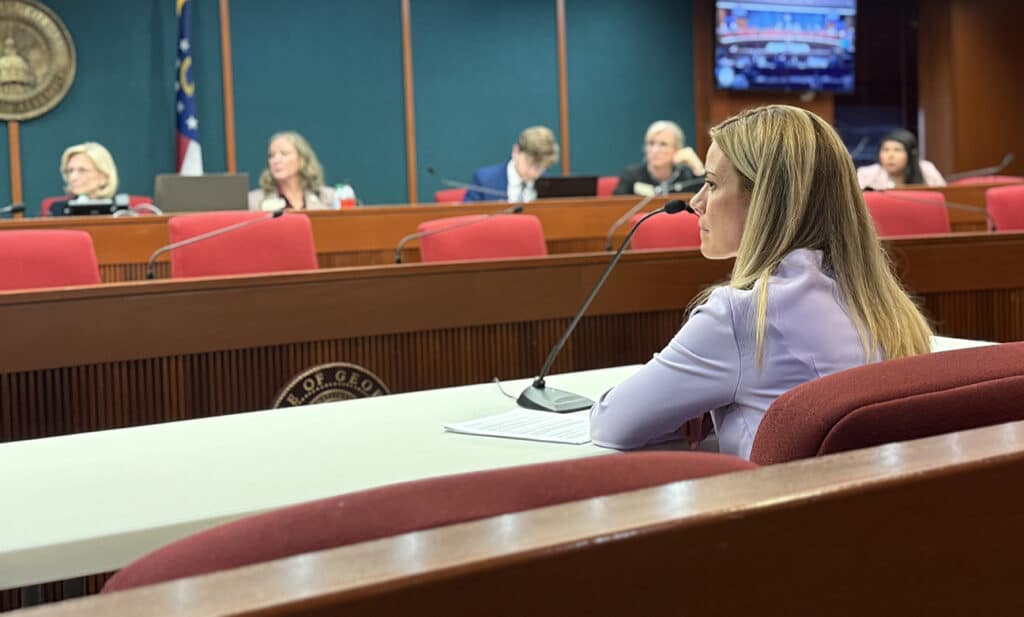
During a contentious, six hour-plus public hearing Thursday, nearly a dozen nonprofits and foster care agencies told lawmakers about “catastrophic” disruptions plaguing Georgia’s child welfare system amid sweeping funding and service clampdowns.
Candice Broce, who oversees the Division of Family and Children Services, faced heavy scrutiny and a litany of questioning from lawmakers seeking answers as to how the division found itself in an $85 million budget deficit.
The hearing was held by the House Appropriations Subcommittee on Human Resources and Judiciary Juvenile Committee to confront the agency’s ballooning deficit and its recent, last-resort measures to cut costs.
Since early November, DFCS has restricted support services for families, terminated contracts with a handful of nonprofits and slashed enhanced reimbursements for caregivers and providers serving foster youth with greater needs such as severe behavioral challenges and disabilities.
“In the years that I’ve done the budget, we’ve had challenges, but we’ve never had one like this,” said Rep. Katie Dempsey, chairperson of the Appropriations Human Resource committee.
On Nov. 7, the Division of Family and Children Services notified its contracted providers that they could not initiate any new services for the families they serve without explicit, written approval from state officials due to the federal government shutdown. But services never returned to normal.
In an email to local courts, Broce claimed that there is “no true suspension of services,” and said the agency is simply requiring a higher level of approval. But according to Joel Lyon, CEO of ProFamily Georgia, an agency focused on family preservation, “The reality on the ground tells a very different story.”
“What once took hours now takes weeks, and for children in crisis, those delays are not administrative inconveniences. They are consequential.”
— Joel Lyon, ProFamily Georgia
Across the state, Lyon estimated 28,000 service authorizations and 10,000 families will be affected by Dec. 31.
“This is not a temporary disruption,” he said. “This is catastrophic.”
He said decisions that were previously made by county workers with direct knowledge of the child and family they were serving, now require approval from a small group of senior staff at state level.
“What once took hours now takes weeks, and for children in crisis, those delays are not administrative inconveniences,” Lyon said. “They are consequential.”
Multiple providers testified about the immediate impacts of the restrictions: Children are no longer visiting their parents. Parents are not getting needed assessments required by their court-approved case plan. Working foster parents are losing resources they were promised to help them care for the highest-need children.
In her first public appearance since the budget crisis became public knowledge, Broce delivered a 30-minute-long statement to explain some of the issues causing the crisis. She pointed to the proliferation of children coming into custody with mental health needs and the “skyrocketing” costs associated with caring for them.
“The most simplistic explanation is that we have more expensive children on our caseloads, and we do not have full control over managing those costs,” she said.
“I hope it goes without saying, but I did not want to terminate contractS. I did not want to change how we authorize access to services and tie the hands of case managers. I did not want to frustrate the work of our partners.”
— Candice Broce, Georgia Division of Family and Children Services
She also pointed to problems with federal funds. She said Georgia relies on the Temporary Assistance for Needy Families program more heavily than other states, receiving about $330 million annually in a block grant. Due to delays after the record-breaking federal government shutdown, she said, the agency just regained access to the money this week. Broce said the agency also “hamstrung” for more Title IV-E federal funds that support foster care.
But as lawmakers sought more clarity, Broce struggled to convey when exactly the agency became aware of the deficit, and whether she has explicitly asked the governor’s office for emergency funds. Georgia sits on $14 billion in budget reserves. Broce assured them that Gov. Brian Kemp would come through. “He’s always helped,” she said.
Rep. Esther Panitch wasn’t satisfied with the response. “But when?” she asked in what became a heated exchange.
“How much more in the deficit do we have to be? How many more kids have to suffer?” Panitch asked.
While it remains unclear why specific services and contracts were ultimately targeted, Broce said she had “no choice” and can’t restore them without additional funds.
“I hope it goes without saying, but I did not want to terminate contracts,” she said. “I did not want to change how we authorize access to services and tie the hands of case managers. I did not want to frustrate the work of our partners.”
Chairperson Dempsey provided some hope for providers, particularly those with terminated contracts, saying they shouldn’t “panic” and that lawmakers are looking for immediate solutions.
“The providers in this room are facing a very critical moment in time, loaded with frustration for the work that you want to do,” Dempsey said. “That’s the reality. We are going to get there somehow, some way.”
EVERY DAY, our nonprofit newsroom seeks to inform readers about issues in the child welfare and youth justice systems and to hold the powerful accountable. This work is not possible without the support of community members like you. Donate today!