
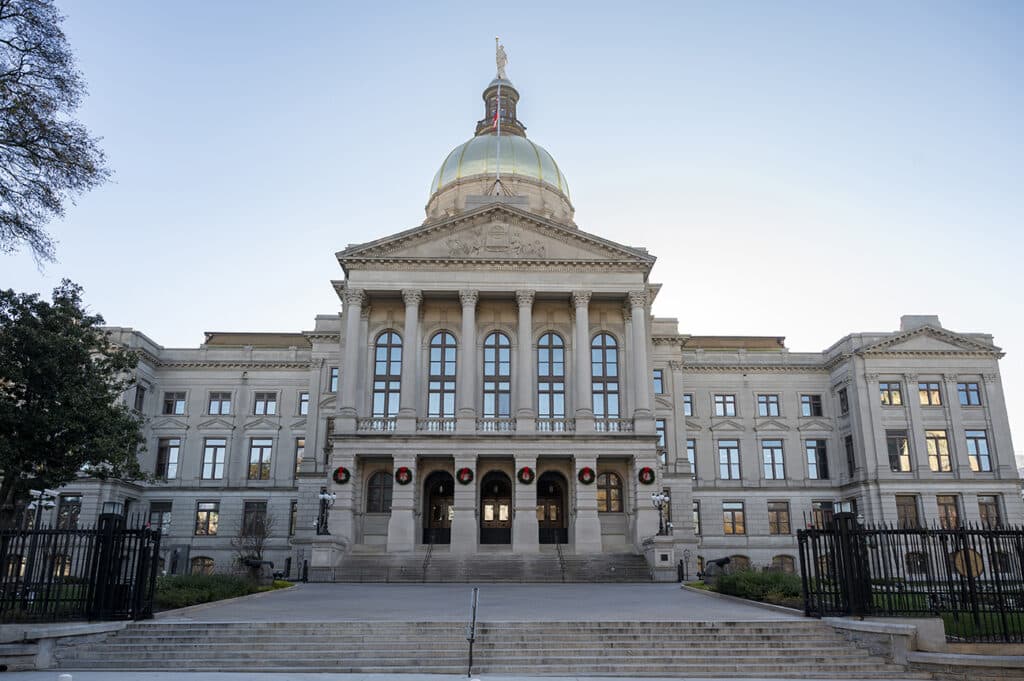
More than halfway through Georgia’s legislative session, several child welfare-related bills have cleared key hurdles — measures aimed at supporting children with autism and victims of abuse, as well as improving child welfare spending oversight.
Some proposals failed to advance. One bill would have created an expedited process for unmarried fathers to establish legal rights to their children. Another sought to overhaulhealth coverage for foster youth by ending the current managed care system overseen by private contractors.
Two pieces of legislation still being considered focus on the state child welfare agency’s finances after it faced a projected $85.7 million deficit. An amended budget signed by Gov. Brian Kemp just closed the funding gap.
At a recent public hearing, Regginald Holloway, a former foster youth representing the advocacy group Georgia EmpowerMEnt, urged lawmakers to consider input from foster youth who are feeling the effects of the division’s recent cost-cutting measures.
“When we talk about deficits, we often speak in numbers,” he said. “But behind every number is a real life impacted, a placement that didn’t last, a service that came too late. If Georgia is serious about understanding the true cost of foster care, then we must also be intentional about listening to the people who live it every day.”
Other active legislation is highlighted below.
Autism screening pilot
The bill: If signed into law, companion bills HB 943 and SB 402 would expand a Division of Family and Children Services pilot program that has offered clinical evaluation and services to foster children with autism. Services for children with attention deficit hyperactive disorder or reactive attachment disorder, or who have been prescribed psychotropic medications would be also included under the statewide expansion. The original 2022 pilot launched in southeast Georgia with $450,000 in state funding. The proposed legislation calls for training and resources for child welfare staff, healthcare providers and caregivers.
What people are saying: During a February legislative session, Dr. Michelle Zeanah, a pediatrician who has overseen the program, told lawmakers that disruptive behaviors related to autism are sometimes misinterpreted as defiance, which complicates kids’ experiences in foster care. Proper diagnosis and treatment was found to improve placement stability, reunification and adoption rates, she said. The pilot also found that autism is six times more common among foster youth.
“behind every number is a real life impacted, a placement that didn’t last, a service that came too late. If Georgia is serious about understanding the true cost of foster care, then we must also be intentional about listening to the people who live it every day.”
— Regginald Holloway, Georgia EmpowerMEnt
Childhood sexual abuse non-disclosure ban
The bill: HB 1187 invalidates any provision of a contract or legal agreement that bars disclosure of childhood sexual abuse claims.
What people are saying: During a Feb. 9 committee meeting, the bill’s sponsor, Rep. Soo Hong, said that nondisclosure agreements in civil cases “force victims to choose between compensation and their voice.” This bill, she said, could help “uncover patterns of institutional silence and negligence.”Georgia would be the fifth state to pass a law of this kind, according to Hong. The bill is named after Trey Carlock, a neuroscience researcher who took his own life in 2019 at age 28. Carlock had been restricted from speaking about abuse he suffered at a Missouri children’s camp under the terms of a lawsuit settlement.
Carlock’s sister, Elizabeth Phillips, told lawmakers about the “despair” her late brother felt due to “intimidating legal tactics.” He was even scared to share his trauma in therapeutic settings, she said.
“I have learned more about my brother’s abuse in his death than I knew during his life,” Phillips said. “For Trey’s life and legacy to matter, let’s set the truth free. Let’s choose to act upon victims’ cries for justice.”
Family Justice Centers
The bill: HB 1283 seeks to boost the number of Family Justice Centers in Georgia. According to the bill, victims of family violence, sexual assault and human trafficking “often face fragmented” systems that can “retraumatize survivors and impede access to justice.” The three existing Family Justice Centers in Georgia bring legal aid, law enforcement assistance, medical exams, counseling, social services and safety planning for survivors under one roof.
HB1283 provides a legal framework for nonprofits and local governments to create such centers in their own communities, and authorizes the state’s Criminal Justice Coordinating Council to provide funding. The bill also adds new protections for victims’ confidentiality.
What people are saying: Julianna Peterson, executive district attorney for Fulton County, told lawmakers last month that Family Justice Centers minimize the need for survivors to navigate multiple agencies and share their trauma repeatedly. She said such centers exist in 40 states and have been shown to decrease homicides, improve access to services and increase successful prosecution of abusers.
Michelle Girtman, executive director of the Waycross Family Justice Center, also described the community value of these centers. She opened hers in 2024.
“I worked really hard to raise money to build our center and pay it off,” she said. “We were thinking 100 cases for our first year would be a very big success, but we’ve seen over 1,000 cases. I’m very excited for justice centers to be established in Georgia and recognized.”
Escalating costs committee
What the bill does: SR 622 would create a study committee to examine how services are delivered and rising costs within Georgia’s child welfare system. The temporary committee would conclude its work on Dec. 1.
What people are saying: Sen. Kay Kirkpatrick discussed the bill last month, pointing to high costs of court-ordered services and mental health care for children with complex needs.These cost pressures have been cited by Division of Family and Children Services Director Candice Broce as some of the reasons behind the recent budget deficit.
Kirkpatrick said three previous foster care study committees produced “a lot of legislation’’ and appropriations in recent years. But, she said, the “issues are complex and we need to continue the work.”
Child welfare spending oversight
The bill: HB 1192 outlines new accounting and regulatory practices for the Department of Human Services and Department of Community Health. It would require state and federal funds allocated for a specific purpose to be maintained in a separate account and to be spent for that purpose only.
What people are saying: Bill sponsor Rep. Darlene Taylor said the legislation was prompted by her appropriations committee’s desire for “more oversight” of the departments. The measure would prevent government-appropriated money from getting “commingled” with other funds. “It’s much easier to trace it and track it that way,” she said.