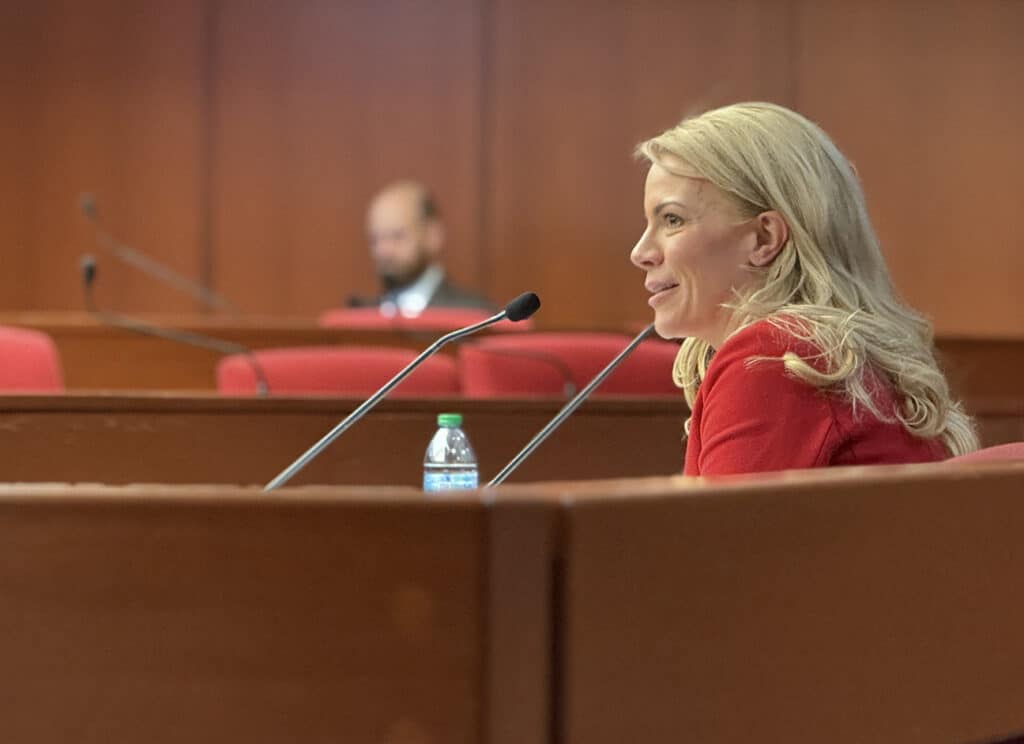
In two public hearings concluding Friday, the head of Georgia’s child welfare agency blamed court-mandated services and community providers for ballooning costs, but assured state lawmakers that recent cost-cutting measures have stabilized her agency’s financial crisis.
“We, in my opinion, are still putting children first,” Commissioner Candice Broce said this week.
The commissioner — who oversees child welfare, child support and aging services within the Georgia Department of Human Services — joined other department heads testifying before legislators reviewing Gov. Brian Kemp’s proposed budget.
The child welfare division’s projected $85 million budget shortfall for fiscal year 2026 dominated her discussions with lawmakers. On Wednesday and again on Friday, Broce devoted the bulk of her testimony to explaining the deficit, and defending cost-containment measures implemented in recent months.
In November, the agency created a stricter approval process for its family support services and terminated several state-funded contracts. Broce told legislators this week that the “four to five” affected contracts are worth about $5 million. She also claimed that these providers unnecessarily “duplicated” services or did not meet their contract obligations.
Broce said these combined moves have helped bring down the projected deficit from $85.7 million to about $48 million. Gov. Kemp’s office also recently told The Imprint he included a $41 million increase in the agency’s foster care budget this year to account for rising costs.
On Wednesday, Rep. Vance Smith described the impact on the ground of Broce’s actions so far. He told Broce that some providers in his district, including some that have operated for more than 20 years, are now at risk of shutting down. Broce responded by saying that she would “personally investigate.”
A letter sent earlier this month to Gov. Kemp by four former agency leaders — some of whom are on the boards of affected providers — confirmed Smith’s description. They called the impacts to date “profound and not easily reversed,” imploring the governor to release emergency funding from the state’s surplus to “immediately shore up child welfare providers and prevent further loss of capacity.”
In her testimony Friday, Broce acknowledged concerns.
“All of our providers are having a hard time,” she said. “We’re having a hard time. We don’t want to be in this position.”
Expanding explanations for deficit
In recent months, Broce has cited numerous reasons for her agency’s fiscal crisis since it became public last fall: inflation, pandemic-related staff resignations, foster home shortages, rising cost of care, and difficulties in drawing down federal funds — particularly during last year’s government shutdown.
This week, she added to the list, criticizing community-based agencies serving foster youth who are at risk of being housed temporarily in hotels and offices.
She said these youth can be difficult to place into home settings due to serious mental health needs, pending criminal charges, gang affiliation, runaway behavior, histories of sexual exploitation, “low IQ” and “fire-starting behaviors.” That has given service providers “incredibly strong negotiating power” when it comes to seeking government money to provide them with services, Broce said.
Broce said when community providers step in to care for these youth, “you better believe I’m going to write the check. I don’t want them in a hotel or office.”
But despite paying these providers more to place and serve children “in very specialized settings,” she said “we are seeing, in real time, when that does not occur.”
Court-ordered services blamed
During her testimony this week, Broce also identified transportation services and behavioral aides for children as the two fastest-growing expenses in Georgia’s foster care system. Both are among the services that critics say have been significantly reduced under tighter fiscal controls Broce put in place — in this case requiring approval from state officials before services can be rendered.
Services that transport foster youth to and from family visits, court hearings and medical appointments cost the agency more than $60 million last year, and Broce said that figure is expected to grow to $70 million this year. As for behavioral aides — specialists who supervise children with mental health or medical needs — Broce said her Division of Family and Children Services (DFCS) spent just over $43 million on those services last fiscal year and is on track to spend nearly $58 million this year.
Family court mandates, Broce told lawmakers, are another “primary” cost driver. She said some judges order child welfare workers to provide services to families “above and beyond” what her agency’s policies recommend. The state agency — rather than families or local counties — is then forced to absorb the costs, even though under state law, she added, the agency isn’t solely responsible for paying for services that help families stabilize and reunify with their children in foster care.
Without identifying specific judges, Broce called out several counties where she said courts have ordered double or triple the number of agency-recommended parent-child visitations, or required weekly drug screenings in cases where substance abuse was not alleged. In some cases, she said the agency has been ordered to assist families whose children are not in state custody, such as providing a behavior aide for a “delinquent” teenager.
Broce then made a point to say:
“I want to be clear here. DFCS does not have an opinion on whether, or to what extent, juvenile judges should be permitted to order services.”
Still, on Friday, Rep. Emory Dunahoo suggested coming up with possible legislation to reel in “rogue” judges and create “parameters” on what they can order in court.
Rep. Katie Dempsey pushed back, suggesting negotiations with judicial leaders first. “There is no doubt that there are more questions than answers,” Dempsey said.