
Against the backdrop of a federal government taking aim at public spending on low-income children and families, New York lawmakers have agreed to significant investments in these working poor households.
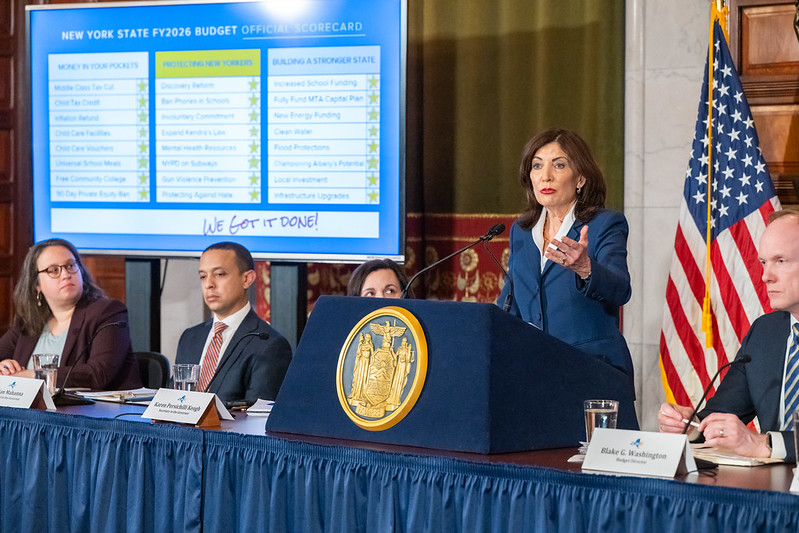
Both houses of the state Legislature passed Gov. Kathy Hochul’s state budget late Thursday night — a $254 billion spending plan finalized after more than a month’s delay.
The 2025-26 budget includes a historic boost to the state’s child tax credit, in line with Hochul’s promise to prioritize affordability for families. Beginning this fiscal year, the tax benefit will be raised from the current $330 to $500 for each child up to 16 years old. More significantly, it triples the benefits to $1,000 for children 4 and younger.
Dede Hill, director of policy at the nonprofit Schuyler Center, called the expansion of benefits — which ensures the lowest-income families receive the most help — “tremendous progress.”
“There’s plenty of data that demonstrates that families with very young children are often those that are most strapped for cash, because parents are early in their careers or often have to take time off to care for young children,” Hill said.
For Danielle Jones, a doula and mental health counselor from Rochester, the additional household income she expects to receive during the next tax season makes her feel like she’s finally able to breathe. Her 3-year-old daughter has a medical disability, and having to pay higher grocery bills for her special dietary needs puts a heavy financial strain on her budget as a single mother.

“Living paycheck to paycheck is really a stressful space to be in, and it definitely takes a toll on my ability sometimes to just fully show up for my children,” Jones said. “Having that extra income would be so helpful and would help really relieve some of the stress around feeding my household.”
Increasing the child tax credit has been a key focus of Hochul’s anti-child-poverty measures since she took office in 2021 — she also included universal free school meals and increased subsidized child care and payments for pregnant and new moms in the final budget.
Social scientists have touted earned-income credits for low-income families as one of the most effective tools for tackling hunger, in a country where roughly 13% of children live below the federal poverty line. In 2021, expanded tax credits offered as temporary federal pandemic relief improved food security for families by 11% on average, particularly for Latino, Black and other people of color.
Parents who rely on subsidized child care also received some good news in the budget finalized Thursday.
Lawmakers voted for an additional $400 million in funding for the state’s Child Care Assistance Program — an amount that exceeded the $1 billion city and state officials initially proposed. The popular program subsidizes most of the cost of child care, roughly $300 per week, for eligible parents of children up to 13 years old. Those eligible only contribute a small copayment, depending on family size and income.
The needs are high statewide. In the last month alone, about15 counties outside of New York City have closed enrollment for new families, with many left on waiting lists, according to Hill. Under the newly approved budget, upstate counties will receive an additional $50 million from the state for child care vouchers in the coming fiscal year.
“Living paycheck to paycheck is really a stressful space to be in, and it definitely takes a toll on my ability sometimes to just fully show up for my children. Having that extra income would be so helpful and would help really relieve some of the stress around feeding my household.”
— Danielle Jones
City and state officials also sought more money from the state to pay child care workers and provide vouchers for slots in day care programs, warning that thousands of families’ livelihoods were on the line. But the final budget did not include any additional investment in that workforce, among the lowest paid professionals in the state.
Danyelle Truesdale, a Buffalo mom of three kids, applied for a childcare voucher two years ago while going through a divorce. When it came through, it made all the difference.
“Things were kind of tough, so I was just trying to find as many resources as possible so that my kids’ lives didn’t shift while we were going through a big change in our lives,” Truesdale said.

Her daughter was 3 years old at the time, and Truesdale, who works as an administrative assistant at the Buffalo City Hall, said there was no way she could have paid the full cost of day care — she racked up a debt of $4,000 because it was so expensive. Now, she also uses the vouchers for her older kids to go to summer camp so she can continue working. Those fees alone would have cost her almost $9,000 out-of-pocket, which she could not afford.
Without the child care vouchers, “I have absolutely no idea what I would have done,” she said. “I had people here and there, but I’m not even sure if I would have been able to keep a job without childcare at that time.”
Parents in New York City may not be as lucky. The additional $350 million the state has allocated to the city for child care vouchers is contingent on the City Council matching an equal amount in the local budget. This requirement elicited strong reactions from top city officials earlier this week, who said parents in need are already being turned away.
That could also lead to a loss of a coveted child care slot for some.
“At a time when working families are already struggling to make ends meet, cutting childcare vouchers is cruel and unacceptable,” city comptroller Brad Lander, who is running for mayor, posted on social media.
“I have absolutely no idea what I would have done. I had people here and there, but I’m not even sure if I would have been able to keep a job without childcare at that time.”
— Danyelle Truesdale
In remarks earlier this week to reporters at City Hall, First Deputy Mayor Randy Mastro said the “state has essentially forced us to have to begin putting eligible applications on a waitlist.” City officials are urging the state to reconsider the fund-matching requirement.
“Sadly, the state’s proposed budget provides insufficient funding for its own program, so we are unable to enroll any new eligible applicants seeking such vouchers beginning today, May 5,” Mastro said.
As they have in each year’s budget cycle of late, New York lawmakers also approved $250 million to fund the Raise the Age initiative, which steers 16- and 17-year-olds away from the adult criminal justice system.
But they did not approve a $50 million carve-out allowing counties to apply more directly for money to pay for critical programs that advance violence prevention, detention alternatives and life-skills training — a streamlining advocates and county leaders have long argued is desperately needed to get local programs properly funded. The Youth Justice Innovation Fund would also have expanded Raise the Age services to include young people through the age of 25.
Julia Davis, youth justice director at the nonprofit Children’s Defense Fund in New York, said this is a critical loss for youth ages 18 to 25, who represent a disproportionate number of arrests and incarceration. Davis called it a missed “opportunity to support emerging adults.”
But she commended lawmakers for including an additional $10 million for pretrial services statewide.
Youth advocates who celebrated wins this week also warned of the future. The Trump administration has taken aim at federally funded youth justice programs, Head Start preschools and the U.S. Administration for Children and Families, which supports state programs providing foster care, child care, housing support and job training.
Against that backdrop, advocates for low-income New Yorkers underscored the need for stronger protections for families from state leaders. Although the state’s spending plan has been passed, in the fall, lawmakers may have to renegotiate its terms once the federal budget is finalized and its trickle-down effects are clearer.
“Looking ahead, New York children and families may need New York State to step up and do much more to buffer families from the impacts of federal action should the federal government follow through with threats to cut Medicaid, nutrition and housing supports,” Hill of the Schuyler Center said.