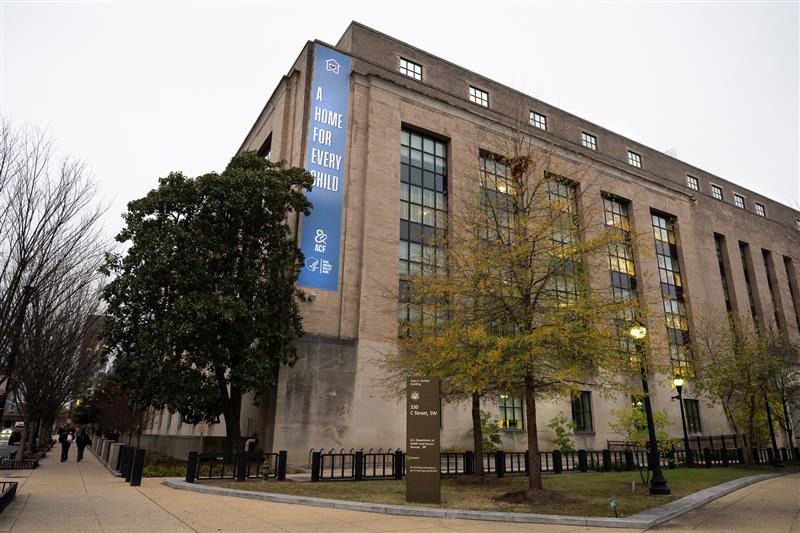

Chaos and confusion reign as Administration for Children and Families staff is cut nearly in half.
On a Thursday in late March, department leaders in the U.S. Administration for Children and Families gathered at a meeting. The warning they received from higher-ups was blunt: On Monday, ACF will look nothing like it does today.
With White House officials and business tycoon Elon Musk on camera calling to “delete” federal agencies and leave bureaucrats “traumatically affected,” cuts to social services appeared imminent.
Line staff knew things were shaky, but as word of the leadership meeting trickled down, worries turned to panic about the fate of their $70 billion division of the Department of Health and Human Services, which administers more than 60 vital programs — from child protective services and foster care to Head Start preschools and cash benefits for low-income families.
“If it looks nothing like it does today,” one administration employee recalled wondering, “what’s that going to mean to services for people on the ground?”
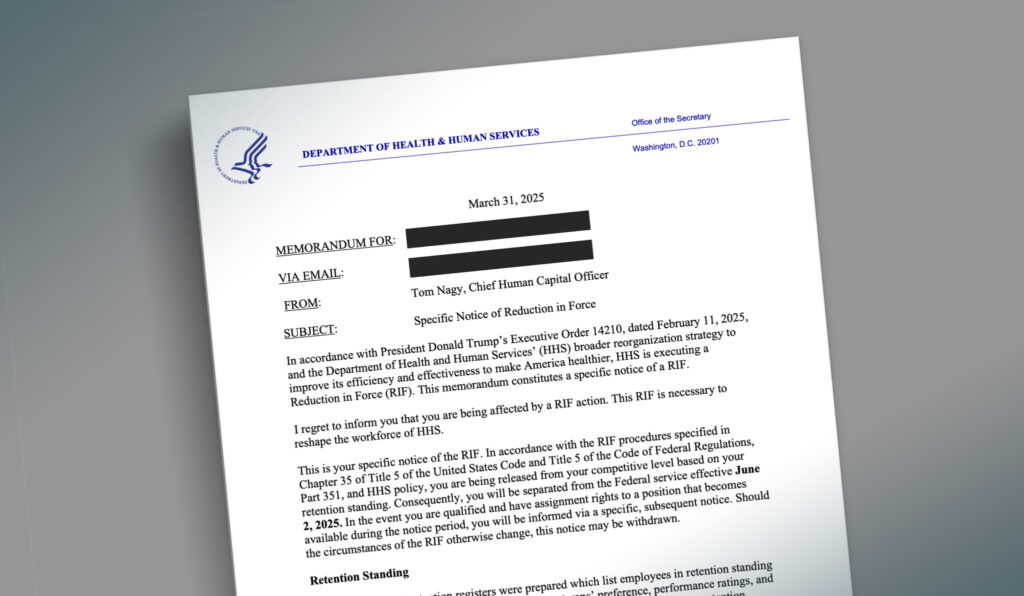
On April 1, roughly 500 Administration for Children and Families employees received notices that they would lose their jobs as part of President Donald Trump’s reduction-in-force bulldozing of federal agencies, according to a tally compiled by former department staff.
Those hundreds of jobs compounded earlier staffing cuts that followed Trump naming Musk head of a hastily created Department of Government Efficiency, or DOGE. According to Democratic senators and former employees, ACF has been reduced by 40% — from roughly 2,400 employees in January to 1,500 in April.
Four of the affected employees shared their stories with The Imprint. Each requested anonymity for fear of reprisal, as they are all still being paid by the federal government and on administrative leave until June 2 when they’ve been told their terminations will be final.
“Instead of policy change, they just fire all the people, and that work doesn’t get done. That’s an important story people outside the government don’t realize.”
— Naomi Goldstein, former research chief for ACF
Though unconnected and working in separate offices and programs across the country from one another, the four shared identical details: There was no transparency about how, why or when restructuring and terminations would take place; paperwork notifying employees of termination was shoddy and full of inaccurate information; and staffers had no time to alert the state agencies they served or prepare them for the upheaval to come.
Their experiences reveal another example of the now-widespread reports of haphazard DOGE-driven downsizing — and portend fallout to come for the nation’s state and tribal child welfare systems.
Naomi Goldstein, who served as research chief for the Administration for Children and Families from 2004 to 2022, described the upheaval for employees as significant — but said the impact on vulnerable families served by ACF is the “most tragic.”
“These are stealth policy decisions. If there is nobody left to push the button to make grants for essential services like child care, child abuse investigations or child abuse prevention, then states, territories, tribes and localities and will not have money to provide those services,” Goldstein said. “Instead of policy change, they just fire all the people, and that work doesn’t get done. That’s an important story people outside the government don’t realize.”
On Wednesday, a spokesperson for the overarching U.S. Department of Health and Human Services told The Imprint that “all statutorily required positions and offices will remain intact, and as a result of the reorganization, will be better positioned to execute on Congress’s statutory intent.”
“Guided by President Trump’s Executive Order, the Department’s restructuring is focused on cutting wasteful bureaucracy, eliminating duplicative administrative roles, and allowing HHS to redirect resources where they’re most needed — delivering better outcomes for the American people,” the spokesperson said.
Offices shuttered
Five of 10 regional ACF offices in Boston, New York, Chicago, San Francisco and Seattle — serving hundreds of tribes and child welfare departments in 22 states — have been shuttered entirely. In these offices, program specialists help states understand what federal funding can and can’t be used for, ensure they comply with federal policies, and oversee mandated annual reporting to the federal government. In a letter decrying the closures, U.S. Sens. Ron Wyden and Bernie Sanders called these specialists “the eyes and ears of ACF.”
In Washington, D.C., entire divisions of staff serving specific programs have been eliminated, including those working for the Social Services Block Grant, a flexible federal funding stream that states use to provide struggling Americans with child care, housing support and job training. More than a third of the annual $1.7 billion block grant budget goes toward child welfare services.
This clear-cutting raised concerns as to how programs overseen by the Administration for Children and Families will stay afloat, and whether local agencies and programs will continue to receive the federal funding they rely on.
One supervisor speculated that the inaccuracies were intentional to justify the terminations.
A group of attorneys general from 20 states filed a lawsuit Monday asking the court to reverse the terminations, describing them as part of an “unlawful” effort to “dismantle HHS.” Some employment law experts have voiced similar concerns.
Nancy Gutierrez, a spokesperson for the Department of Children, Youth, and Families in Washington state — which was among the agencies served by one of the eliminated regional offices — said the downstream effects may not be immediate and could “trickle in over time.” But she emphasized the importance of the relationship.
“We depend on our federal partners to ensure federal funds are distributed to our state for programs and initiatives that support the families we serve,” Gutierrez said.
Democrats in Congress and state attorney general offices have delivered sharper rebukes.
They described consequences from the ACF cuts as: “severe, complicated, and potentially irreversible.”
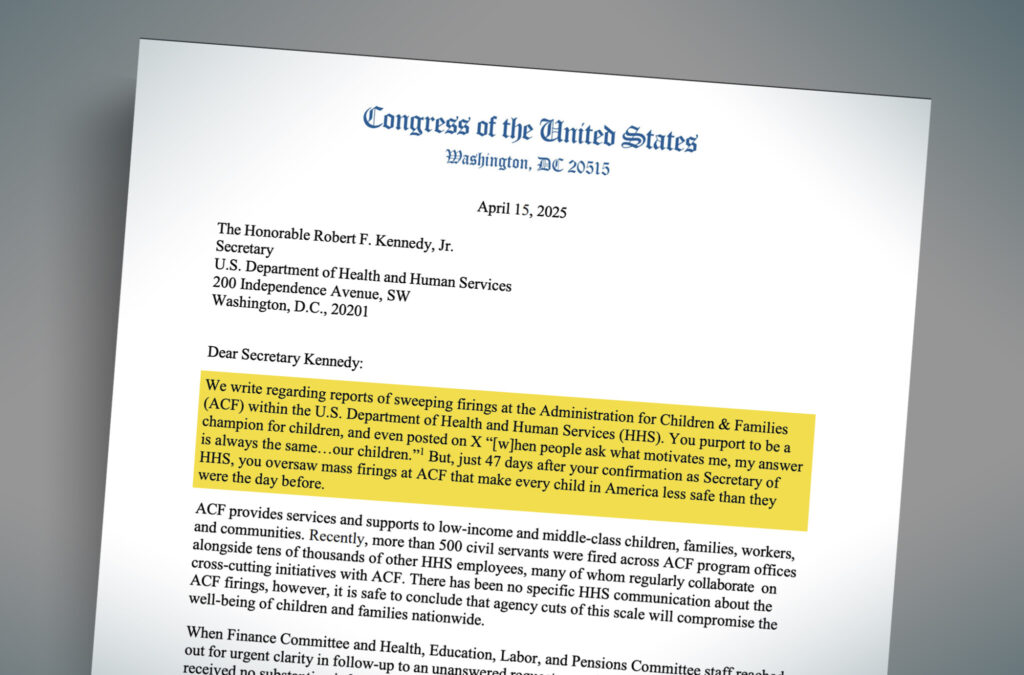
In their letter to the newly named and controversial top health official, Robert F. Kennedy, Jr., Sens. Wyden and Sanders said: “Just 47 days after your confirmation as Secretary of HHS, you oversaw mass firings at ACF that make every child in America less safe than they were the day before.”
When announcing the plan to let hundreds of federal workers in his agency go, Kennedy defended the move.
“Over time, bureaucracies like HHS become wasteful and inefficient even when most of their staff are dedicated and competent civil servants,” he said.
That could well be the case, Rachel Greszler, an economist at the conservative Heritage Foundation, told the Semafor online news outlet. She said it’s too soon to know how the layoffs will affect the country.
“It could be that the cuts and the number of staff have a negative impact. But it could be that they have little impact, or it could be that they have positive impact — I just don’t know yet,” Greszler said.
Months of turmoil, hasty terminations
In a rare disclosure to the press, the four dismissed federal employees provided an insider’s account of what went on.
Once-beloved jobs had turned miserable months before their abrupt terminations, all four staffers said.
It began immediately after President Trump’s January inauguration, when demands began pouring in to defend their work — from DOGE staff, they believe, though it was never quite clear. Requests included proving the merits of a contract and explaining why a program required four employees. They had nearly no time to formulate responses. A Washington, D.C.-based staffer said in one case she had just 10 minutes; the longest turnaround time was 48 hours, she said.
“I loved my job,” said another employee. “But these last few months have been some of the worst months I’ve ever experienced. I’ve lost complete trust in the administration.”
Another staffer said it felt like “hazing.” The rapid-fire nature of the requests made her question if it was an attempt to trip people up, so those mistakes could be used later to justify terminations.
ACF employees were kept in the dark or given inaccurate information. One staffer from a now-closed regional office said she and her coworkers first heard of the impending terminations in the news. When she asked her supervisors about it, she said they were as clueless as she was.
“We were reading things in the media and having a better sense of what was going on from the media than we were from our internal guidance documents,” another DC-based employee said.
False alarms began five days before the termination notices came on Tuesday, April 1. Employees were alerted that they’d get their notices by 5 p.m. Then, later that evening. Over the weekend. Each time, nothing. Staff “breathed a sigh of relief” when they were still able to log into their computers Monday morning.
Another day in limbo passed.
Many were still in bed when their phones pinged with termination emails finally arriving early Tuesday morning. Some staffers on the West Coast, where the letters arrived in the pre-dawn hours, were locked out of their email accounts before they even saw the notices stating they’d been let go.
Access to office buildings and communication software was locked down within hours. At one Western regional office, people lined up at the door trying to get inside to retrieve their personal belongings.
“Their cards had been terminated immediately,” an employee shared. “They were waiting around trying to find someone that could actually let them in.”
Some scrambled to fire off emails to the state child welfare programs they oversaw, trying to let them know what was going on and who they should report to moving forward. But the email lockouts came swiftly, interrupting that effort.
“Those of us that have the direct communication, we weren’t even given the opportunity or the time — we had no idea when all of a sudden we would just lose access,” a regional office staffer said. “I was getting ready to send an email, and then all of a sudden it said, you need to log in, and it wouldn’t let me.”
As colleagues began to talk and share the notices, an alarming trend emerged. The reduction-in-force letters were rife with errors, all four staffers said. Some paperwork didn’t even have names on it.
The letters included cumulative performance evaluations as well as a complicated computation that amounted to how much seniority each employee had — two vital pieces of information that affect future job prospects. On the vast majority of notices, these figures were inaccurately low.
“It’s almost like they just used some generic template or something that had scores in it that weren’t actually real people’s scores,” said one employee.
A supervisor said that an employee on her team had a “middling” performance rating, even though she’d personally reviewed her with the highest possible scores. She speculated that the inaccuracies were intentional to justify the terminations.
Emails requesting corrections to these letters have gone unanswered, although the staffers are being pressured to sign off on the notices, the employees said.
“The way they treat it, like our service didn’t even matter to them — I have been dealing with a lot of trauma around it,” one employee said. “I was really passionate about my job, and just to feel like I’m being tossed into the garbage didn’t feel good.”
“It’s destruction from the inside. I cried, in front of my children, which was really unpleasant. Because public service is part of my identity.”
— former ACF employee
One staffer based in Washington, D.C. said she was terminated without even receiving formal notice — “which doesn’t feel legal,” she said.
She learned of her termination when a member of her team shared their notice that indicated the entire team had been eliminated. Her manager confirmed she was “on the list” and she was locked out of her work computer. Final word didn’t come for three weeks.
“Starting to plan for your next steps is a lot harder when you don’t have that in writing,” she said.
Path forward unclear
Next steps for these and other impacted employees remain murky.
The National Treasury Employees Union, which represents some of the impacted Administration for Children and Family workers, has filed a grievance that could lead to arbitration, according to reporting by Healthcare Dive.
For now, the impacted employees remain in a gray area. Pointing to the possibility of successful lawsuits and indications from DOGE that eliminated employees could be brought back, some hope they’ll be reinstated to their posts. Others don’t want to return to an environment they say has become unbearable, and some hope to join a class-action lawsuit. But they can’t start a real job hunt until terminations become official on June 2. And those who have started looking are struggling amid a deluge of applicants in a narrow, specialized field, one former employee said.
“It’s destruction from the inside,” said another former employee of the DC office. “I cried, in front of my children, which was really unpleasant. Because public service is part of my identity.”
They each worry about the future of the programs — and the people — they’ve dedicated years of service to.
“It’s sad. I know that I will figure something out and I’ll move on. I’m worried about the impacts this is going to have to our jurisdictions and ultimately to the kids and families that they serve,” a regional office employee said. “Are they going to get the funding that they need?”
The outlook for tribes, whose child welfare programs have fewer resources than those run by states, is particularly concerning, three employees said. This is where they expect to first see the fallout of these staffing cuts.
“We’re going to see a lot less tribes get direct funding from the federal government, because they don’t have the capacity to do all of the reporting that we require without a lot of support,” one employee predicted.
Finally, because the employees left with no transition plan, they worry that colleagues from other offices or programs will try to “pinch hit” — despite not being trained in the work or having the right relationships.
“For a lot of our grant recipients,” said the D.C.-based employee, “that’s going to be a very dire situation.”
John Kelly contributed to this story.