
Delayed medical procedures for gender-affirming care, with waitlists over a year long. Online death threats and violent rhetoric.
These are just some impacts that two Indigenous, transgender former foster youth have paid close attention to since President Donald Trump took office for a second time. In the past five years 27 states have limited access to gender-affirming care for transgender minors and the Trump administration has pushed states to end requirements that foster parents affirm the gender identity of foster youth in their care.
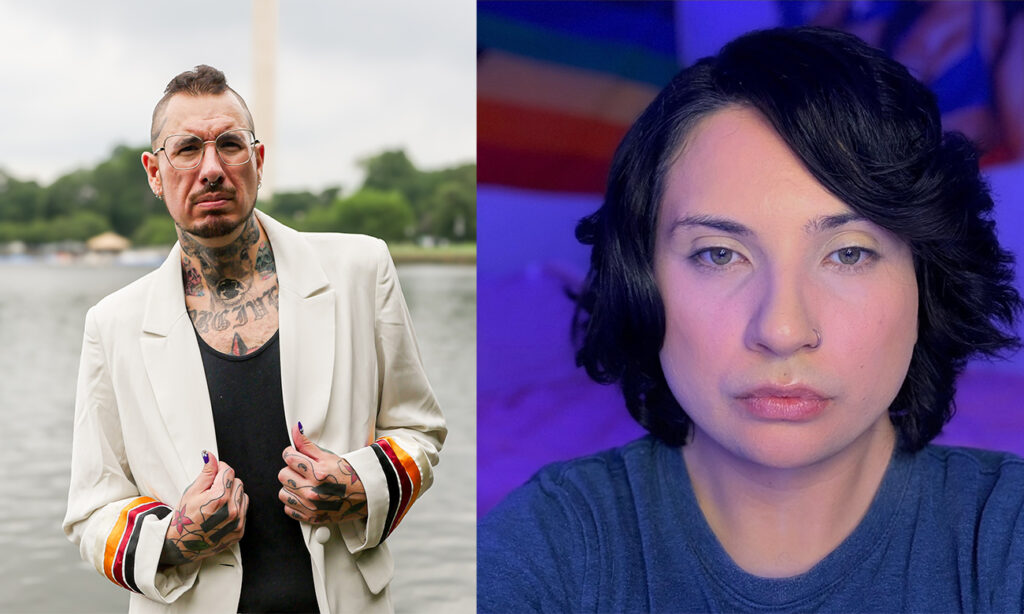
Arc Telos Saint Amour and Aiyana Clark, who both identify as Two Spirit — the term some Indigenous communities use to describe those with varied sexual or gender expressions — lead state and national organizations serving foster youth.
Saint Amour, of the Tap Pilam Coahuiltecan Nation, is the executive director of Youth MOVE (Motivating Others through Voices of Experience) National. The nonprofit advised the Biden-Harris administration on peer support and mental health advocacy and aided in the development of 988, a now-shuttered national suicide hotline that served the LGBTQ+ community.
“I do not say this lightly — the first year of the Trump administration, and the years to come, will literally be deadly for Two Spirit foster youth and other systems-impacted youth of marginalized identities.”
— Arc Telos Saint Amour, executive director of Youth MOVE National
Clark, of the Tulalip Tribes, works on legislation and other efforts to improve Washington state’s youth justice system, and has endured the turmoil surrounding gender-affirming health care firsthand over the past year. Clark is acting chair of the Washington State Partnership Council on Juvenile Justice. Their journey as a foster youth and advocate fighting to indigenize child welfare was featured in a three-part series published by The Imprint in 2023.
In separate interviews with The Imprint, Saint Amour and Clark described their experiences since Trump’s second term began. As they look ahead, both plan to focus on finding ways to strengthen support systems and policies that will protect all foster youth regardless of gender orientation, expression or identity.
These conversations have been edited for brevity and clarity.
What is the focus of your work in the foster care and youth justice systems?
Saint Amour: Youth MOVE National’s work regarding foster care youth and the broad child welfare systems is both rooted in system and policy reform as a harm reduction tactic, and abolition work, facilitating spaces where youth can be creative, innovative and envision long-term solutions for them, by them. We then take what we learn and work with system change-makers, legislators, governments and others to implement those scalable solutions and changes.
Clark: My main focus has always been the well-being of all foster care youth in Washington, regardless of how they choose to identify. They need to have supportive and loving homes.
Speaking as someone who got kicked out of a guardianship placement because of how I chose to identify, I do a lot of public speaking, especially as it pertains to my experience as a foster youth. Also, the council has made it a goal to hear directly from systems-involved youth who are currently incarcerated and we try to work with them to improve outcomes for them and their peers.
How has the first year of the Trump administration affected you personally and professionally?
Saint Amour: I could literally talk for days about the horrors our communities are experiencing, our staff are experiencing, hell, that I’m experiencing as a Two Spirit, queer and trans person of Mexican Native Indigenous descent — but it still wouldn’t be enough to demonstrate the gravity of the situation.
We have literally criminalized being queer and trans, and legalized active eugenics. That affects Two Spirit foster youth at disproportionate rates considering their intergenerational trauma, having lived with instability for so long, lacking loving, affirming and consistent adults, authority figures and systems.
I do not say this lightly — the first year of the Trump administration, and the years to come, will literally be deadly for Two Spirit foster youth and other systems-impacted youth of marginalized identities.
Clark: Seeing this culture war play out and the weaponization of an already heavily marginalized community — that is actively playing out in my life. I constantly face criticism and ridicule for identifying as transgender.
And when it comes to foster parents’ policies, if I were to have been younger and the current administration’s policies were existing, it’s fair to assume I could have potentially been put in the same exact situation that led me to go back into care to begin with.
What are your thoughts on how to work for the next three years under this administration?
Saint Amour: If you are in the field you need to apply for every grant possible and start diversifying your revenue portfolio. Large federal grants are a thing of the past. Get your board fundraising, ask friends for donations — this is truly a “do everything possible” situation, not only to protect the public, nonprofit, mission-driven sector, but to protect the livelihoods of your staff. I truly wish there was a magical, simple solution. There’s not.
You just have to keep going and push through. For foster youth, my best advice is to stick together. Find your people that get you, love you and affirm you no matter what. Find your peers that make you feel safe, make you feel like home, and then hang on to each other tight. Tell your stories, advocate for change, show up to local meetings, get involved. United, we are much stronger. It’s going to be a rough few years at minimum.
“It’s all a matter of really showing up in these next few election cycles and finding policymakers who really do represent us and inspire a lot of hope. It’s about reminding people we’re still here, and I’m not going to vote for you if you don’t acknowledge my existence.”
— Aiyana Clark, acting chair, Washington State Partnership Council on Juvenile Justice
What are you proposing in terms of changes, or focus?
Saint Amour: Two words — small and local. Start with very simple, small, easy to accomplish tasks. This may feel like chipping away at a brick wall with a toothpick, but even that has an impact. If you get wrapped up in the enormity of it all it can be hard to act, or try, or know what to do, or how to start. But if you pick something small and build up, it will come. Go to your school board meetings, go to your civic council meetings, you have to show up.
Clark: It’s all a matter of really showing up in these next few election cycles and finding policymakers who really do represent us and inspire a lot of hope. It’s about reminding people we’re still here, and I’m not going to vote for you if you don’t acknowledge my existence.
What strategy or approach do you think is likely to be effective in this current climate?
Saint Amour: Although this is familiar to most Indigenous folks given our history, this, even by those standards, is still not normal. This administration, the state of the country, this is truly a horrific, abhorrent and unprecedented moment in modern history. I believe in resisting the normalization or assimilation to that. Instead, keep fighting, but choose your battles carefully with intention and strategy, while not feeling guilty for choosing personal or professional security. I also believe it’s important to pay attention to the news.
Clark: I don’t think there’s anything worthy of being effective. Honestly. I think we are so far gone at this point when it comes to specifically trans people, people have already made up their minds about us. I want to be optimistic, but at this point, people are just outwardly being transphobic and disgusting, and there’s not really any repercussions for that.
How is it more challenging for foster youth to receive gender-affirming care in foster homes?
Saint Amour: Queer and trans youth experience disproportionate amounts of harm, violence and lack of safety and affirmation within the home and from caregivers, and this at least tangentially can be related to higher rates of CPS and child welfare involvement.
Youth, especially queer and trans youth when it comes to receiving gender-affirming care, lack the most self-agency, self-determination and bodily autonomy than almost any other age demographic besides potentially our disabled aging adult populations.
When you take this and mix in being a ward of the state, you basically have no rights at all, which was already making it incredibly hard for youth to receive hormone replacement therapy and forms of gender affirming care before this mess.
Aiyana, is there anything you’d like to share about your own access to gender-affirming care?
Clark: I was in foster care from a very young age and it wasn’t necessarily safe for me to express myself early on and get the health care I needed in my life. Here in the state of Washington, health care coverage typically ends when you’re 26. So with me being 25 now, and with the new Medicaid funding requirements and restrictions on transgender health care, I have to rush my procedures and try to get them done within the next year.
Being trans is a journey, and not all of us have the same journey. But I can’t imagine what it’s going to be like for people who are younger than me, who have state health care and are currently transitioning, who are going to lose access to gender-affirming care. The fact they’re going to be losing all these resources that scientifically has been proven to show mental health improvement, is just baffling.