
Concerns persist as April 1 budget deadline is extended.
As New York’s budget negotiations draw to a close, advocates and lawmakers are fighting for millions of dollars in funding to support thousands of families across the state who are on the brink of losing access to affordable child care.
Advocates have called for nearly $1 billion in additional funding to bolster child care resources, including the state’s Child Care Assistance Program (CCAP), which has helped families throughout New York afford the cost of child care. The program, open to parents of children up to the age of 13, provides vouchers that cover most of the cost of child care, which can run about $1,500 per month for infants.
New York has consistently increased spending on the program: from roughly $190 million in fiscal year 2020 to a proposed $1.1 billion in Gov. Kathy Hochul’s executive budget released earlier this year. The program grew in recent years after the state expanded income eligibility guidelines — earlier, only very low-income parents could use the vouchers, but during the last two budgets, families earning up to 85% of the state’s median income have been eligible.
But advocates say Hochul’s current proposed allocation falls far short of the demand. They cite rapidly rising child care costs and post-pandemic changes to cash assistance rules that require parents to reenter the workforce.
Across the state, multiple counties including Essex, Fulton, Hamilton, Madison, Saratoga, Warren and Washington, have already stopped accepting new applications for vouchers, with additional counties expected to close enrollments this month. And in New York City, an estimated 4,000 to 7,000 families a month could be denied continued care.
While there are some bright spots for New York families in the proposed budget — including a child tax credit boost— Assemblymember Brian Maher called the looming child care funding shortfall a “crisis.”
“Child care is not a luxury—it’s a necessity for working families across New York,” he said. “If we don’t act now, thousands of families will be left without the support they rely on, forcing parents out of the workforce and closing child care centers.”
Angel Gray, program and policy manager at Westchester Children’s Association, said the impending budget shortfall disproportionately threatens low-income families who rely on vouchers to maintain stable employment and support their children’s crucial early development.
“Many parents again will be forced to have to choose between child care or some of the other basic needs such as housing or food,” Gray said. “It really perpetuates the cycle of poverty.”
Lawmakers urge governor to reconsider
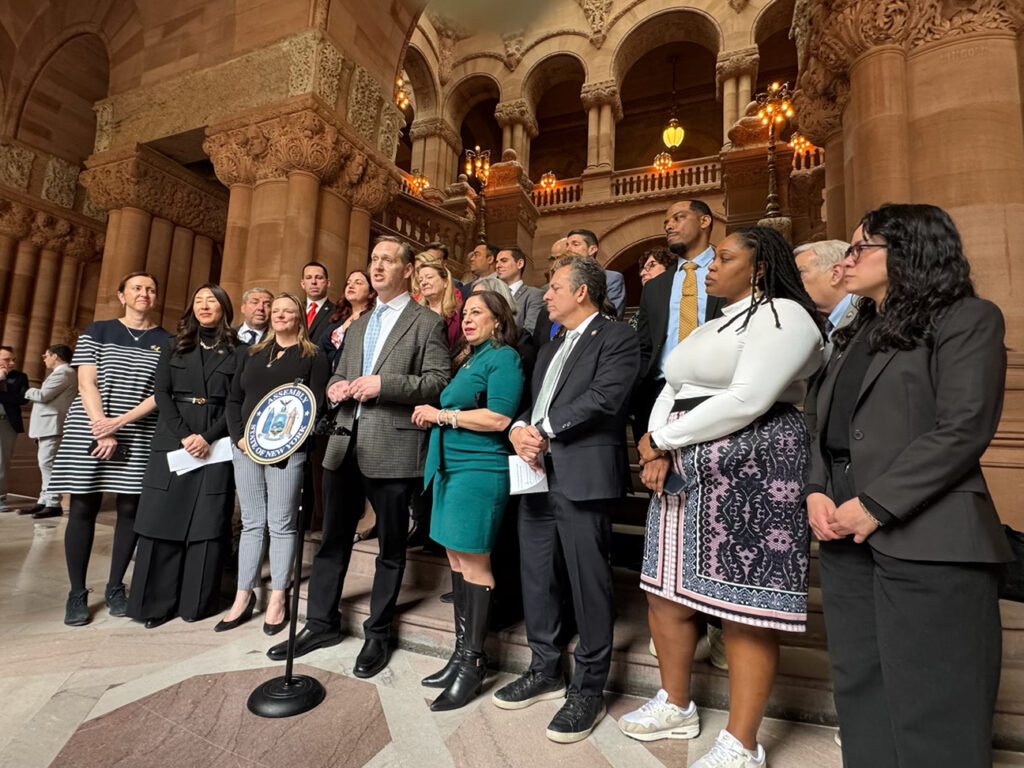
At a press conference in the New York state Capitol last week, 38 bipartisan assembly members joined advocates and parents to call for an additional $500 million for the child care voucher program. They also called for another $500 million to support wages for the state’s child care workforce, which suffers from chronic understaffing.
Assemblymember Miller praised the state’s “meaningful progress” in child care investment, but warned that the lack of funding has already started to affect families upstate.
“The child care crisis isn’t just coming — it’s already here, and families in Madison County are feeling the impact,” Miller said. “The CCAP shortfall is forcing counties to close enrollment, leaving working parents without options and putting small child care providers at risk of shutting down.”
Nearly 50 state legislators representing New York City districts also sent a letter to the governor last month, stating that “one of the silver linings of the pandemic’’ was the infusion of federal child care funds that allowed the state to increase the number of children receiving vouchers in the city from 7,500 to 62,000. But without additional new funding, they wrote, the loss of thousands of vouchers could lead to a spike in the city’s child poverty rate, which is currently at 26 percent.
Mansie Meikle is one of the thousands of parents who was able to take advantage of vouchers provided by the New York City’s Administration for Children’s Services.
There was a time when child care was simply not an option for Meikle, a single mother.
Five years ago, she and her three children, aged six to 12 years old, were living in various shelters around the city. During a particularly difficult time, she spent nearly six hours every weekday on subways and buses, shuttling her children to school in Brooklyn, then commuting to a job in the Bronx — and then back the other way. Everyone was exhausted by the end of each day.
“The kids really didn’t like me for those five months,” Meikle joked last week during a break between her shift as a home health aide and her children’s pickup time at their child care center.
At one point she put her children in a free child care program offered at a shelter, but she removed them after an alleged incident of abuse that Meikle says no one took seriously. Making only minimum wage, she eventually had to quit her job and go on state assistance to care for her children full-time, she said.
After applying multiple times for child care vouchers, she finally received them. The vouchers allowed Meikle to return to work, and she now has a job that she finds fulfilling. That job, as a home health aide, only brings in $350 a week. Her children’s after-school care costs $900 a week for all three children— an expense she could never afford on her own.
The vouchers pay the full cost of her child care and have felt like a lifeline, Meikle said. But the threat of their loss has made her feel as though lawmakers are telling parents like her that just “when you feel you’re about to be on the boat, we’re going to cut it.’’
“I’ll be devastated if I can’t work,” said the 33-year-old mother. “The government is working against me at this point. It’s infuriating.”
“The child care crisis isn’t just coming — it’s already here, and families in Madison County are feeling the impact.”
— New York Assemblymember Brian Miller
Child care workers, especially those running small, independently-owned businesses, also fear losing clients and jobs.
Tiffany Diaz owns and operates My First Steps, a child care center with four locations in the Bronx. Some of her sites offer overnight and 24-hour care.
Many of her clients are low-income, single parents, Diaz said. Others live in the city’s shelters. Before the voucher program’s expansion made it possible for more families to afford care, she struggled to pay her staff livable wages and to keep her doors open.
“Unfortunately, where we live, we’re not well off. We’ve had families that have left owing us thousands of dollars,” Diaz said. “We don’t want to just shoo them out, and we try to give them a little bit more time until they get paid. And we can’t tell our employees, ‘We can’t pay you,’ because then we’ll lose the employees.”
When Hochul expanded access to the voucher program, she also increased reimbursements to providers, which included thousands of dollars in bonuses to child care workers and funding for recruitment and retention. As a result, Diaz was able to open additional sites, hire more staff for overnight shifts and take in more families. Now, almost 90% of Diaz’s clients use child care vouchers, she said.
Her centers serve more than 100 families with kids aged five months to 12 years old. Parents working night shifts are especially dependent on her services, Diaz said. Offering more than just a safe place for parents to leave their children, Diaz and her staff also help with homework and provide warm meals. They send parents videos and reports throughout the day and provide enrichment activities such as STEM day, TikTok dances, academic games and cooking classes. Diaz said these activities are invaluable for children, especially those who have fallen behind socially and academically since the pandemic.
Such work requires experienced, reliable staff members who make liveable wages, Diaz said, but many of them would struggle if current clients lose their vouchers and she’s forced to close some of her locations.
She worries, too, that some families may turn to unlicensed care providers.
“It’s extremely scary,” Diaz said.
Erica Thompson said the situation is particularly perilous for foster parents like her. The state has strict guidelines for who is allowed to supervise foster children, which means friends and relatives can’t help unless they are licensed.
“Even short-term child care disruptions create significant hardships, forcing me to either work from home while simultaneously caring for a high-needs child whose routine is disrupted, or request that already-overwhelmed caseworkers provide supervision in their offices,” she said.
If the worst happens and she loses her child care voucher, Thompson said, she could be “forced to surrender” her foster child to child protective services, “resulting in yet another traumatic disruption for an already vulnerable child.”
Other budget needs for families and children addressed
Gov. Hochul’s budget does include a few bonuses for families and youth, such as a historic boost to the state’s child tax credit, which the governor said would finally “extend a financial lifeline” to families with younger children. She additionally proposed committing taxpayer funds to cover universal free school meals and payments for pregnant and new moms.
The final budget will also likely include an annual $250 million ‘Raise the Age’ appropriation, which, since 2019, has provided funding to counties for incarceration alternatives and community diversion programs aimed at many 16- and 17-year-olds involved in the juvenile justice system.
The initiative has been plagued by concerns about unused or inaccessible funds — as of March 2024, less than a third of the $1.5 billion so far allocated to “Raise-the-Age” programs had been actually spent on youth in need, “leading to a backlog of unresolved family court cases.”
As a solution, this year a Senate proposal calls for diverting $50 million of that funding to a “youth justice innovation fund.” Under legislation reintroduced by Sen. Cordell Cleare and Assemblymember Michaelle Solages, the state’s Division of Criminal Justice Services would administer and disperse the money directly to community-based organizations, bypassing counties. The bill would also make New York City eligible for Raise the Age funds for the first time.
Tim Ragland is a national director at Youth Advocate Programs, an organization that contracts with 16 counties in New York to provide cognitive and behavioral health therapy, life-skills, training and community services for young people in order to prevent their entry into youth prisons and placements in residential care facilities.
Giving money directly to organizations like his would involve fewer hurdles and allow his program to get services to young people faster, Ragland said. Many vulnerable youth are stuck on never-ending waitlists for services, he said.
Legislators had extended the budget’s April 1 deadline through today, although they could pass another extension Thursday.