
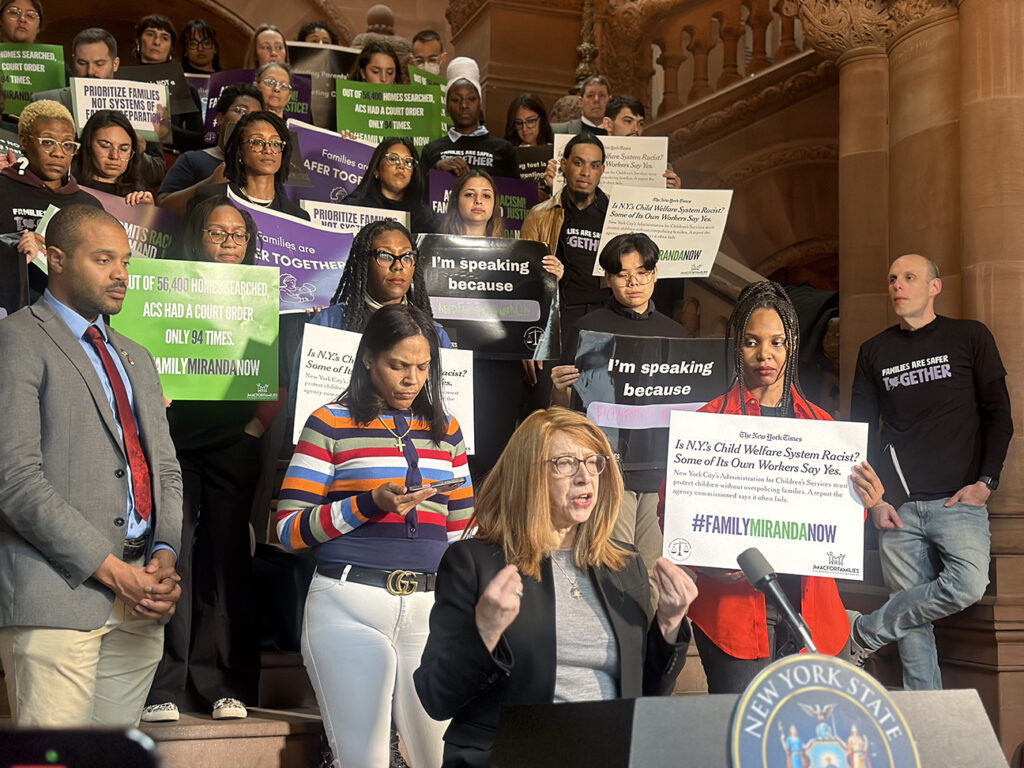
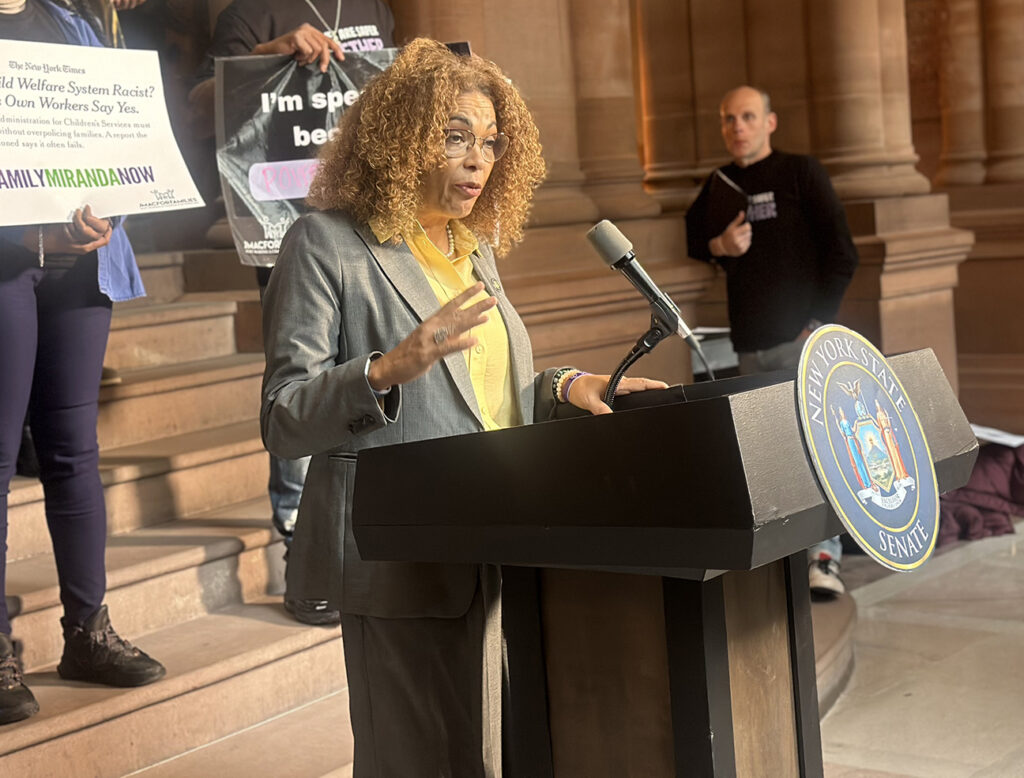
Dozens of parents, lawyers and lawmakers gathered at the New York state Capitol Tuesday to rally for legislation supporting families caught up in child welfare investigations, foster care removals and the termination of parental rights that can result from abuse and neglect allegations.
One mom, Davene Roseborough, told the crowd about being investigated by CPS following an anonymous report, an experience she described as “invasive, embarrassing, humiliating.”
Parents’ rights advocates are seeking renewed attention to four bills that state lawmakers will revisit this year: The Family Miranda Rights Act, the Anti-Harassment in Reporting Act, the Maternal Health Dignity and Consent Act and the Preserving Family Bonds Act.
“These bills ensure that parents are informed of their rights, that families are protected from harassment, and that children can maintain the relationships that shape their lives,” Assemblymember Yudelka Tapia told the assembled. “They put a name to the coercion, secrecy and unjust separations that have destroyed too many lives.”
State lawmakers have pushed these pieces of legislation for years, but have faced opposition from child welfare agencies, CPS union members, and other opponents concerned the changes would erode child safety. Now, some of them say that by making significant amendments to the language of bills and increasing cooperation with opposing parties, this year may offer different outcomes.
Speakers also underscored the deep disparity people of color continue to face in the child welfare system.
“By the time they turn 18, a Black child will have a one in two chance of facing an investigation by Child Protective Services, which may end in a family separation,” said state Sen. Jabari Brisport, who is the sponsor for three of the four bills. “This is a racial justice issue.”
“These bills ensure that parents are informed of their rights, that families are protected from harassment, and that children can maintain the relationships that shape their lives.”
— NY Assemblymember Yudelka Tapia
One Brisport bill, co-sponsored by Andrew Hevesi in the Assembly — the Anti-Harassment in Reporting Act — would require callers to the state’s child maltreatment hotline to provide identity and contact information, which would be kept confidential. Parents such as Roseborough and other advocates allege that anonymous calls are often made by vengeful exes and angry neighbors, resulting in traumatic home visits by CPS. State data, in turn, reveals that the substantiation rates for anonymous calls is far lower than with calls in which the identity of the caller is known.
The legislative proposal passed the Senate last year but failed to garner enough support in the Assembly.
In an interview, Hevesi expressed confidence that the bill would have more success in this legislative session due to helpful discussions he said he’s had with lawmakers who were previously opposed. Some of the concern, he said, came from fears that prohibiting anonymous calls would discourage children from self-reporting.
He said the bill’s authors are “keeping an eye on that to make sure that we prevent the harassment, but we don’t stop any legitimate calls going through the system.”
To that end, he said he’s working on amendments that should be completed in the next two weeks that will make it “more palatable to the members.” The amendments he added, “will change the dynamic of the push this year.”
Tuesday’s rally featured prominent support for another bill that would require CPS workers to read a version of parents’ “Miranda rights” when they appear at the door to investigate reports lodged with the Statewide Central Register of Child Abuse and Maltreatment.
“New York law is clear that — absent a true emergency — CPS cannot enter a home and interview children without either a court order or a parent’s permission,” the bill states. “Caseworkers, however, often do not communicate these basic rights to parents. Instead, they often tell parents that if they fail to cooperate with CPS’s demands immediately, their children will be removed.”
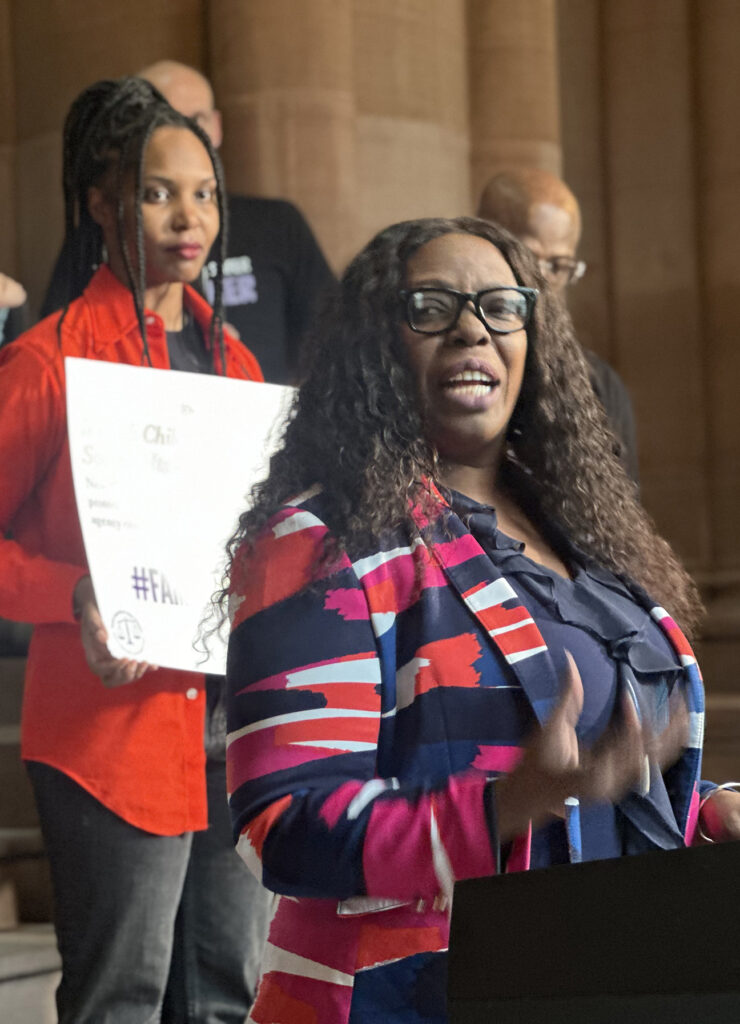
In an interview, Assemblymember Latrice Walker, one of the bill’s sponsors, also expressed renewed optimism for her bill to pass this year because “the advocates and the social services providers are communicating to break through the challenges.”
Walker pointed to the success of New York City’s Administration for Children’s Services recently expanded Know Your Rights pilot program. City workers are now instructed to provide parents with palm-sized information cards containing information about their legal right to deny entry printed in several languages. The pending legislation would require similar disclosures statewide.
At Tuesday’s rally, several parents spoke movingly from personal experience.
One father, D’Juan Collins, spent more than 16 years in court fighting to regain custody of his son, Isaiah, who was less than a year old when Collins was arrested for drug possession and sent to Rikers Island. Speaking at the rally with his son standing beside him, Collins said CPS removed Isaiah, now 18, from the care of his paternal grandmother. His court-appointed attorney did not inform the father of his right to appeal the decision in court, he said. Isaiah was instead placed with non-relative foster parents, who adopted him as Collins eventually lost his parental rights.
“My family even had a magnetic alphabet board saying, ‘Welcome home. Isaiah,’ Collins recalled. “Sadly, that day never came.”
Once he was released from prison, Collins said he visited his son at the foster care agency every Friday. On their last day together before the 8-year-old’s adoption, they built a teepee and took a picture. After that, even supervised visits and communication between father and son simply stopped. Isaiah’s adoptive mother refused to allow Collins to stay in touch with his son, he said.
“By the time they turn 18, a Black child will have a one in two chance of facing an investigation by Child Protective Services, which may end in a family separation. This is a racial justice issue.”
— NY state Sen. Jabari Brisport
Barring parental contact after foster children have been adopted is the focus of a third bill again before state lawmakers, the Preserving Family Bonds Act.
Sen. Brisport and Assemblymember Tapia’s legislation would give judges the authority to order contact between biological parents and their children, if deemed appropriate. Currently, this is solely in the power of the adoptive family.
“No child should grow up wondering why the system erased their family when love and connection were still possible,” Tapia said in support of her bill.
Tapia’s bill is unique among the four reform-seeking proposals, as it’s the only one to have passed both houses of the Legislature three times. But each time, it has been vetoed by New York governors Andrew Cuomo and Kathy Hochul — who last year cited concerns about whether continued contact with birth parents would discourage adoptions.
A final pending piece of legislation would require written and oral consent in hospitals to test new mothers for substances such as marijuana and opioids.
Desseray Wright, now a policy advocate with the Bronx Defenders, told rally-goers Tuesday that CPS removed and placed her son in foster care for 3 1/2 years after the hospital administered a drug test without her consent.
“The trauma that my son experienced in the foster system is something I will never forget, and the pain of being separated from my child is a wound that still affects me to this day,” she said. “We as a family were torn apart by a system that saw us as nothing more than a case to be managed, not as a parent.”
Advocates for parents like Wright say testing without consent can disrupt infant-mother bonding and discourage mothers from seeking medical help for substance abuse issues and other health concerns, for fear of being investigated by CPS.
Assemblymember Linda Rosenthal pointed to the prevalence of false-positive drug test results.
“If you can’t trust your medical provider, you’re just not going to go if you fear that a nurse, a doctor, somebody who works in the health care system is suspicious of you,” Rosenthal said. “Maybe you’re acting tired, maybe you’re crying, maybe you’re upset, you’re pregnant — that is no reason to suspect that you are taking drugs.”
Rosenthal’s bill makes certain exceptions, such as when immediate testing or screening is necessary for a medical emergency.
“A drug test is not a parenting test,” she said at Tuesday’s rally, amid vigorous cheers from the crowd.