

Update: Since publication of this story, Minnesota legislators have agreed to transfer $5 million to the Fostering Independence Grants program to cover tuition and housing costs for foster youth attending college. Under an approved proposal awaiting final action, the funding will be transferred from the North Star Promise Scholarship Program, a temporary solution to the budget shortfall that helps students complete the next school year and avoids wait lists.
Two years ago, Minnesota lawmakers enacted landmark legislation to ensure the state’s foster youth had enough money to attend college, a promise that all those eligible would have the resources they need for tuition, books, housing and incidentals. Young people who had been in foster care at or after age 13, and all those 27 and younger could apply, creating a pathway from shelters, residential centers and foster homes straight into dorm rooms.
Minnesota officials boasted of the broad access to the state’s Fostering Independence Grant, known as FIG.
“This grant removes financial barriers to higher education, ensuring every Minnesota foster has the opportunity to attend one of our state’s great colleges or universities,” Commissioner of the Office of Higher Education Dennis Olson stated in a March 14 press release. “To any member of Minnesota’s foster community contemplating college: the Fostering Independence Grant is here to help you achieve your career goals; all you have to do is enroll.”
And enroll they did. In the first year of the program, 492 youth have used the grants to attend community colleges and four-year universities, with an average $8,639 boost on top of financial aid and scholarships, according to state reports.
“I was so excited when I found out about FIG. It was a breath of fresh air,” former foster youth Travis Matthews, a senior at Hamline University, testified before state lawmakers on March 12.
But the lifeline program appears to have been more successful than state officials anticipated, and the promise of college-grants-for-all may turn out to be hollow.
If it continues to grow at the current pace, the program will require far more than the roughly $4 million budgeted per year for this school year and the next. Pending legislation would make awards available on a first-come, first-served basis, and create a waiting list for those who missed the window of available funding.
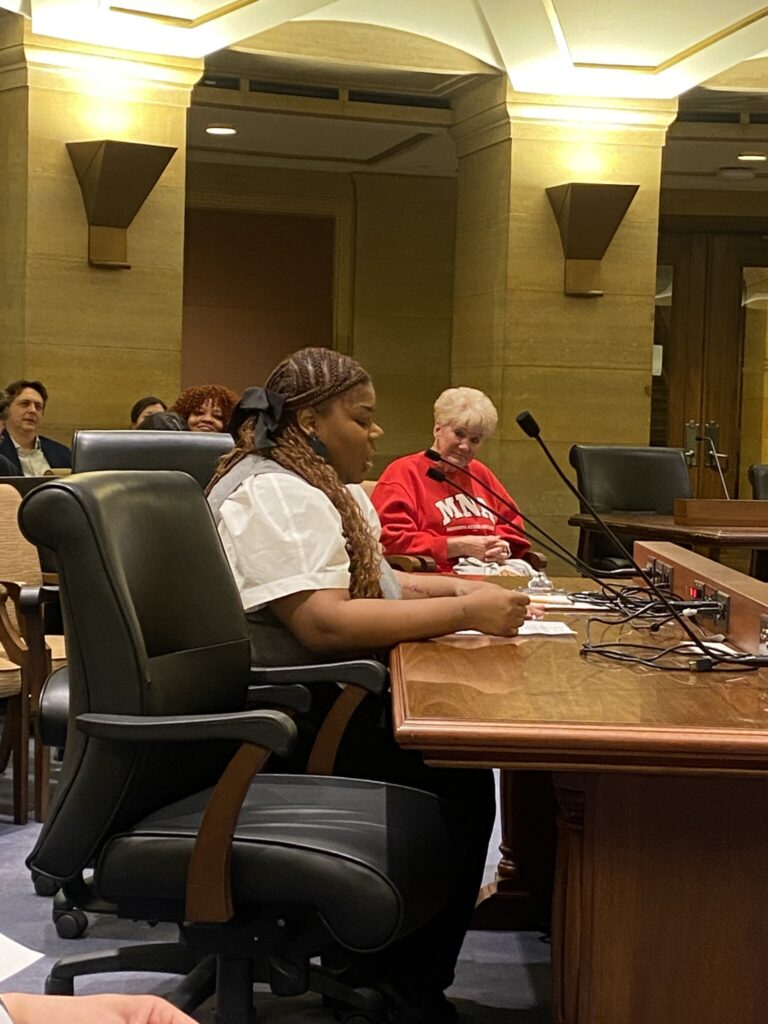
“The state promised that they’d be here,” said Ace Goff, one of many former foster youth who offered impassioned testimony before lawmakers that day. “Take my hand, we got you. They looked at us dead in the face, turned around and let us go. You assured us that FIG wouldn’t be another broken promise.”
Youth advocates are calling for roughly $6 million in additional funds for the program. They predict that as many as 40% of foster youth seeking the grants could be wait-listed in the next college application season, due to the current budget shortfalls.
An even more dire prediction could play out for current students. Their funding could dry up in the fall, analysts warn.
In a series of emotional hearings before the Legislature’s Higher Education Committee this month, members of the St. Paul-based Foster Advocates group called on lawmakers to reject the waitlist option, and to seek the necessary funds for all eligible youth to attend postsecondary schools.
If that fails to happen, the state would take “many steps back,” Matthews said, pointing to the great number of foster youth who end up homeless or incarcerated. “If this bill passes, you’re no different than our parents or the system.”
The Fostering Independence Higher Education Grants were passed by the Legislature and signed into law by the governor in 2021. The bill required the Minnesota Office of Higher Education to establish a postsecondary grant program for undergraduate students previously placed in Minnesota foster care.
Initial awards were disbursed to student accounts in the fall semester of the 2022-23 academic year, amounting to $3.5 million. Given the high demand, last April, the state invested an additional $750,000. In total, 492 students received awards totalling $4.2 million.
So far this year, the number of grantees has grown from 492 to 648 students attending public and private colleges and universities, yet only $4.2 million is budgeted.
“We’ve been running behind two years in a row,” said Adam Johnson, a state financial aid program administrator overseeing the college grants for foster youth, in an interview with The Imprint.
Johnson said with the program’s popularity, it’s become clear that the state “missed its projection,” and he anticipates waiting lists will take effect next year. “The big reason why we have a shortfall, essentially,” he said, “is that students have shown up.”
Foster youth are among the most unlikely group to pursue higher education, due to myriad forces, from lack of family guidance to childhood trauma and poor state support. They apply for and attend college at far lower rates than their non-foster peers, and less than 3% receive a bachelor’s degree, according to the Education Commission of the States. That number stands in stark contrast with the 24% of young adults in the general population with an undergraduate degree.
State officials in Minnesota report that foster youth approach colleges with no “expected family contribution” on their financial aid applications, and significant disadvantages when it comes to meeting basic needs. Applicants are likely to have unstable housing, poor support from adults during a crisis, and food insecurity.
College, for foster youth, can do more than secure a future career and livelihood. It can also provide basic lifeline support: food, shelter, peers and mentoring relationships with adults.
Still, state education officials appear to have miscalculated how high interest would be in the Fostering Independence Grants, and now many may go wanting.
Nia Dyer is among the half-dozen foster youth who testified at the state Capitol, and said she drove four hours to attend the hearing.
“Before FIG, I was stuck. There was this big financial barrier,” she said. “We both took the biggest sigh of relief when my mom and I found out about FIG. Something that seemed impossible for me was now screaming my name.”
The idea of a waitlist is offensive, Dyer and other members of Foster Advocates say.
“With a waitlist, it reaffirms that we have to be one of the lucky ones,” Dyer said. “If we wanted a loving family, we’d have to be lucky. Now, if we want to get to college, we have to be lucky. Why is it that the only time fosters can end up on top is when we have to get lucky?”
Matthews and Goff have written about their advocacy work for this outlet’s sister program, Youth Voices Rising.
Goff said she plans to keep showing up in the state Capitol until lawmakers act. She spent 16 years in foster care, surviving homelessness and juvenile incarceration as a result of being labeled a runaway. These days, she studies criminal justice, social work and human relations at St. Cloud State University. She remains determined to fight for students like herself.
“You know that person who shows up and fixes a problem by becoming a problem themself?” Goff asked. “That’s what I want. I want to be a problem. A good problem.”