In recent weeks, Catherine Dennis welcomed parents and their young children to the Yakima Valley nonprofit preschool she runs — with a dire new challenge.
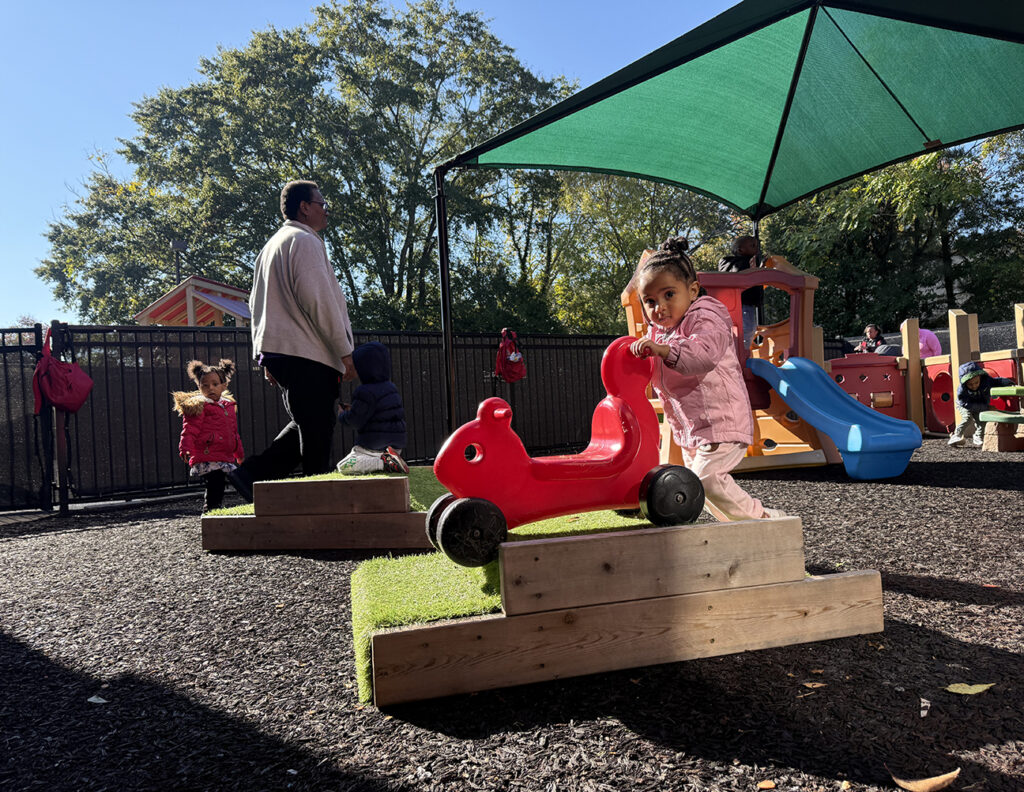
Her bright, freshly painted classrooms in Washington’s sun-drenched wine-and-apple country are understaffed due to state budget cuts, and she has had to entirely eliminate one long-standing program for babies and toddlers from low-income families.
“We used to have a teacher, teacher aide, support specialist, a floater to provide relief for breaks, behavioral support and wraparound support for parents,” Dennis said. Now, with “fewer bodies in the room,” she added, “there’s more emphasis on management of the classroom, rather than effective interactions.”
Similar cuts have taken place across Washington to the state’s well-regarded Early Childhood Education and Assessment Program (ECEAP), as lawmakers attempt to address a multi-billion-dollar budget deficit. This year, the program will serve 14,400 children — 2,000 fewer than last year, according to an analysis released last week by the Washington State Head Start and ECEAP Association.
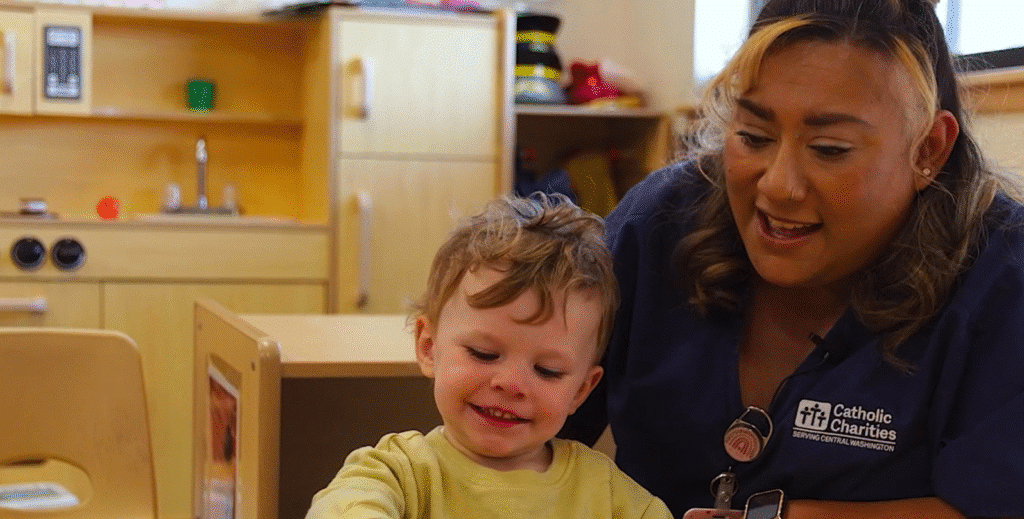
The programs Dennis oversees as director of early learning for Catholic Charities Serving Central Washington are among those hard hit. Her organization lost roughly $1 million in state funding from its $17 million early learning budget, eliminating the Early E-CAP program serving infants through age 3, and canceling its related in-home services for high-need families.
The cuts have already had dire impacts.
Victoria and Marshawn Briggs moved into a cheaper home so they could pay for other daycare options for their 1-year-old, who lost a slot. The move and related upheaval stressed their 3-year-old son, whose acting-out behavior increased, the couple said in an interview.
“His behavioral issues could 100% have been avoided,” said Victoria, 25, who works in human resources. “It’s less intense when he has a strict routine — but there were so many changes at school and at home, it’s gotten more extreme.”
The family is stably housed and employed, said her husband Marshawn, who is also 25 and works as a mechanic. But he grew up in foster care and knows how struggling parents who don’t have enough support can become overwhelmed.
“We don’t want to rely on the government. We want to be self-sufficient, and it feels like we’re being punished for trying to do the right thing. There were a lot of repercussions for this funding being pulled.”
Dennis, 59, knows the difficulty her families face. She is a longtime foster parent and mother of seven who worked her way to financial stability as a single parent. Dennis recalled how stressful it was just to figure out how to stay home from work when her kids got sick.
“It was overwhelming, even though I was extremely capable and had a lot of resources,” she said. “I thought there was no way I could ever manage the complexity of child care and work. That’s why I went into this work.”

The cuts to early childhood programs in Washington follow a tense and continuing debate in the state capital about how to close a historic budget deficit, which Gov. Bob Ferguson projected at $16 billion over four years.
Earlier this year, each state agency had to identify cuts that would slash 6% from their budgets. That amounted to a roughly $150 million reduction for the Department of Children, Youth and Families, which oversees early learning, the child welfare system and related programs.
Instead of digging into foster care services, the agency prioritized early learning for “large reductions.” That has derailed the Fair Start for Kids Act, the state’s $1.1 billion expansion plan for public preschool access launched four years ago — at least for now. The reductions include a $70 million cut to E-CAP and a pause to its roughly $70 million planned expansion, according to an analysis by the advocacy group Start Early Washington.
“We don’t want to rely on the government. We want to be self-sufficient, and it feels like we’re being punished for trying to do the right thing. There were a lot of repercussions for this funding being pulled.”
— Marshawn Briggs
State Sen. Claire Wilson of the Tacoma area introduced the Fair Start act, as well as the bill first introduced in February that reduced the budget for early learning programs in Washington. In an interview, she said the recent cuts were necessary given the state budget shortfall, and that she hoped the setback would be temporary.
“I’m still feeling very optimistic, but I have to tell you, that flippin’ bill was the worst bill I ever had to bring to the floor,” Wilson said. “But I felt like I needed to do that. And what was important to me was we did not cut any of the core programs out of the Department of Children, Youth and Families.”
The state’s programs for infants and toddlers, E-CAP, is modeled after the federal Head Start comprehensive preschools serving low-income families, and offer more than typical day care: Each child can receive extra services for their physical, dental and mental health, as well as nutritional needs. Parents also receive mentoring and peer support for career advice and healthy parenting.
That assistance is now unavailable for thousands of children across Washington.
Adding to the uncertainty for parents, Head Start — which serves another roughly 10,000 preschoolers in the state — has faced its own turmoil. Earlier this year, the Trump administration withheld nearly $1 billion in federal funding for Head Start programs nationwide. Following uproar by Democratic lawmakers and lawsuits, by June funds began to reach local programs, and the administration abandoned a budget proposal that would have entirely defunded the $12 billion Head Start program.
In an interview this week, one Washington mother who relies on state-funded preschool shared the sense of new uncertainty for vulnerable parents — given the recent and threatened cuts at both the state and federal level.
Taylor Madison described how the program has been life-changing for herself and her daughter, helping them rebuild their life together when the child returned from foster care. After a summer spent worrying if her 4-year-old would lose her slot, her daughter was able to remain enrolled at the local E-CAP school run by Catholic Charities in Yakima.
But, Madison, 31, worries about other parents with kids 3 and younger who will no longer be served, particularly if they’ve spent time in foster care and returned home with unresolved trauma.
“Some of those kids were in difficult situations, and are generally the ones who need it most,” she said, citing the therapy the Catholic Charities program offers. “We’re not dealing with the aftermath when we remove programs like this.”
“My job is to convince other people that we need to find a way to fund this.”
— State Sen. Claire Wilson
Christina Weiland, a professor at the Marsal Family School of Education at the University of Michigan, was the lead author of a blueprint for Washington State’s early learning expansion in 2021. She said she’s hopeful that parents of preschoolers will continue making their voices heard, preventing further cuts and uncertainty.
“At the state level, there’s a lot of demand, and these programs are very popular because families work,” she said. “They need them, and they know their kids will be better prepared for kindergarten if they go through one of these programs.”
State data shows 15% of the children enrolled in E-CAP had been homeless during the school year or in the prior year; nearly 900 enrolled children were in foster care or living with relatives; and another 1,365 came in contact with child protective services at home. More than two-thirds of the enrolled children in the 2023-2024 school year were Latino, Black, Asian, Native American, Native Hawaiian or Pacific Islander or two or more races.
Katy Warren, deputy director of the Washington State Association of Head Start and ECEAP, said Washington’s cuts to early learning programs could be replicated in other states, where local lawmakers may use that funding to offset sweeping new restrictions on federal Medicaid and food stamp spending approved by the Republican-dominated Congress and signed by President Trump.
“Legislators around the country will be asking: ‘How am I going to make that decision between, 30,000 people off of food stamps, or reducing the pay rates for child care?’”
Sen. Wilson declined to offer a timeline for the restoration of early learning funding, but added she is “hellbent” on getting it done.
“My job is to convince other people that we need to find a way to fund this,” she said.