
A filing in U.S. District Court asserts that “a parent with limited income cannot simultaneously pay hundreds of dollars in child-support and save money for adequate housing, food, clothing, and medical care for their children.”
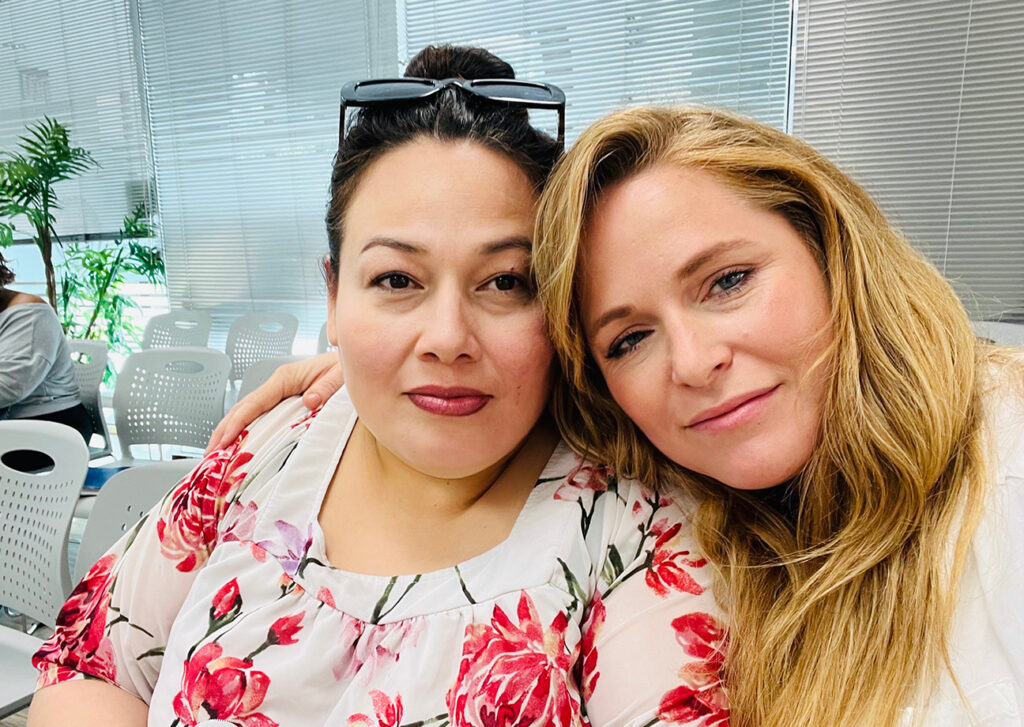
A Georgia mother whose poverty led to the loss of her children is challenging the state’s practice of billing poor parents for foster care in a federal lawsuit that could become a legal precedent for other cases nationwide.
The civil rights suit was filed against the state’s Department of Human Services on behalf of Annalinda Martinez, a mother who lost custody of six daughters in 2018 after she and her children became homeless. Since then, the state has charged her nearly $500 a month for their care, court records show, a fee Martinez says plunged her into debt and hampered her ability to get her children back.
Her lawsuit argues that the state “operates an unconstitutional child support program, in which the biological parents of children in foster care are charged exorbitant amounts of money with no regard for the parents’ inability to pay.” It goes on to describe the human cost of that program: “Inability to pay these child-support charges results in mounting debt, threats of incarceration, delayed reunification, and the denial of the constitutional right to parent one’s children.”
State officials declined to comment on the pending lawsuit or answer questions regarding policies critiqued in the lawsuit.
Georgia amended the practice of billing impoverished parents for their kids in foster care in 2024. But lawyers for Martinez assert the change did not apply to parents with prior cases and that they are still being charged. State statistics published last year by WABE cited roughly 4,000 parents paying such a price.
Martinez never regained custody of her six daughters. But the legal fight, she said, is about more than just her family recouping its lost income. Her attorneys want protections extended to all parents with children in foster care and are seeking to have the lawsuit certified as a class action. They’re also asking for attorneys’ fees and for class members like Martinez to be reimbursed for payments made.
“To have your child taken away, that does something to you,” Martinez said. “I know that at the end of this, this is going to help me, yes, but it’s also going to help other families too, and that’s what I really hope for.”
The lawsuit, filed Aug. 19 against the Department of Human Services in the U.S. District Court for Northern Georgia, also named its divisions of Child Support Services and Family and Children Services (DFCS).
“There are hundreds of other parents trying their best, trying to take care of their kids, that don’t need these unaffordable bills — it’s essentially mandating uncollectible debt,” said Phil Telfeyan, executive director of the national nonprofit Equal Justice Under Law, a legal advocacy organization representing Martinez.
Martinez’s attorneys said this case is one of the first of its kind to challenge child support collection for foster care, and if successful, would become a legal precedent for similar cases nationwide.
“A ruling would not be limited just to Georgia,” Telfeyan said. “It would serve as the first precedent in every other state on how to analyze foster care fees.”
A national policy shift
Child welfare advocates have long argued that poverty unfairly pushes children into foster care. They criticize agencies for separating families instead of helping them address the root causes of their instability.
In recent years, a growing number of states have taken specific aim at policies that involve billing parents for their kids’ time in foster care.
And in 2022, the federal government issued a directive that encouraged states to stop collecting such payments from parents living in poverty.
“It is not in the best interest of any family to be pursued for child support when they have already been whipsawed by economic insecurity, family instability and separation,” the Administration for Children and Families stated.
Following that, more than a dozen states, including California, Minnesota and Washington, passed laws or issued administrative orders limiting the practice, according to Jill Duerr Berrick, a professor of social welfare at the University of California, Berkeley, who tracks the issue.
At least six states, and the city of Philadelphia, went a step further by forgiving overdue payments, also known as arrears, she said. California relieved tens of thousands of residents of up to $400 million in foster care-related debt.
“I would have never thought that I would seek help from an agency that decided to just rip every one of us apart.”
— Plaintiff Annalinda Martinez
Federal data indicates that the policy shifts have already had an effect: Collections for foster care payments nationwide have declined substantially over the past three years, according to Berrick.
Georgia was among the states that shifted its approach and in August 2024, changed its policy. Its child welfare agency would no longer require child-support payments from parents if “reduced income” prevented or delayed a family’s reunification.
But the changes were not applied retroactively, meaning impoverished parents with longstanding cases like Martinez were still responsible for those monthly payments.
“One really interesting irony of our lawsuit is that Georgia already decided that for some parents in poverty, they will not collect these unaffordable foster care fees,” Telfeyan said. “But they’re not applying that policy across the board.”
Child welfare advocate Sarah Winograd finds additional irony in removing children from their homes because of poverty but then adding to the family’s financial instability. Her nonprofit Together with Families raised money to help Martinez with the outstanding debt.
“It’s just a terrible system,” said Winograd, a regular opinion writer for The Imprint. “It’s not doing what the department is tasked to do. It’s not protecting children. It’s not strengthening families. So why is the department still doing this?”
‘My life went to hell’
Martinez’s ordeal began in 2018, when she learned that her ex-boyfriend had sexually abused one of her daughters, according to court filings. She reported the crime and after she testified at his trial, he was incarcerated.
Martinez tried to get by on her own, juggling three jobs to provide for her kids, the complaint said. But without his income, she couldn’t afford the rent. She and her six children were evicted from their apartment in January 2018, and that night, were forced to sleep in their van.
Martinez sought help from Georgia’s child welfare office the next day. Having spent part of her own childhood in foster care without a negative experience, she said she believed this was an agency she could trust.
“It almost felt safe,” said Martinez, who now lives in a suburb northwest of Atlanta.
Martinez hoped the agency would help her find housing — perhaps a shelter that would take her and her daughters in, or a spot on a waitlist for subsidized housing. Instead, caseworkers told her they would be taking her children from her, she said.
“My life went to hell,” she said. “I would have never thought that I would seek help from an agency that decided to just rip every one of us apart.”
Afterward, a court order formalizing her daughters’ foster care placements stated that Martinez would be “responsible for reimbursing all or part of the costs and expenses incurred for the treatment, care and support of the children,’’ according to the lawsuit.
She was also told she could regain custody if she secured stable housing, according to the complaint. But the child support payments made saving money for that goal “impossible,” Martinez said.
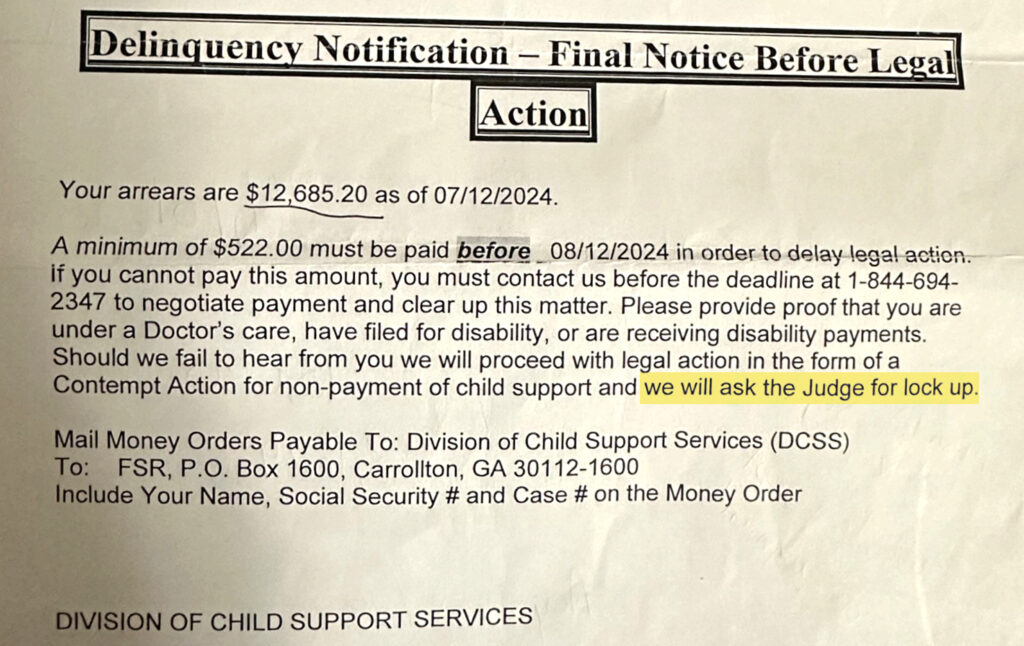
She worked to make payments for years but eventually fell more than $13,000 in debt.
“They suspended her license because she had this debt backed up,” Winograd said. “She took these odd jobs, whatever she could get, and they would garnish her wages.”
With “mounting child-support debt, no hope of sufficient housing and a promise from DFCS” that her daughters would be adopted together, Martinez surrendered her parental rights in May 2023, according to the lawsuit.
The promise to keep the siblings together wasn’t kept, Martinez said. And the child support bills kept coming. Then came the threats.
Winograd remembers the panicked phone call she received last year from Martinez after the mother opened a letter from the Georgia Division of Family and Children Services that threatened jail time if she didn’t address her ballooning debt.
By this time, Martinez had two more children, now aged 3 and 5, and she was terrified of what would happen to them if the state carried out its threat, Winograd said.
“I don’t have anyone to take my two youngest kids,’’ Winograd recalled her saying. “Can you take them?”
Winograd said she assured her: “You’re not going to jail. We’re going to figure something out.’’
Winograd’s nonprofit eventually pulled together more than $16,000 through an online fundraiser to pay off Martinez’ debt and help her with food and rent. Martinez was able to get her driver’s license back after paying the debt, but the donated money only went so far.
Today, three of her children have aged out of the foster care system, two have been adopted and one is awaiting adoption. Despite the fact that only one of them is still in state custody, Martinez is still billed the same amount each month.
She has sought to reduce the payments for more than a year now, but says those efforts have been thwarted by the state as well. Her suit additionally seeks an end to Georgia’s practice of continuing to collect support from parents of children who are no longer in foster care.
“Why are parents being charged for kids that the state’s not even taking care of?” Winograd said. “It just doesn’t make sense.”
Reforming systems, reuniting families
The practice of making biological parents pay for their children’s time while in the state’s custody dates back to 1984, when Congress amended the Social Security Act to allow states to recover some child welfare expenses from parents through child support collections.
Over time, this approach became routine in many states, said Berrick. But, she said, the research shows that, “kids are just much less likely to ever get home if their parents have to pay the state for their time in foster care.”
One study found that a $100 increase in the monthly child support order amount can delay family reunification and extend children’s time in foster care by more than six months. Such payments inhibit parents’ ability to achieve the stability needed to get their children back by making it difficult to afford safer housing or address other inadequate living conditions, according to the research.
The resulting debt can quickly spiral out of control. Unpaid support can accrue interest as high as 12% when it goes to arrears, Berrick said.
“Agency representatives I’ve spoken with across the country are sympathetic to this issue and are very eager to see this policy shift. But they do face formidable barriers.’’
— Jill Duerr Berrick, UC Berkeley professor of social welfare
In the end, Berrick said states only end up seeing about 33 cents for every dollar they spend to recover the money.
For agencies, ending the practice is not a simple task, Berrick said. Doing so potentially requires overhauling outdated systems, manually sifting through cases to identify those with collections or in arrears. It also eliminates a source of revenue.
“Agency representatives I’ve spoken with across the country are sympathetic to this issue and are very eager to see this policy shift,’’ she said. “But they do face formidable barriers.’’
For now, Martinez’s focus is on raising her 5-year-old daughter and toddler son, who turns 3 today. After all she has lost, milestones are especially important to her.
“Because I don’t have my other kids, I like to really celebrate their birthdays, the ones I have at home,” she said.
She wants to throw him a party. But she just sent off her latest child support payment and paid her rent. There isn’t money left for a big celebration, she said.
Even as she tries to rebuild her life with the two young children who still depend on her, she finds it hard to not dwell on what was “torn apart” and may never truly get repaired. She has regained tentative contact with her three eldest children who are now adults, but not the others.
She says she thinks of all six girls every single day.
“Even when I talk to my older ones, it’s still hard,” she said. “Where are my other kids? We always wonder, are they safe? Are they OK?”