
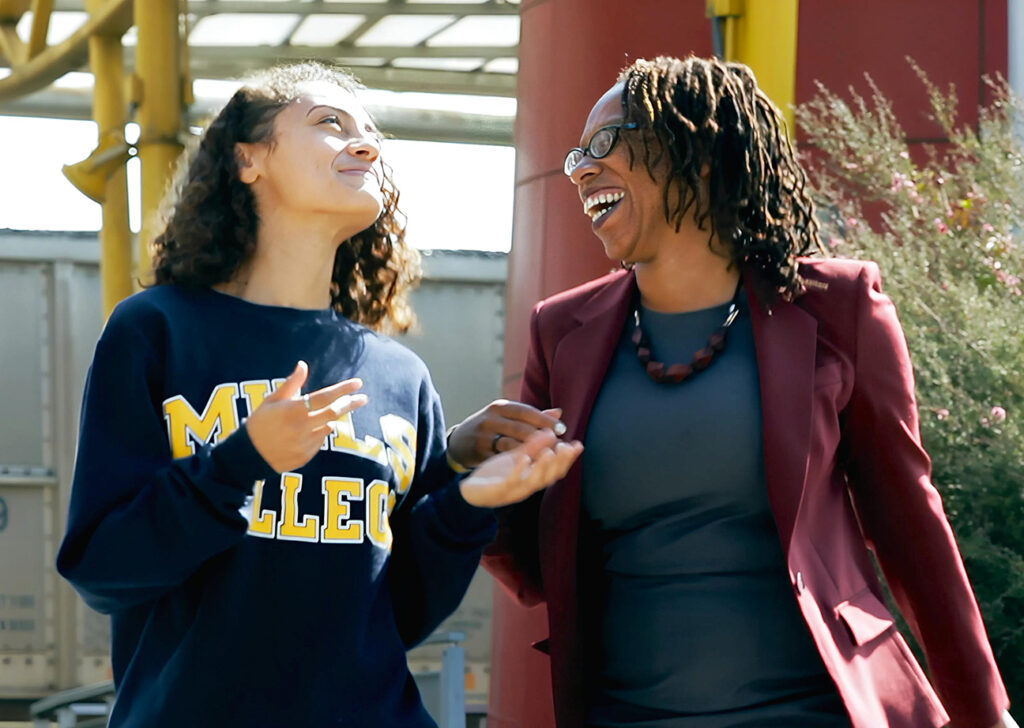
Before she became a leading candidate for a seat in the U.S. Congress representing Northern California communities, Lateefah Simon was “every teacher’s nightmare.” By age 16, she had dropped out of school and landed on probation.
But her fierce determination remained intact.
Simon worked nights at Taco Bell. And as a community health worker, she passed out free condoms and supported young people surviving on the streets. The native of San Francisco’s historically Black Fillmore neighborhood became a mother at 18. And a year later, she was named executive director of the group that would become the Young Women’s Freedom Center. The nonprofit supports young women and trans youth of all genders who have survived foster care, justice systems and community violence.
After a 25-year career in community organizing and civil rights advocacy, Simon, 47, has now set her sights on elected office. She is vying to fill the seat of Democratic Rep. Barbara Lee, a near-iconic figure to many Bay Area progressives who has served as one of the few Black women in Congress since 1998.
In the March 5 primary election, Simon handily secured her spot on the November ballot, earning 56% of all votes cast for California’s 12th Congressional District. The remaining democratic votes were split among eight other challengers vying to represent the cities of Oakland, Berkeley and San Leandro.
Simon, who is African American, is viewed by her supporters as the best choice in a district with a long legacy of powerful Black political leaders that stretches back decades, including former member of Congress Ron Dellums. She is also well known for her work as a civil rights activist throughout the Bay Area. She has been endorsed by The San Francisco Chronicle and Rep. Lee, who mounted an unsuccessful bid for an open Senate seat this year. Simon will face off with educator Jennifer Tran in November.
In 2003, Simon became one of the youngest recipients of the Macarthur Foundation’s prestigious Genius Awards. She went on to earn a bachelor’s degree in public policy from Mills College and a master of public administration degree from the University of San Francisco.
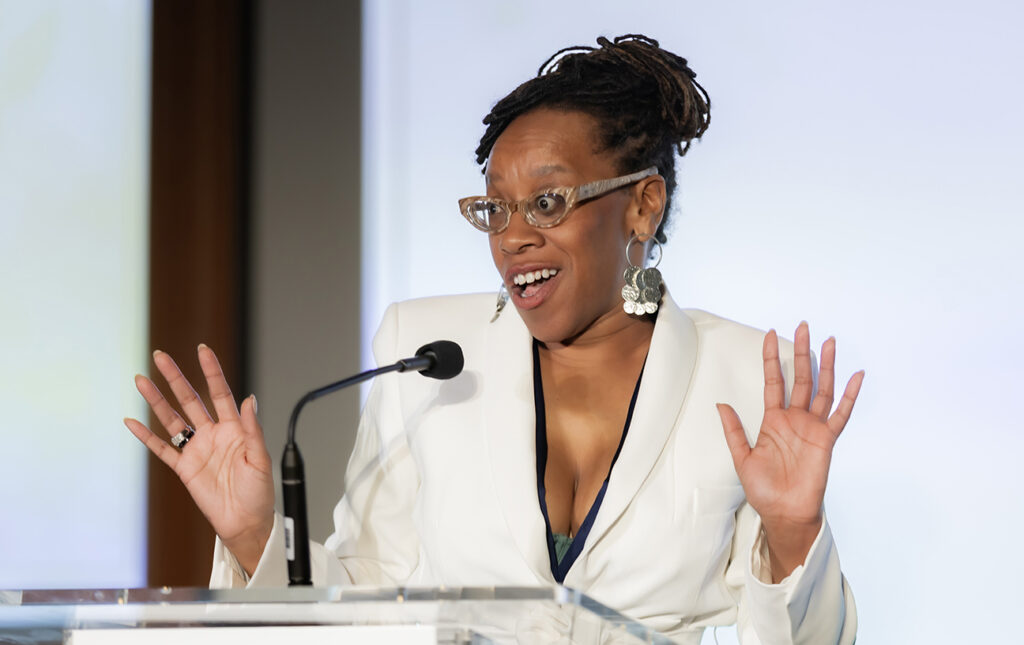
While working with former San Francisco District-Attorney-turned-Vice-President Kamala Harris, Simon developed Back on Track, a program designed to reduce recidivism rates among young adults in the criminal justice system. She also served as the president of the Akonadi Foundation, which funds programs that serve youth of color in Northern California.
Simon, who is legally blind and relies on public transit, was elected in 2016 to a seat on the Bay Area Rapid Transit Board of Directors, where she has worked to promote equitable access to public transportation.
“From her teenage years working to support young women and trans youth, to fighting to make public transit more affordable and accessible, she is a fierce advocate and proven leader,” Rep. Lee said in a press release. “It’s my honor to pass the blue baton to Lateefah, who I trust to stand up for the values of the 12th District, and continue building the broad coalition working together for a better world.”
In an interview with The Imprint, Simon — a mother of two — shared her thoughts on the need for young people who have been through foster care and youth justice systems to have political representation; successful approaches to working with women and girls in the justice system; and the people helping write her policy platform. She calls them her “sister warriors.”
The following interview has been lightly edited for length and clarity.
As you look back on a career that has stretched from street outreach work to the world of philanthropy, what would you count as your proudest moment?
My proudest moment was last night (Feb. 22) at the Young Women Freedom Center’s 30th anniversary, seeing an organization that I helped to develop that has now impacted two generations of young people.
It’s very special, very special, to be able to still be a part of a movement that is led by young people who have been failed by every institution — and in many cases, by their families as well. I’m proud that there is a space and a place for young women to dream, to fight and simultaneously, to just be. The members keep me extremely humble. I’m proud that I’m a part of something larger than myself.
But I can walk 10 minutes from my house, and there are young people who are living in tents. So we still have a lot of work to do.
That work has informed my whole life and will continue when I get into Congress.
Did any of the “sister warriors” have requests or thoughts on your campaign?
I’ve been organizing for the first year of my campaign. I’ve been knocking on a ton of doors and talked to 1,200 people individually. After the primary, the Young Women’s Freedom Center members are building a platform, with all the data that we’ve collected in my organizing during my campaign.
Of course, I’m gonna go to the young people, trans kids, young women, young mothers, that’s who I’m fighting for. We’re going to develop how we’re going to lead and how we’re going to govern together.
“I’m proud that there is a space and a place for young women to dream, to fight and simultaneously, to just be.”
You started organizing with the Young Women’s Freedom Center as a teenager who had dropped out of high school, before becoming the leader of the organization at just 19. What did you learn about yourself about how to be an effective advocate during that time?
I was the worst student. What really kept me in school was debate. I found that competitive debate was a place that I really loved. I loved Model Congress, I loved Lincoln Douglas debate. Those are fights and I literally loved the battle of ideas.
But I was every teacher’s nightmare. Like so many young people, when you don’t have a quiet and safe space to study, it’s hard to succeed.
I was in trouble as a kid, being out all night, and a lot of times not being able to go home. I was really struggling after being put on probation. I was working fast food at night. I dropped out of high school for a while because I was supporting myself. And when I got to the center, I was like, oh my God, I could actually get paid to work with sisters that I’ve kind of been outside with, been in community with.
Can you tell me about becoming a mother while you were heading the Young Women’s Freedom Center?
I had a baby pretty young who’s now all grown up. It’s so funny. My daughter just graduated law school, and she’s four weeks into her job as a prosecutor. She works in the reentry court in D.C. I had that baby on my hip through everything — and she and I, we’ve just raced through it.
I was the first mother at the center, and one of the first organizers. And life was tough back then. The reality is, things feel different now. I’ve gone to college, I’ve gone to grad school — but the communities that I come from haven’t shifted so much. And while I’ve had some personal successes, I really want everybody that I grew up with and everybody that I know, all of us, to be able to pay our bills on time and to not be food insecure, and to have reproductive health on demand.
I can go on and on, but I really know what it’s like to not have a place, to not have a bed, to be sleeping on somebody’s couch. My senior year of high school, we were evicted. I still have nightmares about being homeless, and being in an abusive relationship. Those are very real situations for folks right now who don’t have the luxury of organizing and fighting.
There’s probably very few members of Congress who have dropped out of high school or who have had to experience eviction. What is the power in being able to share that in Washington, D.C.?
Folks have asked me, why are you running for Congress? I have a really good philanthropy job now. But I want to be in the grit fighting for us. Herein lies the challenge to me: it doesn’t feel like it’s gonna be a fun job. I understand nothing happens in Congress. I’m a student of government, and that doesn’t mean we can’t continue to fight.
Through the courts, and through the congressional floor, we have won huge battles, from desegregation to the fights to solidify climate change. There’s so many things that I want to do. And I know that they don’t happen overnight.
“Believe me, I’m not afraid of folks who have demonized and dehumanized people of color, disabled people, queer people. I’m used to that. I’m used to staring across from someone who doesn’t see me as human.”
What should our readers know about the skills you would bring to Congress?
I’ve seen too much not to do it. And frankly, working on the streets as an organizer, spending a lot of time in jails and prisons — sometimes I’ve had to literally fight off pimps from coming into my office when I was running the center. I’m not afraid of any Republicans.
Believe me, I’m not afraid of folks who have demonized and dehumanized people of color, disabled people, queer people. I’m used to that. I’m used to staring across from someone who doesn’t see me as human. So I know it’s not going to be an easy job. And clearly things don’t move fast there, which I know is frustrating. But the cavalry isn’t coming. We have to save ourselves.
In recent years, some states and counties have worked to address the needs of girls and young women in the justice system, something that the Young Women’s Freedom Center has long prioritized. How far do you think we’ve come on this front and what else can these systems be doing?
In our work, we’re constantly talking about the back end of things. I can’t imagine what a Bay Area would look like where housing was affordable and where transportation systems were reliable, and where schools actually loved young women of color.
The reality is that these young women are going to school and they’re being taught by folks who don’t look like them and honestly, who try, but our teachers are no different than anyone else. They’re pushing out their biases and their own racism. Young people are going to school hungry every single day. You can’t learn if there’s a domestic violence issue that just happened in your home the night before.
So we’re at the back end when we’re talking about how do you fix people who have mental health issues, who’ve never been supported and have not had mental health treatment on demand? We’re still dealing with so many of these root causes, like addiction and the lack of affordable houses and their parents.
You’ve described the need for systems to “mandate hope.” What do you mean by that?
In the Back on Track program, where we were working for a district attorney, I mandated holistic care. So either you’re gonna go to therapy, you’re gonna get a gym membership or you have to do something to work on yourself — and we were going to pay for it. It sounds so kooky, but it works.
You need to do something to work out the harshness that you’re surrounded by. I’m gonna work on your housing, and your health care and your child care. We have to really address some of the most basic needs of folks. That is not going to completely end crime, but I gotta tell you, it certainly does halt recidivism when the 360 of anyone who is in trouble is addressed.