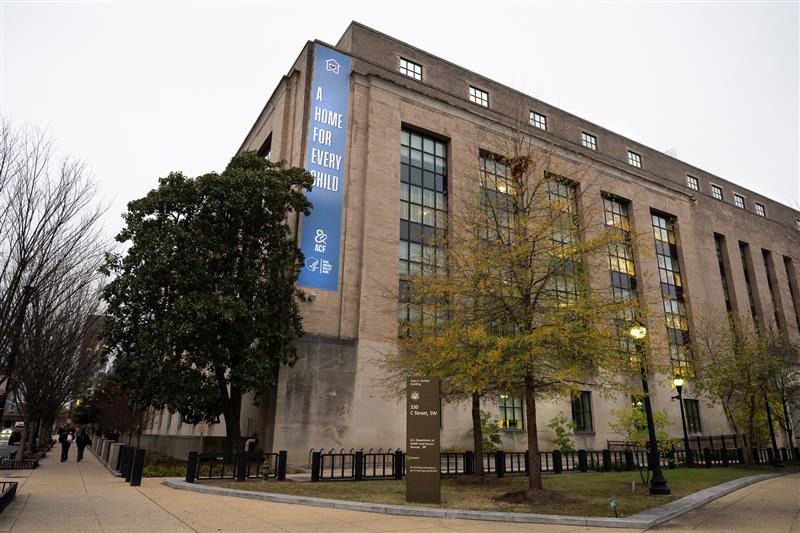


Months after the White House ordered mass layoffs at the federal child welfare agency, 500 workers remain on paid administrative leave, while state and tribal programs serving kids and families are left without support they need to perform mandated work.
In interviews with The Imprint, employees laid off from the Administration for Children and Families said things are “already falling through the cracks” at the agency — which oversees child protective services, Head Start preschools and cash benefits for low-income families — with nearly half the staff gone.
Five of the agency’s 10 regional offices that served 22 states and hundreds of tribes have been completely shuttered, leaving local officials with no one to answer questions about the status of grants, how federal funding can be used and how they must document the services being provided.
The employees requested anonymity for fear of reprisal.
“I still have our constituents contacting me personally, asking: ‘Who do we talk to? Where do we go?’” one laid-off employee from a Western state said. “I’m doing my best to connect them with people that I know, but there’s no real connection for the people in the organizations in my region as to who they’re supposed to be working with.”
A spokesperson for the Department of Health and Human Services did not respond to questions about the dismissals.
Terminations were handed down April 1 to more than 8,000 employees at the Department of Health and Human Services, including roughly 500 from the Administration for Children and Families. They were set to become final on June 2.
But a U.S. District Court judge has delayed final action, leaving the employees — and the local officials who rely on their services — in limbo as the federal government continues to pay them to stay home from the job.
The regional office employee said that in group chats on the encrypted platform Signal, colleagues still on the job describe providing only “the bare minimum” of services the office must give to local governments and grantees.
“I just want to do good work and want to support our constituents out here, and we’re not doing that right now,” she said.
The deputy director of California’s Department of Social Services cited similar concerns in a recent court declaration. Maria Guadalupe Jaime-Mileham reported that her state’s programs had been left without sufficient federal support since the firings.
Her agency was notified that California had been reassigned to the regional office in Denver, but Head Start and other child-serving programs have not been assigned to staff members there, so there is no one to contact for assistance. That has left in the lurch nearly 2,000 sites for Head Start — a preschool program for low-income families managed by the Administration for Children and Families.
California recipients “regularly relied” on federal Head Start staff “for many aspects of the day-to-day operations,” as well as “training, technical assistance, monitoring, site visits, and other support,” Jaime-Milehame wrote to the court. “No such support or technical assistance, whatsoever, has been provided since April 1, 2025.” Since the firings, she added, her state has been unable to “locate” federal workers who have the necessary knowledge of California and federal laws “sufficient to perform these functions.”
The Department of Health and Human Services did not respond to questions about reassignments.
Lawsuit challenges firings
Since Donald Trump’s January inauguration, staff at the Administration for Children and Families (ACF) has been cut by roughly 30 to 40%, according to former employees, legal filings and Democratic senators. The reductions in force have been repeated throughout the federal government, driven by its newly created Department of Government Efficiency, spearheaded by billionaire business tycoon Elon Musk. The goal is described as an elimination of “wasteful bureaucracy.”
The April 1 staff cuts to ACF — a $70 billion division of the Department of Health and Human Services — were quickly challenged in court.
On April 28, a federal lawsuit was filed in San Francisco by local governments in Texas, Maryland, Washington, Illinois and California, as well as 11 nonprofits and three labor unions representing government employees and federal contract workers: the American Federation of Government Employees, the American Federation of State, County and Municipal Employees and the Service Employees International Union.
They allege President Trump acted “in clear excess of his authority” and violated the separation of powers when he issued an executive order calling for a sweeping restructuring of the federal government with the stated goal of “eliminating waste, bloat, and insularity.” They’re asking the courts to declare the action unconstitutional. The lawsuit also states that federal employees left behind in decimated departments have been “injured by significantly increased workloads.”
“We are filing this lawsuit to challenge the hostile takeover of government by billionaires and anti-union extremists. From the mass firings of federal employees to effectively shutting down agencies formed by Congress, this White House has repeatedly broken the law and violated the Constitution to advance their extremist Project 2025 agenda,” AFSCME President Lee Saunders said in a statement.
“After dramatic staff reductions, these agencies will not be able to do what Congress has directed them to do.”
— U.S. District Judge Susan Illston
In court filings, the defendants — which include Trump, Musk, the Department of Government Efficiency (DOGE), and Health and Human Services Secretary Robert F. Kennedy, Jr. — maintain that the president was within his rights to instruct federal departments to shrink their ranks, and that agency heads complied with the law in executing the directive.
“The President has inherent authority to exercise ‘general administrative control,’” of the executive branch, they state in a court filing. “Agencies thus ‘must implement the President’s policy directives to the extent permitted by law.’”
Lawyers for the Trump administration also argue that federal employment disputes are supposed to be addressed outside of the courts. The Supreme Court recently agreed with this argument, siding with the government in a case alleging these firings violated union rules.
On May 22, Judge Susan Illston of the U.S. District Court of Northern California issued a preliminary injunction keeping the terminations from becoming final. All affected employees remain on paid administrative leave until a final decision in the case is made.
In her order, the district court judge wrote that the plaintiffs were likely to succeed in the case, which alleges that the mass firings across the government have been “unlawful” and “unconstitutional.”
“Agencies may not conduct large-scale reorganizations and reductions in force in blatant disregard of Congress’s mandates, and a President may not initiate large-scale executive branch reorganization without partnering with Congress,” Illston wrote, further stating that DOGE has no statutory authority over other departments.
Do you have a story to share about the impact of the mass firings and restructuring at the Administration for Children and Families? Email stiano@imprintnews.org or send us a Signal message at ImprintNews.76
Illston also raised concerns that statutorily required work would suffer if the firings aren’t reversed: “After dramatic staff reductions, these agencies will not be able to do what Congress has directed them to do,” she wrote.
The Trump administration has asked the U.S. Supreme Court to issue an emergency stay on Illston’s ruling and allow the reduction in force orders to continue.
Similar lawsuits pending
The lawsuit is one of many that have been filed against the Trump administration in response to its attempted restructuring or elimination of federal agencies.
In May, attorneys general from 20 states filed a lawsuit asking a federal district court in Rhode Island to reverse the terminations at Health and Human Services, describing them as part of an “unlawful” effort to “dismantle” the department. The Trump administration is opposing the case on similar grounds.
And last week seven fired department employees filed a suit claiming their termination notices were “hopelessly error-ridden” and contained “systemic inaccuracies” as part of a “deep-seated animus toward federal workers.” The suit seeks class-action status and requests monetary damages for an estimated 10,000 impacted employees.
Four fired employees told The Imprint that their notices, and those of essentially everyone they knew, had incorrect performance ratings and time served, affecting their severance pay and viability for future government jobs. Some notices didn’t even have names on them.
In some instances, similar lawsuits and public pressure have resulted in terminated federal employees being reinstated — sometimes briefly — to their positions. Probationary health and human services employees who had been terminated in February were reinstated by a California district court judge — until the Supreme Court granted the administration’s request to halt the rehiring while the case progressed.
In May, after Trump issued an executive order calling for the Department of Education to be dismantled, a federal judge in Massachusetts blocked the administration from terminating its entire staff.
Michael Fitzgerald and John Kelly contributed to this reporting.