
As the Eaton Fire bore down on his family’s home, Alexander Ballantyne remained vigilant throughout the night. While the sky filled with smoke, he recounted, the 25-year-old monitored the Watch Duty app, and kept hitting refresh on his computer in search of updated evacuation orders in his Altadena neighborhood in Los Angeles County.
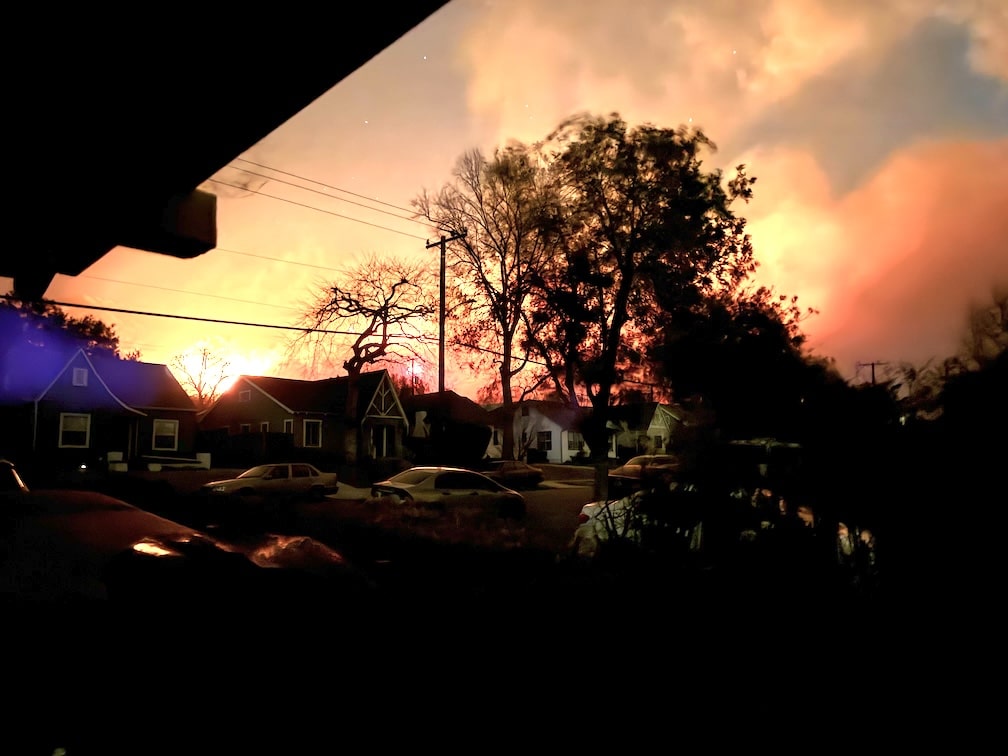
At 3 a.m. on Jan. 7, the raging wildfire was no longer distant. It lit up the San Gabriel Mountains above Harriet Street. Sleeping nearby were his elderly uncle and aunt, who suffers from multiple sclerosis, and another aunt who had taken refuge with them.
Suddenly, smoke billowed into the house. Ballantyne roused the two women and grabbed his aunt’s wheelchair, headed to the Ford Bronco. Fearful of looters, his uncle stayed behind for a short time, and ended up virtually licked by flames.
Their family’s home was gone, he told his nephew a short time later in a nearby Macy’s parking lot on Lake Street.
Reflecting on how he managed this tragedy, Ballantyne recalled earlier hardships that had prepared him.
“My experience in foster care kind of made me more suited for stuff like this, just in terms of having to be adaptable, and having to change in a split second,” he said. “The way I looked at it from day one is that materials can be replaced. I’m just thankful we all got out with our lives.”
According to the Los Angeles County Department of Children and Family Services, The Imprint has learned, 199 children and youth in foster care were displaced by the epic wildfires that have torn through the region since Jan. 7. None have been injured in six fires, authorities report.
The tally includes 33 children and young adults who lost homes in the Eaton Fire in Altadena. Of the hundreds evacuated, dozens have now returned home. But still others have had to live elsewhere due to the poisoned air, now filled with a toxic stew of heavy metals, asbestos and arsenic. Heavy rain on Sunday has also brought a risk of mudslides in areas affected by the fires.
“YOUNG PEOPLE IN FOSTER CARE HAVE ALREADY FACED IMMENSE CHALLENGES, AND THIS DISASTER HAS ONLY ADDED TO THEIR STRUGGLES — FORCING THEM TO NAVIGATE THE UNCERTAINTY OF LOSING THEIR HOMES, BELONGINGS, AND SENSE OF SECURITY. THE TRAUMA OF DISPLACEMENT AND THE DISRUPTION TO THEIR EDUCATION AND SUPPORT SYSTEMS WILL REQUIRE ONGOING ATTENTION AND CARE TO ENSURE THEY CAN HEAL AND CONTINUE MOVING FORWARD.”
— Children’s Law Center Executive Director Leslie Heimov
Many more former foster youth, like Ballantyne — as well as caregivers and professionals in the nation’s largest local foster care system — have also been impacted. Children’s attorneys have lost their homes. Family visits with kids in out-of-home custody have been upended, and youth have had to flee residential treatment centers, leaving behind all their earthly possessions and fleeing on a moment’s notice. One facility run by Bourne Family Services was completely destroyed.
Twelve county employees serving foster youth have had homes destroyed, and 108 remain displaced.
The Children’s Law Center of California, which represents roughly 20,000 children in the county’s child welfare system, was also hard hit by the fires. In addition to the hundreds of child clients impacted, six staff members have lost their homes.
Executive Director Leslie Heimov is most concerned for the foster youth. Even after they head back to familiar routines, she said, they will require additional support, above and beyond already weighty needs.
“Young people in foster care have already faced immense challenges, and this disaster has only added to their struggles — forcing them to navigate the uncertainty of losing their homes, belongings, and sense of security,” Heimov said in an emailed statement. “The trauma of displacement and the disruption to their education and support systems will require ongoing attention and care to ensure they can heal and continue moving forward.”
Department of Children and Family Services Director Brandon Nichols echoed a similar theme, and pointed to a theme of resiliency that is also ever-present in this population.
“The loss and devastation in communities leveled by this disaster is overwhelming,” he said. “While I recognize the deep trauma that comes with losing a home, I firmly believe in the power of family, faith and community to heal and rebuild.”
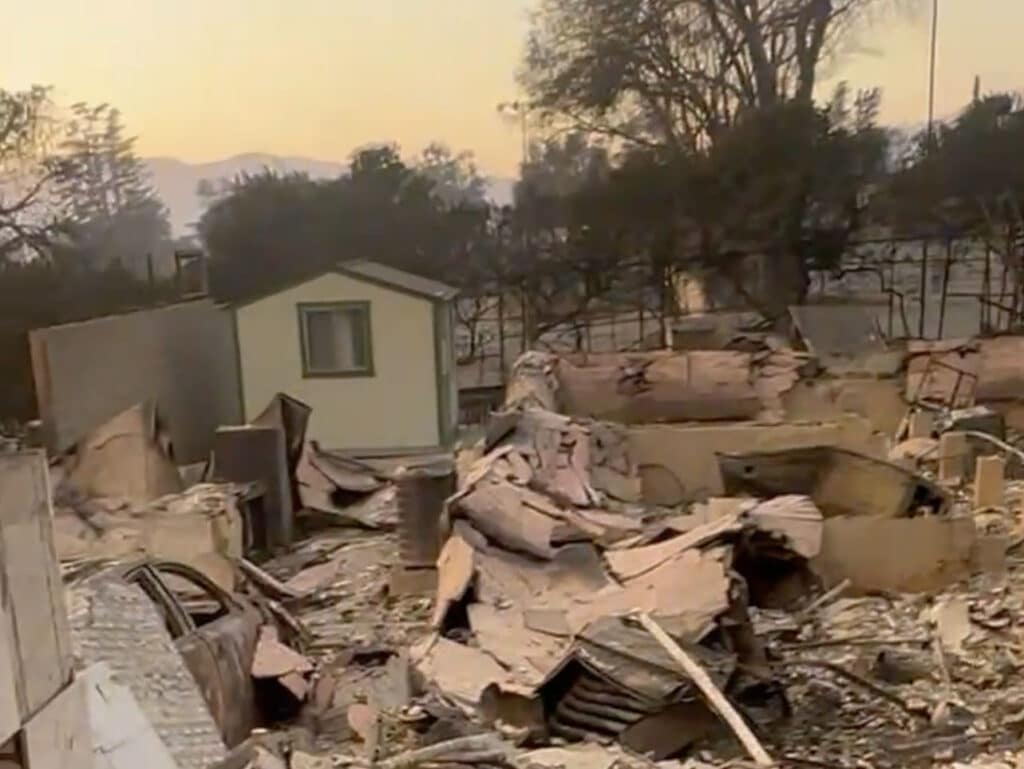
Nearly three weeks have passed since a cataclysmic wave of wildfires first besieged Los Angeles County, annihilating whole neighborhoods from the coastal Pacific Palisades neighborhood to Altadena, nestled in the foothills of the San Gabriel Mountains. The fires erupted because of bone-dry conditions and extremely high Santa Ana winds, which ignited multiple fires throughout the region and inhibited firefighting from the sky that could have dampened the lightning-speed spread.
Roughly 40,000 acres have burned so far, and more than 15,000 structures have been destroyed, according to Los Angeles County officials. Twenty-seven people have perished in the fires so far, and dozens more are still unaccounted for.
Susanna Kniffen, senior director of child welfare policy at Children Now, anticipates that foster youth impacted by the fires will face unique struggles in the weeks and months to come. She speaks from experience. In a drought-plagued state and a globe succumbing to climate change, her Oakland-based nonprofit has served youth and providers survive other state wildfires, including the 2017 Tubbs Fire in three Northern California counties and the 2018 Camp Fire in Butte County.
“In the aftermath of a disaster, it can be difficult for youth and caregivers to connect with social workers and social services agencies in their area as they may be stretched thin or struggling to manage their own circumstances,” she said. “Relocation may disrupt regular visitation with biological family members, connections to trusted therapists, and access to critical community supports.”
Destructive fires can be especially difficult for young adults leaving foster care, who rarely have accumulated savings, she added. Trusted adult connections and community organizations may suddenly have even less capacity to help.
In L.A. County these days, frontline workers are stretched thin.
Teri Badia, the county child welfare agency’s deputy director in the bureau that includes Pasadena and Altadena, said social workers have been performing some heroics in recent weeks.
On Jan. 7, as the fires began their destructive fury, Badia said the agency was tracking the fires’ path. When evacuation orders were first issued, she asked her social workers to check in on all families in the area, and make in-person visits with all those who had been evacuated.
One social worker caught up with a family at a shelter, where they were seeking refuge after fire destroyed their home. She connected them to resources available through the Foster Care Project at All Saints Church in Pasadena, as well as temporary housing — a key challenge for many families in a region with already sky-high real estate costs.
“These next few months are going to be tough, but this is just another reset for me. But I’m still me, I’m still Alex, I’m still transferring. I look at it as, like, there’s no other option. I can’t stop moving forward in my life because of this fire.”
— Alexander Ballantyne
Meanwhile, some of the workers themselves had lost homes or access to child care. One employee recounted why he showed up back at the office:
“He told me, ‘I need to come to work,’ and that being at home is just too sad, thinking about how he lost everything,’” Badia recounted. “This is a part of our creed as social workers — we serve in times of need.”
The process of mourning is already underway for some former foster youth. Mariah Hernandez, a former foster youth and adoptee, lost her family’s home on Olive Avenue in Altadena — a place of warmth and connection for family members and all types of children. Her parents served as foster parents to more than 100 young people over two decades, while running a home day care. Her parents retired from the business and fostering several months ago, but continued to welcome those who had grown up there.
Hernandez, now a teacher in Redlands, said her mom nurtured generations of children from her kitchen, a centerpiece of a loving home that is now ashes.
“The kitchen — always full of laughter, of people, of the whistling from the kettle on the stove as it boiled water for the coffee, of pots and pans on every countertop, some empty and dirtied, others filled with rice and beans to eat throughout the day for anyone to grab at any moment,” she wrote on a Gofundme campaign for her family.
Hernandez began staying at the family’s home at age 7, before being adopted five years later. She said she is grateful her family is all safe and avoided injury from the Eaton Fire. Her sister’s family and her parents are now living at her sister’s home in nearby Arcadia.
But some prized possessions will be missed by her mom in particular, Hernandez added. Those include a picture of her brother in his Navy uniform, and a misshapen ceramic cup Hernandez made in high school. Her mom had cherished it, placing it on a bedroom windowsill to display flowers.
For his part, Ballantyne is now staying in Santa Clarita, where he feels “blessed” to be able to stay with relatives while many others remain in shelters or motels. Despite the outbreak of the newest Hughes Fire on Wednesday, his family is safe.
Like many other victims of the wildfires, he has launched a GoFundMe campaign to assist his elderly relatives.
He is also recovering. Days after the fire, his eyes continued to burn from smoke exposure. And for a week after escaping the fire, his mucus was black he said.
But Ballantyne has also stayed steady. He is a full-time student at Pasadena Community College and says instructors there have been “incredibly understanding,” extending due dates on assignments and letting him work at his own pace on some classwork.
He is on the brink of a long-awaited goal and not about to be derailed: attending a four-year college. Ballantyne said he was homeless at age 18 after graduating high school, and ended up couch surfing and sleeping in break rooms and cars. All his possessions at that time fit into a box, and they were eventually lost during that chaotic time.
Ballantyne is now just one semester away from completing his community college courses, and has been accepted to California State University, Northridge and California State University, East Bay. He is eagerly awaiting news from other colleges. He hopes to major in business or nonprofit management.
“These next few months are going to be tough, but this is just another reset for me. But I’m still me, I’m still Alex, I’m still transferring,” he said. “I look at it as, like, there’s no other option. I can’t stop moving forward in my life because of this fire.”