The Trump administration’s call for a funding freeze could total hundreds of billions of dollars, with sweeping impacts on social safety net programs serving children and families. Under threat: child protection and juvenile justice, private foster family agencies, homeless shelters and nonprofits providing foster care services.
UPDATE: On Wednesday, the Washington Post and New York Times reported that the White House budget office has “rescinded” its previous memo freezing federal social services grants. The Imprint will continue to inform readers on further developments.
In a swipe at social spending that stunned state and local officials and advocates for the poor nationwide, the Trump administration ordered a halt to virtually all federal spending on social services, issuing a directive that sought to freeze hundreds of billions of dollars in federal funding.
The memo released from the Office of Budget and Management Monday night that remained in place for more than a day before the courts temporarily intervened calls for a near-immediate pause on all agency “grant, loan, and other financial assistance programs” — much of which focuses on keeping struggling families intact. The spending freeze could have affected monthly checks allowing grandparents to take in kids from foster care, programs helping mothers and fathers reunite their broken families and housing stipends that keep teens raised in state custody off the streets.
In a separate document, the office detailed federal programs subject to the freeze, including Title IV-E of the Social Security Act, which funds foster care, as well as adoption assistance, child abuse and neglect block grants, and programs designed to educate young adults aging out of the child welfare system.
Myriad other social supports that millions of families rely on are also on the list: Head Start, which provides early childhood education to low income families; the Special Supplemental Nutrition Program for Women, Infants, and Children — or WIC — which provides nutrition and healthcare to pregnant women and their babies and young children and Section 8 housing vouchers.
“Families across the country are wondering whether their child’s preschool is open, whether they can take their child to the doctor, or whether school meals are still available,” First Focus on Children President Bruce Lesley said in a statement.
An analysis by his bipartisan advocacy group estimates that as much as $329 billion in funding for the nation’s neediest children appears to be in danger.
“The Administration has injected fear and despair into families who depend on services — which, by the way, they’ve paid for with their taxes — to care for their children.”
The rationale for the Trump administration’s extraordinary directive was outlined by the Office of Management and Budget’s acting director Matthew Vaeth.
“The hardworking people who look out for others in their communities are at risk of losing their livelihoods because the Trump Administration has put more focus on cutting taxes for its billionaire allies than protecting children, seniors, veterans, and millions of other Americans.”
— Statement from the Center for Law and Social Policy
He stated that the move was part of the incoming administration’s efforts to eliminate “Marxist equity, transgenderism, and green new deal social engineering policies.”
“This temporary pause will provide the Administration time to review agency programs and determine the best uses of the funding for those programs consistent with the law and the President’s priorities,” Vaeth wrote.
The announcement was instantly applauded by Republicans across the country, who now control both houses of Congress and head up 27 statehouses.
“The State of Texas fully supports President Trump’s efforts to cut waste, fraud and abuse, and eliminate funding for DEI and radical gender ideology initiatives,” Gov. Greg Abbott’s press secretary, Andrew Mahaleris, told The Imprint in an email. “This pause in funding will bring transparency to federal spending and is long overdue. Taxpayer dollars should be used to help taxpayers.”
Rep. Tom Cole of Oklahoma, who chairs the House Appropriations Committee, told reporters that he saw the directive as a “legitimate exercise of executive oversight.”
“The State of Texas fully supports President Trump’s efforts to cut waste, fraud and abuse, and eliminate funding for DEI and radical gender ideology initiatives.”
— TEXAS GOV. GREG ABBOTT
“I think that’s probably what you ought to do when you’re coming in as a new administration,” Cole told CNN’s Manu Raju, adding that “appropriations is not a law, it’s the directive of Congress.”
But minutes before the pause was set to take effect at 5 p.m. ET today, a federal judge blocked parts of the order from taking effect. Under the administrative stay ordered by District Court Judge Loren AliKhan, the administration cannot suspend any funds appropriated by Congress. The stay expires Feb. 3, and a hearing on the issue has been set for Monday.
Full impact and legality unclear
The government has ground to a halt eight times since 1981, all due to Congress failing to reach a spending deal or a president vetoing such an agreement. Another funding cliff looms on March 14, the next point at which the government is set to run out of money.
But critics say the Trump administration’s attempt to halt the flow of money that has already been approved is illegal. In interviews today, numerous policy experts and advocates pointed out that Congress has exclusive power to approve spending, and that the executive branch cannot unilaterally take the actions it proposed.
“What the law allows and what this administration is doing are different things. I think he’s prodding to see what he can get away with and what will get pushed back,” said Sean Hughes, who leads government relations for the consulting firm Social Change Partners.
Hughes added that the administration can put a hold on discretionary spending, but not mandatory payments like those made to child welfare agencies through Title IV-E to pay foster and kinship families.
Some political leaders called the move more bravado than true policy.
Rep. Jonathan Windy Boy of Montana, a member of the Chippewa Cree Tribe, expressed doubt that the move would be successful and likened the attempt to “school bullies on the playground.”
The funding pause is on hold at least until Monday’s hearings, and may well be largely tied up in the courts for much longer, policy analysts speculated.
But multiple lawsuits have already been filed by the National Council of Nonprofits, the American Public Health Organization and Main Street Alliance, which represents small businesses. Multiple states and tribes have also indicated they intend to sue the Trump administration over the spending freeze called for on Monday.
“This memo will have a devastating impact on hundreds of thousands of grant recipients who depend on the inflow of grant money (money already obligated and already awarded),” the lawsuit filed today in the Washington D.C., district court states, which they use to “improve the day-to-day lives of the many people they work so hard to serve.”
A coalition of Democratic attorneys general from 23 states, including California, New York, Arizona and Hawaii have also filed suit.
While the administration indicated that the pause would be temporary, a statement released by the D.C.-based Center for Law and Social Policy warned that even a short- term loss of funding could be catastrophic for programs that may be unable to cover payroll or rent in the interim.
“The hardworking people who look out for others in their communities are at risk of losing their livelihoods because the Trump Administration has put more focus on cutting taxes for its billionaire allies than protecting children, seniors, veterans, and millions of other Americans,” the statement read.
“The hardworking people who look out for others in their communities are at risk of losing their livelihoods because the Trump Administration has put more focus on cutting taxes for its billionaire allies than protecting children, seniors, veterans, and millions of other Americans.”
— Statement from the Center for Law and Social Policy
Government and child welfare leaders sound the alarm
There’s little disagreement however. If the pause in funding goes into effect, it would have sweeping impact on essentially all of the social safety net programs serving children and families: child protection and juvenile justice, private foster family agencies, homeless shelters and nonprofit organizations serving families in the foster care system or those at risk of entering.
Many of these programs are paid for with a combination of federal and state dollars. Some state leaders expressed deep dismay over what the loss of funds would mean for vulnerable families in their states.
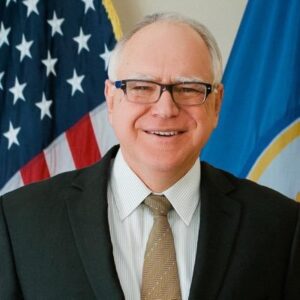
“Minnesota will do what we can to keep the lights on, but we cannot fill the nearly $2 billion hole this will put in the state budget each month,” Gov. Tim Walz said in a press release. “Shutting off this funding will have a devastating impact on peoples’ lives – from cancer patients, to securing our prisons. President Trump is leaving states out in the cold without any guidance or explanation.”
Walz said he believes the move is unconstitutional, and indicated that his state would sue the administration.
New York Gov. Kathy Hochul echoed Walz’ concern: “No state on their own is going to be able to backfill the loss of billions of federal dollars. That’s not possible,” she said at a press conference Tuesday.
But Hochul took a more circumspect tack regarding the legitimacy of Tuesday’s announcement, giving a nod to past actions that have been publicity-attracting but had little substantive impact:
“I’m not playing whack-a-mole with every single initiative that comes out of Washington. We will deal with the issues when they become a reality.”
Hochul noted that she is also working with state Attorney General Letitia James on possible litigation strategies.
In the immediate aftermath of the announcement, little is clear about precisely how specific groups and local governments will be affected. But some details were starting to come to light.

Jeremy Kohomban, CEO of Children’s Village in New York, said funding for their migrant children’s program will be impacted. His staff have been looking for ways to fill the funding gaps to avoid any interruption of care for the children, but he noted that reunifying them with families can’t happen without federal approval.
His organization and others are in the dark as to how to proceed, he said.
“We were unprepared for the barrage of broadly worded executive orders, the related MOUs freezing funding, and our inability to identify anyone in DC able to provide guidance or answer simple questions,” he said. “What happens to the children?”
Alex Briscoe, a principal with Public Works Alliance, said the Trump Administration had a fundamental misunderstanding about how local safety net systems provide services such as ambulances, homeless care, special education, medication for children in foster care and care for children with cancer, among other key programs for vulnerable populations.
“Politics shouldn’t matter when we’re talking about how fast the ambulance can get there, or what a suffering child requires to stay alive,” he said in an emailed statement.
Briscoe, a well-regarded expert on Medicaid services who presented his work on children’s mental health at a White House Summit last October, said he hoped a “compassionate fix” would be forthcoming and that fights over funding safety net services would be spared from a divisive national discourse.
Tribal child welfare impacts
Another yet-unknown facet of this funding pause is how it would affect tribal governments, many of which operate their own child welfare and safety net programs with support from the federal government.

The funding that tribes receive for Indian Health Services, tribal child welfare programs, as well as funding specific to education and land management needs could all be in jeopardy, according to the Office of Management and Budget’s memo. Each tribe will need to assess how their programs have been affected, said Kate Fort, director of Clinics at Michigan State University College of Law.
In a statement sent to The Imprint today, a spokesperson for the Department of the Interior — which is tasked with honoring the “nation-to-nation relationship with Tribes” — said it is “reviewing a number of actions to implement President Donald J. Trump’s Executive Order.”
“This is a devastating blow to vulnerable families in the CPS system who depend on these resources in order to reunify with their children. Without these entitlements, it will take longer to reunify families and could possibly result in permanent family separation. As families lose these benefits and as a result, lose housing, food, and medical care, we are likely to see an increase in CPS case filings.”
— SANTEE SIOUX ATTORNEY ANGELA BIBENS
Meanwhile, Santee Sioux attorney Angela Bibens, who runs a private practice in Colorado, is worried about the bottom-line impact such a freeze could have on the vulnerable families she serves.
“This is a devastating blow to vulnerable families in the CPS system who depend on these resources in order to reunify with their children,” Bibens said. “Without these entitlements, it will take longer to reunify families and could possibly result in permanent family separation. As families lose these benefits and as a result, lose housing, food, and medical care, we are likely to see an increase in CPS case filings.”
Frozen Programs
Below is The Imprint’s annual chart of federal appropriations for youth and family programs. We have confirmed that all of the programs on this list are subject to the freeze initiated by the Trump administration