

Much attention was given to the executive order on foster care issued by President Trump on Nov. 13, which he signed surrounded by First Lady Melania, Vice President JD Vance, several cabinet secretaries, and scores of invited guests.
The executive order advances some ideas and actions around foster care specifically, but begins, “My Administration is dedicated to empowering mothers and fathers to raise their children in safe and loving homes.”
On the same day, Nov. 13, a Trump-adjacent policy shop issued a treatise that might be viewed as the fleshing out of that one preamble statement in the executive order. And it’s a doozy.
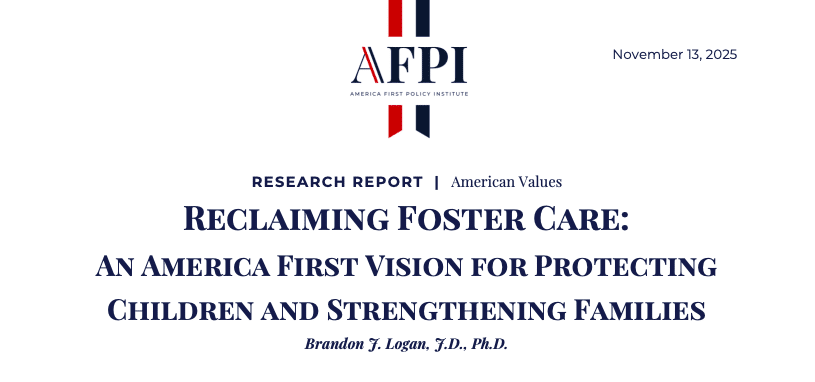
“Reclaiming Foster Care: An America First Vision for Protecting Children and Strengthening Families,” was published by the America First Policy Institute, a think tank closely aligned with the administration that was founded and is led by former Trump officials. It prescribes some big picture solutions springing from the premise that the current child protection process has led to oversurveillance, a lack of community support for families, and consequently, the separation of too many children from their families.
The vision, as written by the paper’s author, Brandon Logan:
“Today’s child welfare apparatus operates on the assumption that government agents — armed with checklists, risk assessments, and professional credentials — are better equipped than parents to determine a child’s best interests. This inversion of rightful authority has created not just constitutional violations but human tragedies, as children are traumatized by unnecessary removals and families are destroyed by state intervention.
To be clear, some parents do fail in their duty to protect their children from serious harm, but this reality does not justify treating all parents as suspects or defaulting to state control rather than family support.”
You can read the entire 21-page paper here. At its core, it expresses a desire to shift more responsibility and federal money into community-led efforts to prevent families from entering the kind of crises that find them in the orbit of child welfare systems. Such a network existed before there were government social workers and systems, the paper states, and that network must be rebuilt.
Is it official Trump policy? No. But this shop is closely aligned with the administration, and it certainly does not seem like a coincidence that it was released on the same day as the executive order.
Among the suggestions it offers in that direction…
Earlier guarantees of legal counsel
Some states still do not mandate that lawyers are provided to all parents involved in child welfare proceedings. The majority do, but only at the point a child either has been separated or the prospect of that is on the table.
The “Reclaiming Foster Care” paper calls for what has generally come to be known as pre-petition legal counsel. “Parents and children must receive immediate access to legal representation before any removal occurs, ensuring these limitations on government authority are enforced,” it says.
It is worth noting that federal funds for legal counsel (for both parents and children) was unleashed during the first Trump administration, and then further embedded in federal policy by the Biden administration.
Overhaul of Title IV-E
Title IV-E is the biggest flow of federal funds to states for child welfare. It can be drawn down through reimbursement to cover the costs of foster care, adoption subsidies, services aimed at preventing foster care, and the administrative costs related to all of those things.
The reach of this federal entitlement has been weakened over time due to some archaic income eligibility tests dating back to the 1990s. But this paper argues that the structure and size of IV-E steers the policies and actions of states toward an unnecessary amount of removals into foster care and placements into adoption or guardianship arrangements, as opposed to reunification.
The solution, per Logan’s missive: Take IV-E, combine it with all of the other dedicated federal funding streams for child welfare, and turn it into a large block grant that states can use freely to administer their systems. And since that is unlikely to happen quickly, if ever, he argues that Congress should more immediately “eliminate the categorical restrictions and allow states maximum flexibility in using federal funds for family preservation, legal representation, kinship navigation, and voluntary community programs.”
He also suggests that the Trump administration should use executive orders and its authority to regulate programs to “maximize state flexibility.”
Community-Led Operations
In 2023, Nora McCarthy wrote a series of columns for The Imprint envisioning a paradigm where much more of the responsibility of keeping kids safe was shifted from government systems into the hands of the community. In this paper, Logan describes Community Care Compacts as a means to achieve this, which he explains is a formal alliance of “churches, nonprofits, and civic organizations that assume primary responsibility for child protection in their regions.
These compacts would operate “parallel to, not under,” government-run child welfare agencies. The paper cites some examples to work from in building such an entity, including Florida’s privatized system, which features Community-Based Care agencies that manage large swaths of the state (Logan argues this system worked well when Florida had a IV-E waiver that kept its funds flexible), and the 100 Families initiative in Arkansas.
Related to this, but more of a state-related recommendation, is what the paper argues describes as “legitimizing non-state care arrangements.” This refers to programs such as Safe Families for Children, which facilitates voluntary, temporary placements of children that are sought out by parents. Safe Families and other respite or relief care organizations already operate in plenty of states, but Safe Families met notable pushback in New York when it sought approval to expand there in the early part of the decade (ultimately, they did gain approval).
End the Use of Youth’s Benefits to Pay for Foster Care
As we reported some weeks ago, Alex Adams, Trump’s new leader at the Administration for Children and Families, voiced his intent to rein in the use of Social Security disability and survivor benefits by state and local child welfare agencies. In a letter to state child welfare directors, he said he would “actively and expeditiously work to curb this abusive practice to ensure vulnerable youth have the resources they need to succeed.”
This paper takes the same view: “The practice of states claiming foster children’s Social Security benefits, survivor benefits, and other federal payments must end immediately.”
Remove Federal Timelines to Permanency
The Adoption and Safe Families Act, passed in 1997, first introduced terminations of parental rights into federal policy. The rule, per the law: if a child has been in foster care for 15 of the past 22 months, states must initiate a termination of parental rights. There are some notable exceptions, including for children who are living with relatives.
“Reclaiming Foster Care” argues that states “should be freed from federal timelines that force premature termination proceedings.” Permanency plans should instead be individualized.
A bill to remove these federal timelines in most cases was introduced in the House in 2021 by California Democrat Karen Bass. That went nowhere, and Bass left Congress soon after, having been elected mayor of Los Angeles.