
More low-income families in New York City can now enroll in a prenatal and early childhood program that connects families with registered nurses who conduct home visits, providing “small moments of guidance and medical insight” that can be invaluable.
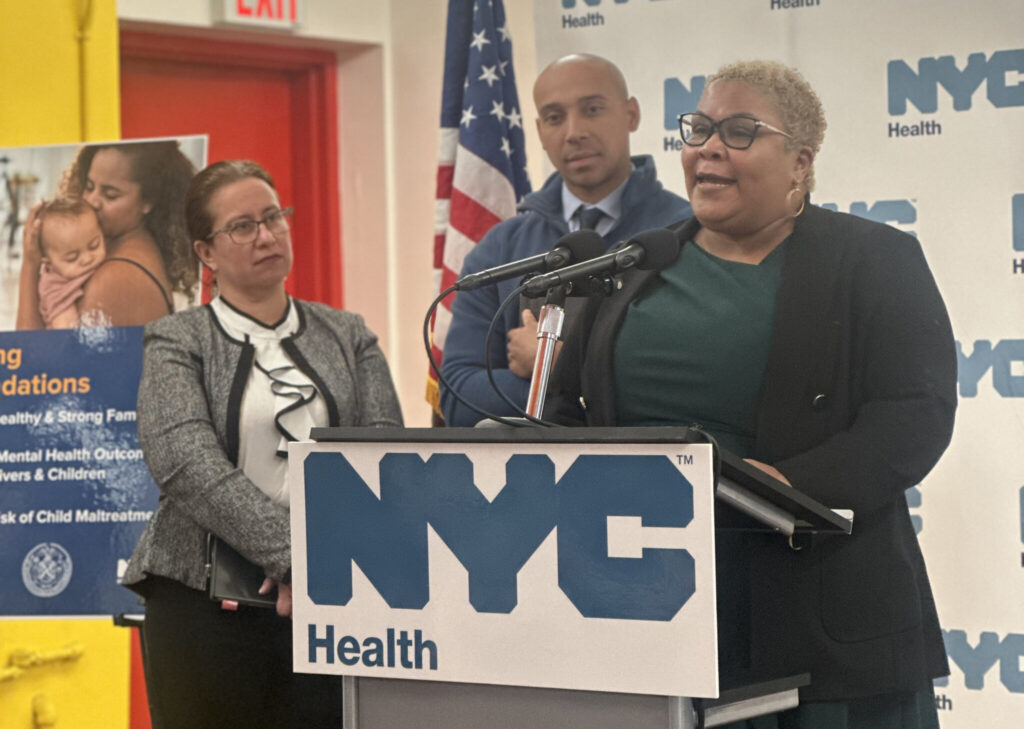
Ana Maria Ramirez, an RN in the program, shared these and other insights about the Nurse-Family Partnership outside East Harlem Neighborhood Health Action Center at a Friday press conference.
“You can’t measure the value of a listening ear for a mother’s frustrations — or being able to stop all the noise and anxiety around them by reminding them that their baby is their motivation — or teaching how to play with their baby, or take care of themselves while they navigate a major change in their body and mind,” Ramirez said.
City officials and local residents are highlighting an initiative called Strong Foundations, a $20 million expansion of the Nurse-Family Partnership that has been operating since 2003. The collaboration between the Administration for Children’s Services and the Department of Health provides Medicaid-eligible mothers from pregnancy through a child’s second birthday with postpartum mental health support and lessons on breastfeeding and safe sleep. The program prioritizes new mothers in families that face barriers to health care and stable housing, and who have been involved in the child welfare or criminal justice systems.
“All parents deserve access to high-quality prenatal and perinatal care.”
— New York City Mayor Zohran Mamdani
Under the recent expansion, parents with more than one child are now eligible for the home-visits. The initiative will also fund more training and job opportunities for early childhood staff and mental health professionals.
“All parents deserve access to high-quality prenatal and perinatal care,” Mayor Zohran Mamdani said in a press release. The new offerings, he added, “will ensure that all New Yorkers, and particularly those who face structural barriers to care, are provided with the resources they need at the very beginning of their child’s life.”
The Nurse-Family Partnership program has worked with over 25,000 expecting parents in the last 20 years, and city officials stress it is especially critical for families in Black and brown neighborhoods, where access to health care is often lacking.
“We will use this program to help increase higher rates of breastfeeding, childhood immunization, and more importantly, make sure that our families keep growing nice and healthy,” Deputy Mayor for Health and Human Services Helen Arteaga said.
On Friday, a mother who participated in the program two years ago told the dozens assembled how nurse Ramirez helped her navigate her first pregnancy while she was living alone in a family shelter, “struggling with loneliness and depression.” Jackie Rodriguez spoke publicly with her 2-year-old daughter. The toddler clad in a pink dress played with a wooden toy maze as her mother spoke about losing her own parents a few years earlier.
“I always thought I would have my mom with me, and facing pregnancy without most of my family, in a difficult housing situation, was really overwhelming,” Rodriguez said. “It’s amazing to know that more families like mine will be able to benefit from the program.”
In addition to connecting more parents with visits from registered nurses, the health department also plans to use the funding over three years to increase staffing at the city’s five perinatal and early childhood mental health clinics, and to create a fellowship for health care providers to support families with young children through a “culturally sensitive and trauma-informed” lens.
“I always thought I would have my mom with me, and facing pregnancy without most of my family, in a difficult housing situation, was really overwhelming. It’s amazing to know that more families like mine will be able to benefit from the program.”
—Jackie Rodriguez, mother who participated in Nurse-Family Partnership
Nurse-Family Partnership is available in most states in the country, and national evaluations of the program found some improvements in maternal mental health as well as fewer language delays among children of the participants, when compared to those not in the program. Mothers also relied less on food stamps and experienced better economic mobility.
But researchers are divided on the program’s impact on reducing child maltreatment. Some studies have found that home-visiting programs had a negligible impact on reductions in injuries and hospitalization of children.
In her city, Luisa Linares, deputy commissioner for the Family Services division of the Administration for Children’s Services, said the agency heard firsthand from parents with young children that they wanted to be connected to prenatal health care in their communities, without risking child welfare involvement. She described the Strong Foundation as setting a national example “that city agencies can work together to do right by families.”
“Supporting families and connecting them to prenatal early childhood services outside child welfare, extremely makes sense,” Linares said. “We will improve caregiving and child health outcomes, promote child well-being and ensure healthier families and stronger communities.”
Nurses in the program go beyond helping women navigate pregnancy and postpartum care or providing essentials such as diapers and Pack n’ Plays, commissioner of the city’s Department of Health and Mental Hygiene Dr. Alister Martin said.
Martin’s mother, an immigrant from Haiti, was a nurse in the program who made lifelong connections with her patients, attending their quinceañeras and graduations long after the service was over.
“She would often share pieces of her work with me — how it felt to sit down with undocumented and mixed-status families to help them navigate social services, or to answer that first call from a new mom trying to escape an abusive situation, or to be a mentor for young women who are exploring their ambitions to go back to school,” Martin said at the press conference.