
With so many alarming actions coming almost every day from our government, it’s easy to lose sight of the potential impact of any single act. But the Trump Administration’s drastic and unprecedented effort to freeze roughly $10 billion in funding for families’ child care and other essential needs in five states led by Democratic governors is a fundamental threat to every person’s access to public services and assistance — from help paying for child care to bridge repairs — that are funded in whole or in part by the federal government.
In particular, the Administration is trying to freeze federal child care funding and funding for the Temporary Assistance for Needy Families (TANF) program and the Social Services Block Grant (SSBG). TANF provides income assistance to very low-income families with children, and TANF and SSBG support a range of services, including child care, job training, and protective services for seniors. A court has temporarily halted the freeze until February 6.
This funding freeze could be a prelude to a much larger effort by the Administration to withhold or place new requirements on federal funds going to states based on their political leanings. The Administration is now reportedly conducting an extensive review of federal funding from all departments except Defense and Veterans Affairs that is awarded to entities within more than a dozen states, and all but one (Vermont) are led by a Democratic governor. This may signal that more funding freezes could be forthcoming.
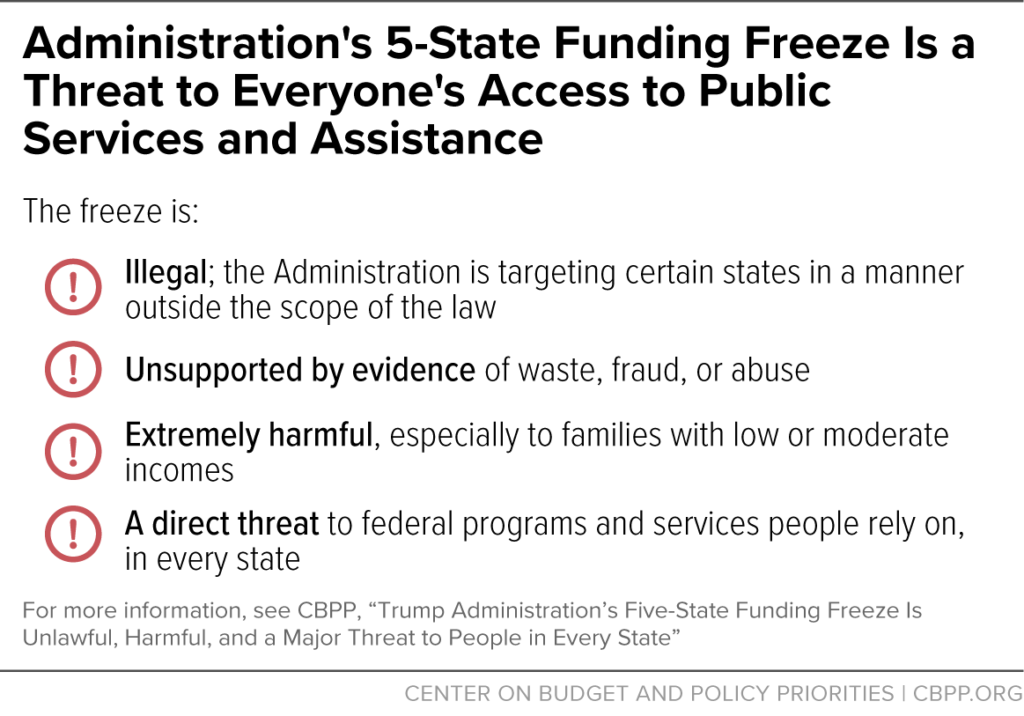
The actions the Administration has already taken in its five-state funding freeze are illegal, unsupported by evidence, and extremely harmful to families with low and moderate incomes. Illegal, because the Administration failed to show any noncompliance on which its actions are based or follow the statutes and regulations that dictate how mis-expenditures are investigated and, if verified, addressed. Unsupported by evidence, because the Administration has not provided any information documenting fraud. And harmful, because millions of children would see their families lose capacity to cover child care or other essentials like rent, utilities, and diapers.
The Trump Administration is making broad-brush claims about fraud across five states without providing any credible evidence about the programs in question that has held up under scrutiny. Instead, it relied on a YouTuber’s debunked claim about child care in Minnesota. Worse still, the Administration is using the pretext of fraud to pursue a campaign of escalating violence against our nation’s immigrants and those standing up for their neighbors and community members.
Fighting fraud is important: misusing federal funds takes public services away from people who need them and undermines confidence in government more broadly. But combatting fraud needs to be based on evidence, be done in accordance with federal law, and be undertaken in furtherance of program integrity, rather than for political or anti-immigrant goals.
Moreover, to maintain public support, combatting fraud also needs to be done consistently, without regard to favored or disfavored groups or programs. That has certainly not been the case under the Trump Administration. It has targeted these three programs serving low-income people for blanket funding freezes in five Democratically led states without providing any evidence of wrongdoing. At the same time, it has fired federal inspectors general across the government, who are charged with rooting out fraud, and has exacted deep cuts in IRS anti-fraud efforts, despite wide evidence of tax fraud among wealthy households and businesses.
Understanding the Funding Freeze
Here are the basics of what happened earlier this month. On January 6, the U.S. Department of Health and Human Services’ Administration for Children and Families (ACF) sent letters to five states — California, Colorado, Illinois, Minnesota, and New York — stating that their federal funding for the three programs was in a “restricted drawdown” pending the states complying with new requirements. Those requirements include inappropriate demands for private information about people receiving cash assistance through TANF as well as information about their family members, even if they are not receiving assistance, apparently as part of the Administration’s anti-immigrant crusade. (The Administration has not presented any evidence that people without lawful immigration status are accessing TANF, which includes harsh immigration-related eligibility bars.)
Additionally, the letters include onerous demands for information about TANF and SSBG service providers over many years, as well as child care attendance documentation. While the Administration did not explain what “restricted drawdown” meant, states were unable to access any funding from these programs once the drawdown restriction went into effect.
On January 9, in response to a suit filed by the five attorneys general in these states, a court issued a temporary restraining order on this funding freeze.Before this order expired on January 23, the court extended it until February 6.
The Administration’s effort to block funding for these states exceeds its legal authority. In the case of TANF, for example, ACF’s imposition of new requirements as a condition of funding violates a specific statutory prohibition on regulating the conduct of states unless expressly provided for in statute. In addition, the ACF letters to the five states assert the authority for the funding freeze comes from a general regulation related to noncompliance with federal statutes. That general regulation, which cannot supersede the more specific requirements of the TANF statute, requires federal agencies to take a series of steps before withholding funding, including identifying specific noncompliance and the actions the state must take to come into compliance. But the Administration has failed to identify any noncompliance by these states, either in the letters or in subsequent communications, instead citing the Administration’s concerns that there could be fraud based on unsubstantiated allegations that they do not even bother to detail.
TANF, CCDF, and SSBG already have procedures and penalties spelled out in their statutes and regulations to address program integrity and any potential misuse of funds. It should be noted that these statutes and regulations seek to balance state flexibility with program integrity. States are responsible for following federal requirements, including rules around eligibility, audits, and provider oversight. And the federal government is responsible for determining compliance. If policymakers decide that current program integrity requirements need to be adjusted, they can propose changes to the laws and regulations — processes that allow time for those with expertise to provide input — but they cannot ignore rules now in effect or simply set, by administrative fiat, new requirements that are contrary to current law.
The Trump Administration is ignoring the procedures laid out in federal law and regulations for identifying and addressing mis-expenditure of funds. Instead, it has taken a drastic step: immediately targeting certain states for a complete freeze in funding unless and until they comply with the Administration’s demands, which go outside the scope of what’s allowed under the law. Such a freeze on federal funding has never been imposed in the history of these programs.
What the Law Requires
The underlying law for the TANF program lays out a process for addressing concerns about fraudulent or improper spending, which is monitored annually by independent audits, whose findings are reported to the federal government. The law sets specific penalties for states found to have violated TANF requirements or failed to provide adequate financial oversight.
Indeed, a $100 million penalty was assessed in Mississippi at the end of the Biden Administration in response to a corruption and embezzlement scandal in the state’s TANF program. But the Trump Administration rescinded the penalty for Mississippi to provide the state more time to gather data, standing in stark contrast to its treatment of the five states targeted under its funding freeze, which was not based on specific allegations let alone verified mis-expenditure of funds.
Similarly, child care spending under the CCDF requires independent annual auditing that is reported to the state and to the HHS Secretary, along with repayment requirements for any misspent funds. State data also are provided for the calculation of the CCDF error rate, which is based on case reviews to determine whether children receiving assistance are eligible. States with high annual error rates (above 10 percent) are required to undertake corrective action. The national error rate for child care expenditures under this measure was only about 3.5 percent in 2023.
Federal child care regulations also require states to have financial management systems and procedures that can identify and investigate fraud risks, and they require all states to conduct on-site inspections of child care providers receiving federal child care funding — both providers that are licensed and those exempt from state licensure — at least annually for compliance with health and safety standards. These on-site inspections also ensure that programs receiving funding are in fact open and serving children. Like in TANF, the regulations also specify the steps the federal government will take if it makes a final determination that funds were misspent or a state otherwise was not complying with the statute.
And finally, SSBG also includes requirements to audit state spending under the program by an independent agency at least every two years, with a requirement that a state repay any unlawful spending.
Funding Freeze Would Cause Harm
Beyond being both unlawful and unsupported by evidence, the Trump Administration’s five-state freeze would also be extremely harmful to low-and moderate-income families. TANF provides essential funding to states for basic cash assistance to some of the lowest-income families in our nation, in addition to supporting child care, early education, services for at-risk youth, and other related services for families. With their federal TANF funding, the five impacted states provide cash assistance to nearly 1.2 million people, including over 800,000 children, with monthly cash benefits that allow them to cover some of their most basic expenses, such as rent, utilities, diapers, and school supplies. TANF funds are also used for a host of services, including child care.
CCDF is the leading federal source of funds dedicated solely to helping working families access and afford quality child care. Across the five states, CCDF programs serve an estimated 339,000 children who receive care from an estimated 96,000 total child care providers, according to a report from the Center for American Progress.[12] (Many child care providers serve both children receiving child care assistance and those who do not receive that assistance.)
SSBG is the most flexible of these programs, helping states provide care and protection for both vulnerable adults and at-risk youth, special services for people with disabilities, child care, counseling, and other services. In fiscal year 2022, the five states reported using SSBG funds (which are often combined with other funding) to provide assistance and services to well over 2 million people.
Threat to People in Every State
The Administration’s attempted five-state funding freeze represents a direct threat to all federal funding in every state. If the Administration can unilaterally block funding to any state on the flimsiest of pretexts, without legal authority or justification, then every federal program and service people rely on is at risk.
Indeed, a week after the five-state funding freeze was announced, President Trump declared that his Administration would stop providing federal funds to any state it considers to include a sanctuary jurisdiction, where local authorities limit cooperation with the Administration’s mass deportation agenda.[14] (Courts stopped a similar attempt to cut off federal funding to such jurisdictions last year.) And as discussed, there were reports earlier this week about potential broader reviews of funding for states with Democratic leadership.
Left unchecked, the Administration’s effort to cut off funding to state and local governments whose policies or political leadership it opposes gravely undermines Congress’ constitutional spending authority, while also destabilizing and politicizing states’ relationship with the federal government. And it threatens all kinds of funding, from transportation to public schools, community health centers, services to children who have been abused or neglected, disaster relief, financial aid to students at state universities, and much more. Everyone could become a victim of this uncertainty and disruption, which could leave people no longer able to count on public services that states provide with federal funds.
This was republished with permission from the Center on Budget and Policy Priorities.