This column relates accounts of family engagement by a nonprofit working to keep families together while avoiding child welfare involvement.
Ashley’s involvement with Together with Families began in the fall of 2022, after a domestic violence incident led to child welfare involvement and months of homelessness. Her history with the child welfare system, however, began much earlier.
She entered foster care as a young child while her mother struggled with addiction and her father served in the military. She said her mother wanted help and wanted to keep her children, but did not receive the support she needed for addiction, mental health or poverty.
Ashley said she experienced neglect and abuse in multiple foster placements and witnessed abuse of her sister. At age 3, she said, a foster parent wrapped a rubber band tightly around her thumb, cutting off circulation. The injury was not treated in time. Doctors later transplanted her big toe to reconstruct her damaged thumb.

She said she changed placements twice before being placed with relatives at age 10. She remained in kinship care until adulthood.
“Foster care didn’t feel safe,” Ashley said. “I learned not to trust people.”
As an adult, Ashley married, became a mother of four and lived in Cobb County, Georgia.
In the spring of 2022, Ashley said her husband assaulted her during a domestic violence incident inside their home. She said she fought back to protect herself and her children. Ashley is 5 feet tall. She said her husband is 6 feet 2 inches.
She said she left Georgia immediately afterward and drove to Florida with her children because she feared further violence. She did not know that, based on her husband’s account of the incident, both of them were charged with battery.
About a month later, she returned to Georgia to address her apartment lease and retrieve her belongings. She was arrested on the outstanding warrant for the battery charges, and spent three days in jail. It was the first time she had been incarcerated.
“I didn’t know who had my kids,” she said. “I didn’t know what was going to happen next.”
While she was in jail, Ashley said her husband took the children. After her release, Ashley went to her husband’s home, picked up the children and returned to Florida.
Less than a week later, the Georgia Division of Family & Children Services (DFCS) contacted her. Ashley said she was informed that a child welfare case had been opened because of the domestic violence incident and that she needed to return to Georgia.
She said she feared losing her children.
“I was terrified my kids would go through what I went through,” she said.
Ashley returned to Georgia. She said she filed for a temporary protective order soon after arriving. The order barred her husband from contacting Ashley or the children and remained in place until the child welfare case was resolved. Ashley said he is no longer involved in their lives.
For approximately six months, Ashley lived in extended-stay hotels while working the night shift at Kroger. She stocked shelves overnight and cared for her children during the day. Most of her income went toward weekly lodging.
She described the hotels as loud and unpredictable, with police responding to calls and people coming and going at all hours. She said she kept their belongings packed in plastic bins in case they needed to leave quickly. When rates increased or rooms became unavailable, she moved them again. She later stayed temporarily with a friend.
As part of the DFCS case plan, Ashley was required to complete individual counseling. Each child was required to attend counseling and complete assessments. The agency also required stable housing.
In the fall of 2022, after more than six months without stable housing, DFCS referred Ashley to us for help securing housing, clothing and supplies for her children, as well as support navigating the child welfare system. The worker also asked that we help Ashley complete the requirements of her case plan.
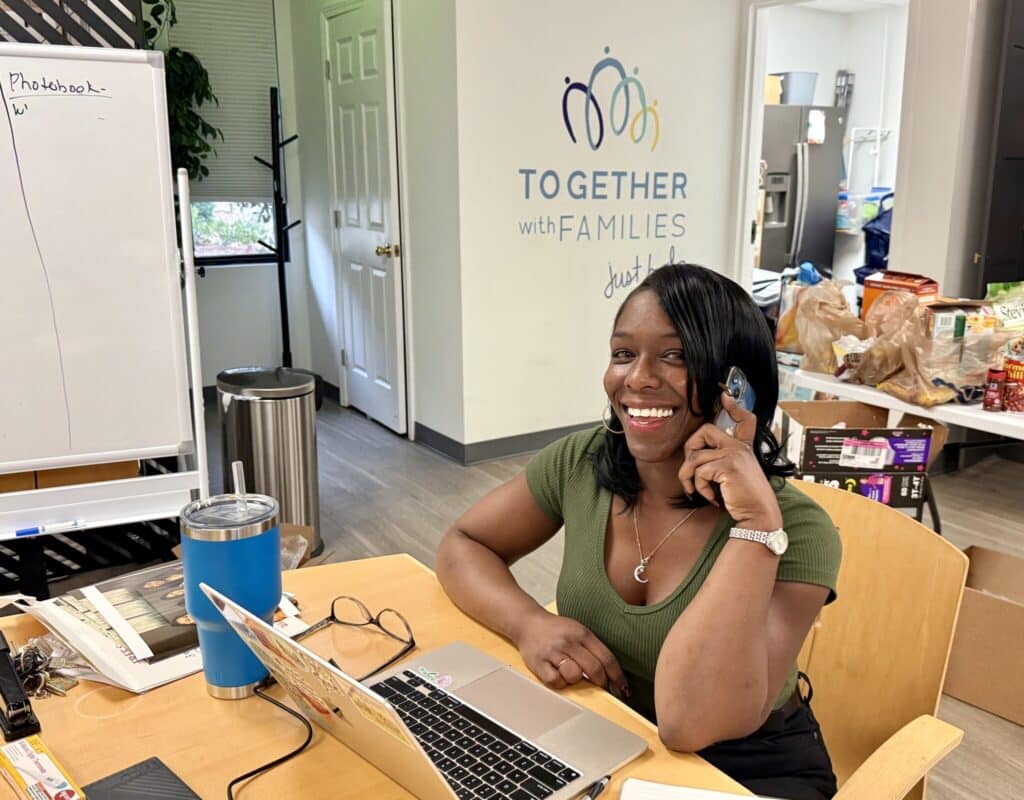
We contacted Ashley the day of the referral. She said she was overwhelmed, but trying to do everything required of her. She was working overnight shifts, caring for her children during the day and moving between extended-stay hotels. At the same time, she was expected to attend court, begin counseling, take her children to counseling and complete assessments. She said she worried that missing an appointment or misunderstanding a deadline could cost her custody of her children.
“I was scared to talk to anyone,” Ashley said. “I didn’t know who was safe to reach out to.”
We met with Ashley and reviewed her case. We focused on consistency and follow-through. If we told Ashley we would make a call, we made it. If we said we would check on an appointment time or paperwork requirement, we confirmed it and followed up to earn trust.
Transportation quickly became a barrier. Ashley said she was running out of money after paying weekly hotel rates, and gas costs were limiting her ability to get to court and required services. We provided gas cards tied directly to court, counseling and other required appointments so she could remain employed and in compliance.
We also stayed in contact between appointments. Some calls were logistical, but others were simply to check on how she was doing. Ashley said she was still learning that it was safe to ask for help, and that knowing someone would answer and follow through mattered.
During this time, Ashley had been approved for a rental home through a housing partner. Utilities had to be placed in her name and deposits paid before the keys could be released. We coordinated directly with the housing partner to confirm requirements and timelines. When Ashley said she did not have the remaining funds for the utility deposit and initial costs, we launched a small fundraiser on social media and raised the amount needed so service could be turned on and the lease finalized.
When Ashley received the keys, the unit did not have furniture.
Through our resource center and community partners, we provided beds and mattresses. We provided kitchen and living room furniture, household supplies, clothing and hygiene items so the family could move into a furnished home with essentials in place.
Ashley continued working overnight shifts while attending required meetings, completing counseling and complying with the DFCS case plan. Her children attended counseling and completed required assessments. We stayed in contact, checking on appointments and next steps, and continued coordinating with DFCS as Ashley worked toward case closure.
By early 2023, Ashley was employed and living in her home with her children. The child welfare case was closed and the battery charges stemming from her domestic violence incident were dismissed.
After the case closed, Ashley returned and asked how she could help other families navigating similar crises.
In the fall of 2023, she joined our design team and became part of a parent ally pilot program, supporting parents experiencing homelessness and other poverty challenges and child welfare involvement. She later enrolled in a nine-month apprenticeship program focused on leadership development and family engagement. She helped co-design the curriculum and graduated in early 2025.
In the summer of 2025, Ashley began contracting with us to support development efforts and community events. In January 2026, she joined our team in Baltimore at the Annie E. Casey Foundation to present on the work the foundation had funded, including the apprenticeship program she helped design and complete.
She said she now has a relationship with her mother, who is doing well.
“I wish someone had helped her,” Ashley said. “She wanted help. She wanted to care for her children.”
Today, Ashley is helping us design a weekly program for high school youth living in relative care and experiencing poverty. She will serve as coordinator when it launches later this year.
“My childhood was about surviving,” Ashley said. “If I had this kind of support early, my life would have looked different. I want to give youth living in relative care and separated from their parents what I wish I had: a safe place to belong, heal, and grow.”