
Maryland’s shocking past and troubling present
When we were in charge of Maryland’s Department of Juvenile Services (DJS), we were stunned both by the indefensible racial disproportionalities reflected in our system, especially among youth being tried as adults, and also by how little discussion was occurring regarding these stark disparities.

Determined to force a reckoning, we began researching the history of our department. Even though we’re veterans of efforts to reform the youth justice system and inequitable treatment of youth of color, what we found shocked us, resulting in the recent launch of the Forgotten Children Initiative.
With the help of Govern for America Fellow Crystal Foretia, we researched the history of how our department confronted issues of race. Maryland opened a separate youth facility to remove young people from adult prisons in 1855, following the example of places like New York and Boston that had created “Houses of Refuge.” But, like so many other Southern states, this Baltimore facility was for whites only; Black youth would need to wait nearly another 20 years for the House of Reformation and Instruction for Colored Children to open in Cheltenham, Maryland in 1873. When it opened, the youngest child transferred into it from adult prison was 5.
While separate, these facilities were anything but equal. The budget for the whites-only House of Refuge was several times the budget for the similar-sized House of Reformation. Black youth were targeted for menial work in the fields or factories, whereas education was emphasized for white youth. Instead, Black youth were subject to harsh working conditions, frequently being leased out to farmers in surrounding Prince George’s County, only a few years after the end of slavery in Maryland.
William Creasey, a former resident of the House of Reformation, told The Afro American in 1925 “I was at Cheltenham 3 years, 5 months, and a few days, and I had school two afternoons during this time. They would hire the boys out with mean people who hated colored people and the boys were worked just like slaves.” Likewise, another former House of Reformation resident, Harry Brown, told a grand jury investigating conditions there, “At one time I was supposed to be earning $5 a month — I earned it, but I never received it.”
It would have to wait until 1961, seven years after Brown v. Board of Education, before Maryland’s youth justice system would be desegregated. This was not because state policymakers became suddenly enlightened about racial equity. Quite the contrary, Maryland’s attorney general, on behalf of the precursor to our department, fought Thurgood Marshall and Juanita Jackson Mitchell — Maryland’s first Black woman lawyer — to the state’s high court before it was ordered to integrate.
While we were conducting this research, it was suggested that we contact Claude Waters, a former deputy superintendent of the Cheltenham facility who had worked there for 40 years and whose father had worked there for 40 years before him, possibly reaching back to the segregation era. Waters informed us that several boys who had died in custody at the old House of Reformation were buried in woods adjacent to the facility.
After some searching, we located the burial ground, but instead of finding the four to five gravestones Waters told us he had seen there, we found row upon row of unkempt and unacknowledged children’s graves — we initially thought as many as 100 — in a deeply wooded area. Most graves were marked only with cinder blocks covered with dirt, leaves and mold.
Abused in life, these children would be disrespected and forgotten in death.
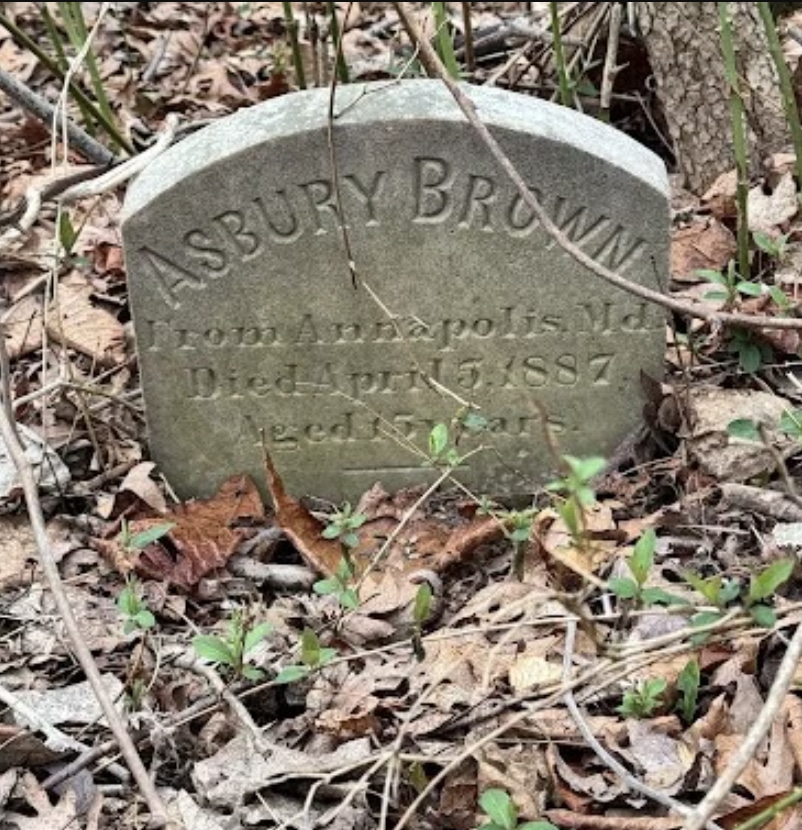
Further investigation reveals that at least 230 youth were buried in this grave site from the late 1800s until 1939. While most of their causes of death are listed as natural ones like tuberculosis, one has to wonder given the abuse these young people were subject to and how devalued their lives were by the state.
Harry Brown, a man who escaped from the House of Reformation as a child, told The Afro-American in 1934 that he helped conduct some of the burials, and that he knew “of no effort to embalm the bodies or to notify parents or guardians of the boys’ deaths.” He also stated, “on one occasion… parents came to inquire about a boy and were told that the boy had run away; but the truth is that I had helped bury the boy just the night before.”
What we found surprised even us, but perhaps it shouldn’t have. For a state that now has a progressive veneer, Maryland has an awful youth justice record, especially when it comes to racial inequities. Maryland automatically charges youth as adults for 33 categories of offenses, resulting in the state having more people in its prisons who entered when they were juveniles than every state other than Alabama.
In fact, the percentage of people in Maryland’s prisons serving time for crimes committed before they turned 18 is double the national average. Ninety percent of those are youth of color; 81% are Black. There are similar rates of overrepresentation of youth in the state’s youth prisons that we once ran. Maryland also has the highest rate of imprisoning Black young adults ages 18 to 25 for long sentences (beyond 10 years) of any state in the country.
Despite this virtual war on young Black people in Maryland, there was barely a whisper about any of these racial disparities either within our department or in the public discourse. This despite the fact that youth crime was garnering extensive, and wildly exaggerated, coverage in Maryland’s news media during our tenure there.
The reason for dredging up this painful and racist history isn’t to “adore the problem” as our friend and colleague the late James Bell used to say. The point is to learn from it and not repeat it. A casual glimpse into the successor facilities to the House of Reformation in Cheltenham and the House of Refuge in Baltimore shows that their beds today are nearly all occupied by youth of color. Ironically, while there’s a temptation to shake our heads at the racism of Maryland’s public officials from a hundred years ago, at least they were removing young people from adult prisons.
There have been fledgling attempts to change Maryland’s practice of automatically charging more youths as adults — the vast majority of whom are youth of color — over the past several decades, none of which have succeeded, although the discovery of this segregated burial ground appears to be spurring action on this issue this year.
Not only is there legislation sponsored by the chairs of the Senate and House judiciary committees to reform Maryland’s “autowaiver” law this session, but there is also finally legislation to investigate and acknowledge these children’s deaths. A hopeful sign of progress: the autowaiver reform bill recently passed out of the Senate and is awaiting action in the House.
As for our part, the harrowing discovery of gravesites has prompted the formation of the Forgotten Children Initiativeat Georgetown University’s Center for Youth Justice (Schindler will direct the initiative, with Schiraldi as an adviser). We’ve already uncovered more burial grounds adjacent to juvenile facilities around the country, similar to Cheltenham’s and the notorious grave site at Florida’s Dozier School memorialized in Colson Whitehead’s Pulitzer Prizewinning “Nickel Boys.”Schindler has visited one in Connecticut; and Richard Ross, the photographer of Juvenile-in-Justice fame, has begun to take some harrowing pictures of burial grounds in other states.
There has been tremendous progress in reducing the number of young people in youth and adult prisons throughout the country over the last 25 years, with incarceration numbers declining dramatically in both alongside sharp declines in youth crime. But we still have a long way to go, especially when it comes to equalizing treatment of youth of color. Remembering that every single one of these youth was and is someone’s child — in life and in death — is part of that, and is the raison d’etre for the Forgotten Children Initiative. Perhaps when we remember that, we can begin to treat them the way any of us would want our own children treated if they were in similar straits.