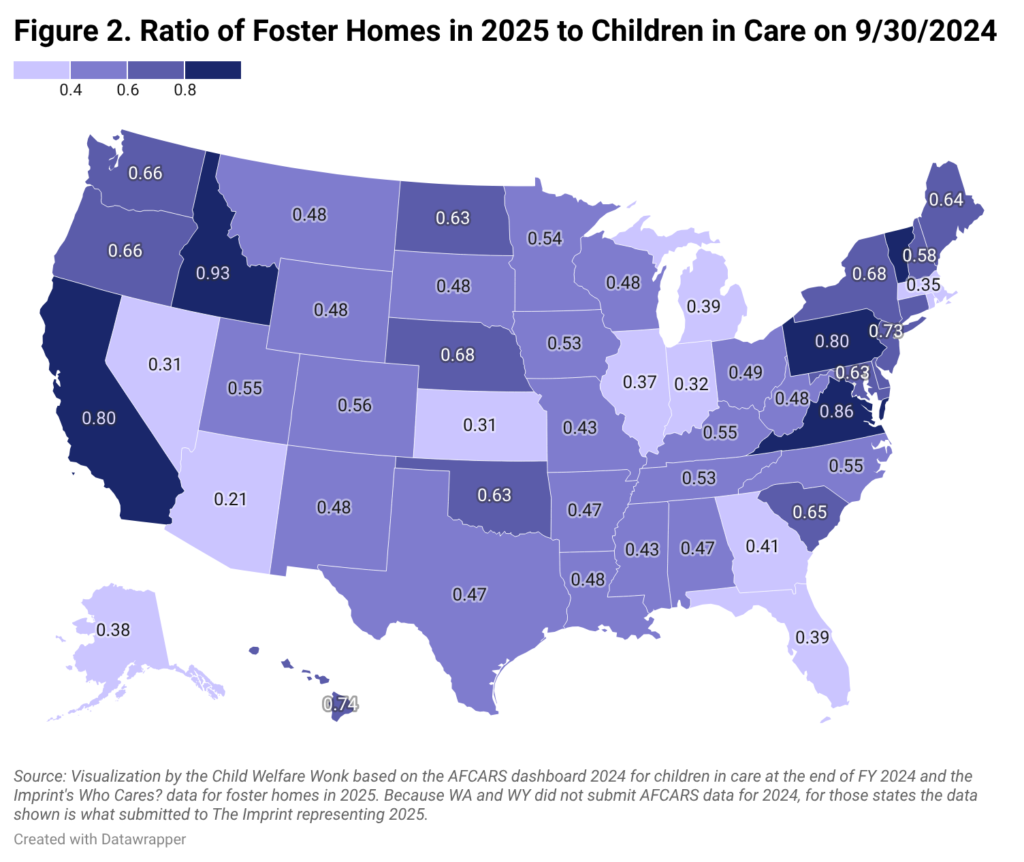
How many homes does each state have for every child in foster care?
The Administration for Children and Families’ A Home for Every Child initiative is predicated on a simple idea; the availability of a foster home for every child in foster care is a proxy for the overall health of a state’s system.
Our field is inundated with data, and a broad range of priorities. In that context, a single unifying metric to look across the full continuum, from prevention through permanency, is novel.
But is it a mark that states can hit if they aim for it?
Questions of how we can use data to formulate, implement, and track progress on policy goals fueled my 36 years analyzing child welfare policy and data at the Office of the Assistant Secretary for Planning and Evaluation within the U.S. Department of Health and Human Services, and now inform my work as a Senior Contributor at Child Welfare Wonk.
In order to effectively make decisions under the unique constraints they face, leaders of public and private organizations in each state need insight into their baseline, to develop strategies that work.
In an analysis that Child Welfare Wonk released today, I looked at The Imprint’s Who Cares dataset alongside federal AFCARS data to establish a state-by-state baseline for ACF’s Home for Every Child initiative, mapping exactly where each state is starting its journey toward the 1:1 ratio goal.
No state has yet achieved the Administration for Children and Families’ goal of having at least one licensed foster home for every child in foster care.The distance between where states stand today and where ACF wants them to go varies enormously, so the national average of .53 obscures more than it reveals. The findings are striking. State ratios range from 0.21 in Arizona to 0.93 in Idaho. 25 states have ratios below 0.5. Read the full analysis, with a state-by-state breakdown, here at Child Welfare Wonk.