
Opioid addiction has devastated Native families in Minnesota. A group of Native mothers shared their experiences with substance abuse and the lessons from their recovery.
This story is being co-published with Sahan Journal.
On White Earth Reservation in northeastern Minnesota, a culturally specific treatment program helps Native parents struggling with opioid addiction. The Maternal Outreach and Mitigation Services (MOMS) program serves any pregnant or postpartum parent with substance problems. They just have to get there. Some participants come from 60 miles away.
By the time these parents arrive at MOMS, their substance use has often led to significant problems with employment, housing, and child custody.
The program has achieved remarkable results. And, statewide experts say, it may suggest new directions and strategies for other distinct communities seeking to develop successful opioid treatment programs.
On White Earth, the MOMS participants do not take their unique experience for granted. They express gratitude to Julie Williams, who founded MOMS in 2015, and to the program that they say has saved their lives. They are willing to share their stories to spread the word that treatment, when done thoughtfully, can work.
Sahan Journal visited Williams and four of the participants last summer. As we sat down in the conference room, one of the women burned sage: a familiar cleansing practice for the group’s daily gatherings. The conversation went on for hours, until hunger took over and we drove to a supper club for grilled cheese and wild rice soup.
Here are their stories.
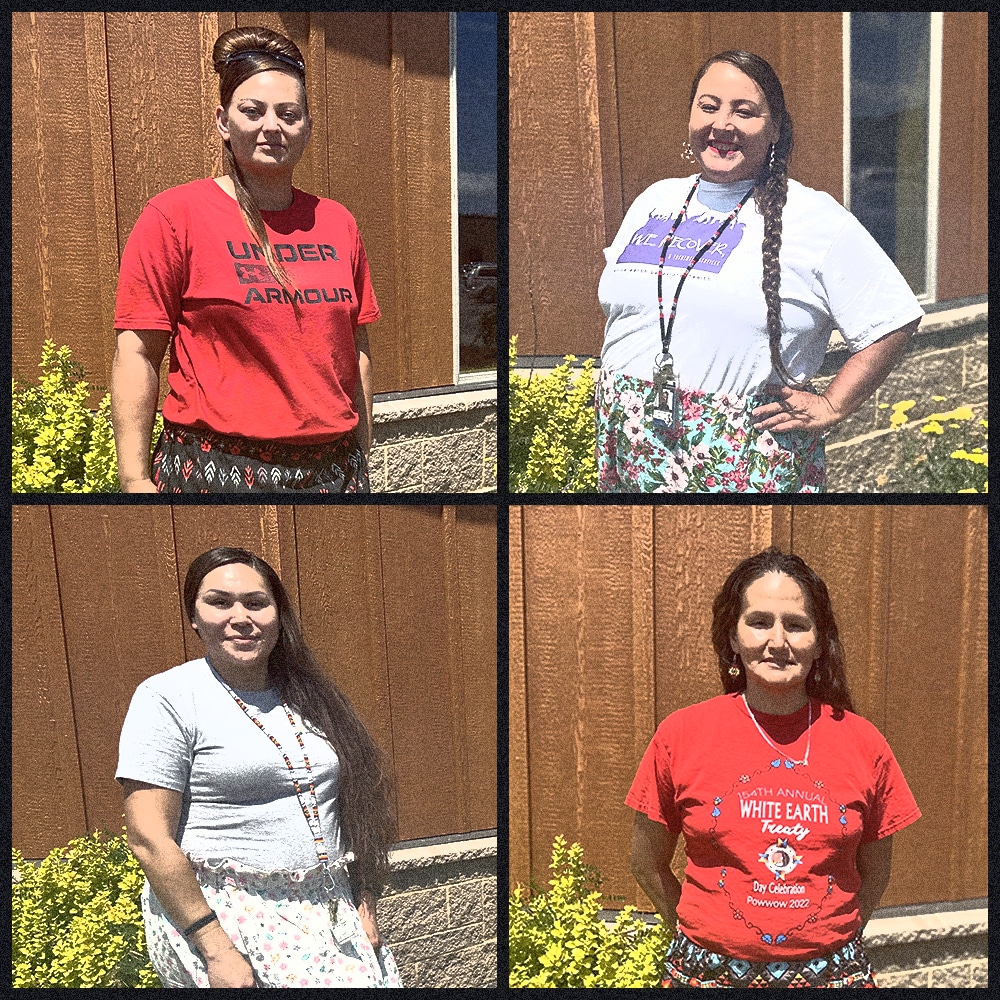
A recovery and treatment coordinator, Lacy Armstrong has been sober for nine years.
Photo by Sheila Mulrooney Eldred.
An alcohol and drug counselor, A.B. has been sober for nine years.
Photo by Sheila Mulrooney Eldred.
Cassie Person works as an alcohol and drug counselor and parents two biological CHILDREN PLUS two “bonus” kids.
Photo by Sheila Mulrooney Eldred.
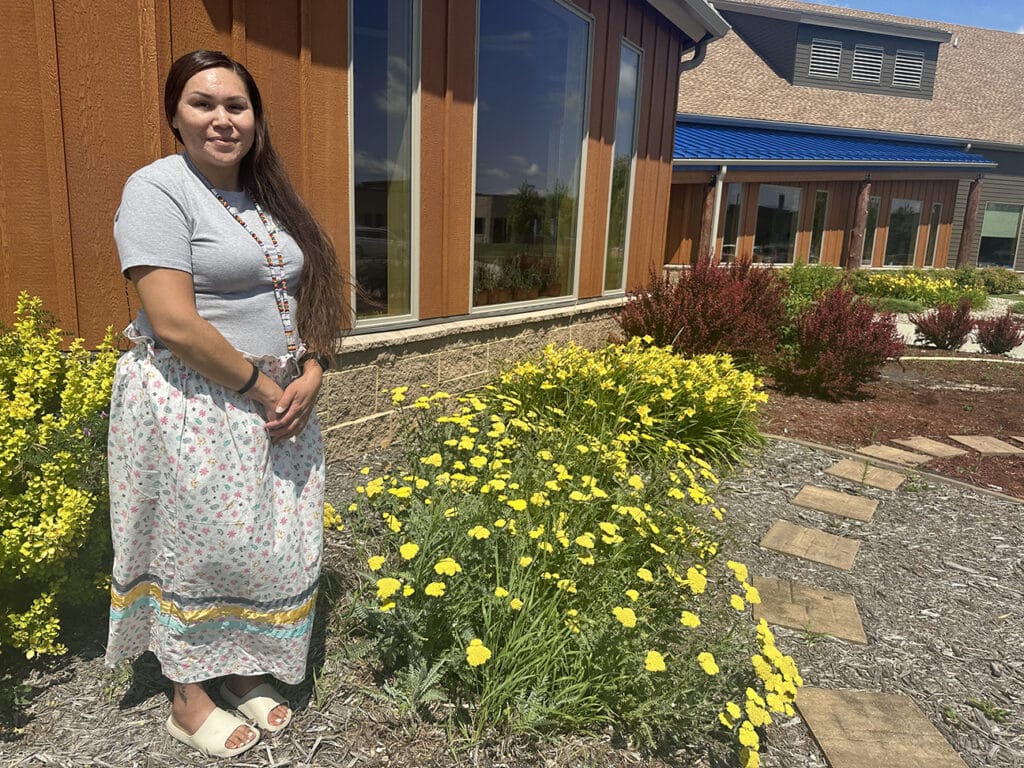
Teah Lovejoy works as a recovery treatment coordinator and has four children.
Photo by Sheila Mulrooney Eldred.
•
Native Mothers Know the Generational Trauma of Losing Their Children. One White Earth Mother Describes How She Rewrote the Script.
Looking back on it, Lacy Armstrong says, a successful life path was right in front of her.
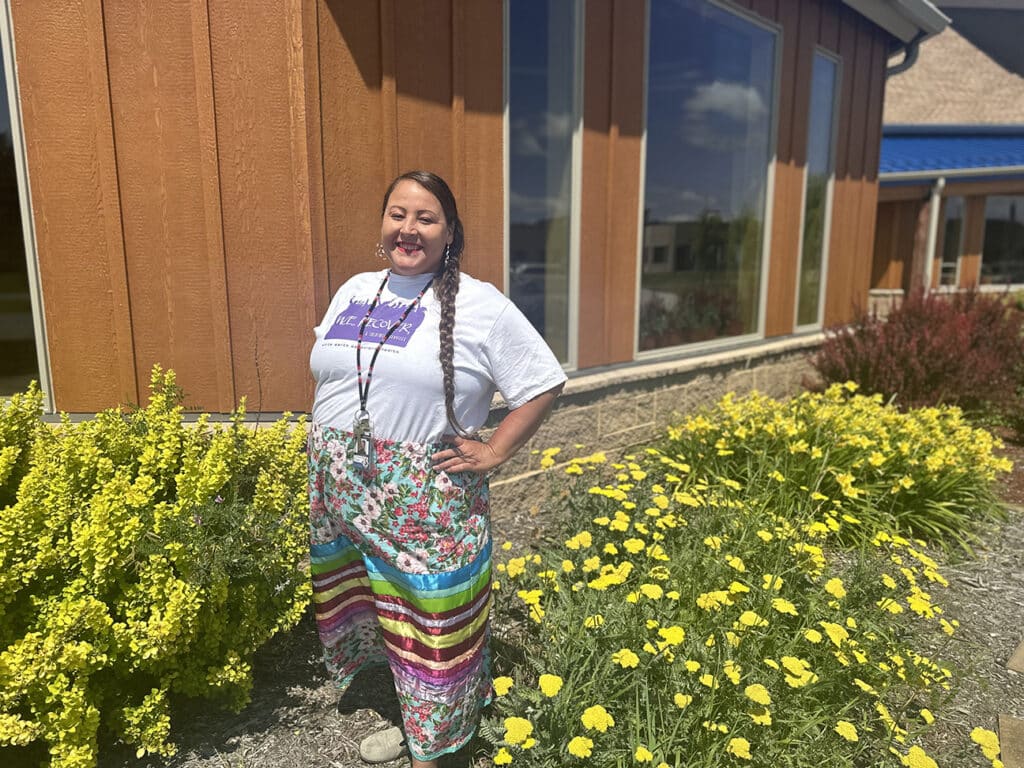
She wears a “We Recover” T-shirt over a traditional blue floral ribbon skirt, earrings in the shape of flowers, and bright lipstick. Her braid reaches to her waist, and she is quick to smile.
After graduating from Bagley High School, Armstrong followed her passion for singing and music to Northland Community and Technical College, in Thief River Falls. She earned a degree in audio production from the Minnesota School of Business, in Waite Park.
But in that year after college, away from home, she floundered. She moved to St. Paul to look for a job in 2009, but instead found a boyfriend who used prescription opioids. He took her to parties where Percocet rivaled alcohol as the substance of choice.
LACY ARMSTRONG, 37
Recovery and Treatment Coordinator at White Earth Substance Abuse Program
Doula-in-training
Mother of four
Home town: Mahnomen
Tribal affiliation: Leech Lake Band of Ojibwe
Nine years of sobriety
“I’m book smart and street smart,” she jokes. “I graduated college — damn, you did the four-year college thing — but then I learned the drug trade right after that. You’re supposed to get a good job, good career…but I’m really well-rounded.”
Armstrong moved back to the White Earth Reservation at the end of 2010 and managed to stop using heroin.
That summer, her partner died from an overdose. Four months later, she discovered that she was four months pregnant.
After giving birth to a daughter, things were good for about 18 months. Then she started another relationship with someone who used hard drugs. When he, too, died of an overdose, she spiraled. Desperate to get clean, she made it only four days after the funeral before she started using again. Not knowing how to cope with her grief, she spent time in and out of jail, where she was put on suicide watch, and on and off the streets. Her parents took care of her daughter.
In 2014, Armstrong was civilly committed — a step in which the state compels someone to seek treatment — and sent to Brainerd Four Winds Lodge, a culture-based sobriety program without medication. While she was there, she received her spirit name — a tradition in which an elder confers a name that speaks to the person’s character — at her first sweat lodge ceremony. It was, she says, a spiritual awakening.
But she was home for just a few days before she ran into someone who she knew sold drugs.
“And that was my relapse,” she says.
After another failed drug test, she was given two options: Go back to inpatient treatment without her family, or try the new MOMS program at White Earth.
“I was the No. 2 client and I was scared,” she says. But the staff did not judge her; she immediately felt comfortable sharing her story.
Her partner at the time, Donovan Burnette, was one of the first men to join MOMS.
“I don’t think I would be here today without this program,” Burnette said. (They’ve since broken up, but remain in touch.) “Look at how many parents this program gave back to the kids.”
Armstrong also started learning more about the connection between historical trauma and addiction. Growing up, she hadn’t known that Native Americans traditionally didn’t use substances or alcohol, she says.
She grew increasingly interested in the history of trauma and Native Americans. She learned about many factors that contributed to the drug epidemic among Native people. European colonization and the disastrous introduction of alcohol into Native communities. Boarding schools that separated Native children separated from their parents. And child-welfare policies that destroyed Native families.
“It wasn’t just a few people here and there, it was a lot of people losing kids,” Armstrong said.
“I know that my journey was affected deeply by the historical trauma of our people, the loss of our life ways.”
Armstrong has been sober since Sept. 2, 2015. That same year, she regained custody of her daughter and gave birth to a son. Today, she works as the administrative assistant for the cultural program at MOMS.
“I will always aim to uplift and break cycles for my children, the people that I have affected during my addiction, our ancestors, before and after,” she says. “I live my life in a good way to honor them and to honor my children and myself.”
•
‘I help others now’: A Native mother reflects on overcoming the shame of addiction.
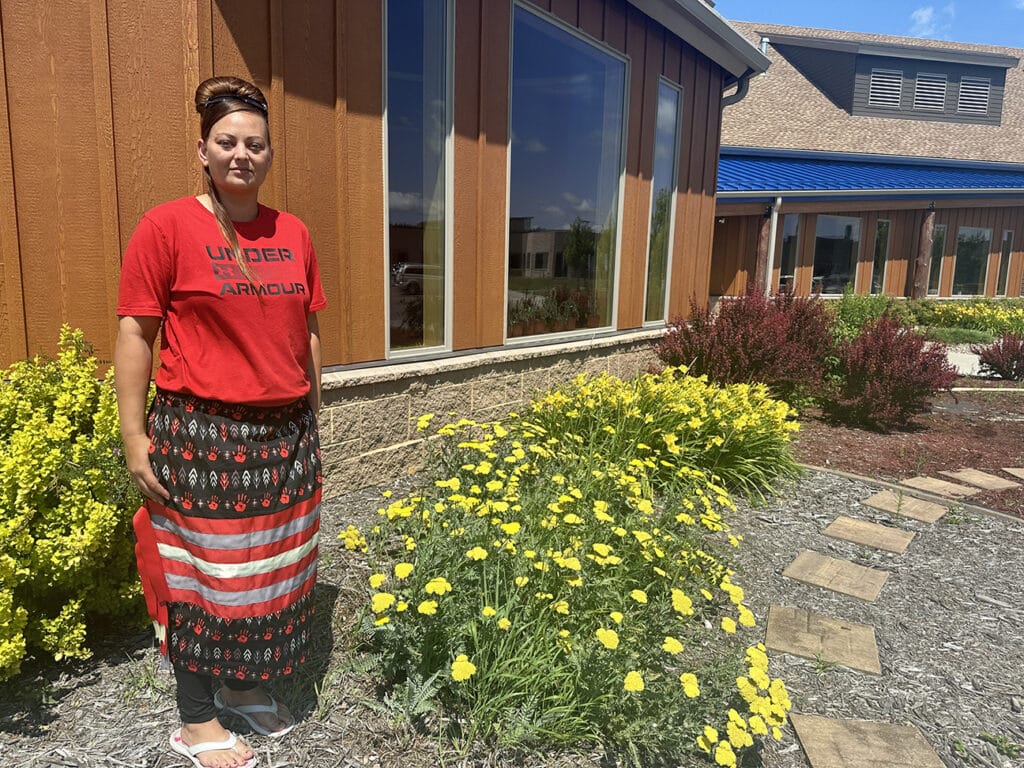
Her kids are now school age, but A.B., who requested to be identified by her initials only, says specific memories from their early childhood still haunt her. A.B. wears a red, black and gray ribbon skirt, flip-flops, a red Under Armour T-shirt, her hair in a sleek high bun. As she tells her story, she fidgets with the lighter she’s used to light the sage. Ceremonial smoke wafts through the air in the conference room.
During her addiction, A.B. says, she couldn’t afford much in the way of gifts. For Christmas, she relied on Toys for Tots for her son’s presents. For birthday parties, she knew her mom would help out.
One time, her son asked her for a snack at the store. Brown had the money in her pocket, but she was also thinking about buying the drugs that would keep her from going through withdrawal.
“I’ll never forget it,” she says. “Even though I had the money to buy it, it was like that money was for me.”
A.B. avoided using while she was pregnant with her daughter. But the day she left the hospital, she buckled her baby daughter into her car seat, reached under her seat, pulled out a plate and did a line of heroin.
“It’s bad to say, but I did,” she says.
Like many people with opioid use disorder, A.B.’s addiction started in the medical system. As a kid, she used to get cluster headaches so bad that all she could do was lie in a dark, quiet room. When she was 13 or 14, a doctor prescribed Vicodin for the headaches.
“Like, bottles of it,” she says. “And it just spiraled out of control. It seems like it just happened so fast.”
A.B., 31
Alcohol and drug counselor
Mother of two
Tribal affiliation: member of White Earth Nation
Nine years of sobriety
She quickly needed higher doses of Vicodin to control the pain. When she saw a different doctor, who prescribed a non-narcotic medication, she bought Vicodin or Percocet on the street. When that got too expensive, she turned to heroin.
By the time she had kids, she and her significant other were desperate for help. But they didn’t want to risk losing their children. That fear seemed insurmountable and turned into a barrier for seeking treatment.
“How are we going to do it? Like, who’s going to watch the kid?” If she told her mother and signed over temporary custody of her son, “she’s never going to give him back,” she said.
Finally, a friend told her about the MOMS clinic and gave her director Julie Williams’ number. And one day, when she couldn’t get the baby to stop fussing and crying, she stepped outside onto her balcony, closed the door and sobbed.
You need to do it, she told herself. You need to get help. You can’t keep going on like this.
She dialed Williams’ number. Williams understood her fear.
“With small towns it’s hard,” Williams says. “Our families know each other. So it’s scary for people to reach out and have to be completely vulnerable.”
A.B. was especially worried that her mom — who worked near the MOMS building and didn’t know about her addiction — would see her. Williams arranged for A.B. to park where her mom wouldn’t notice the car and told her to sneak in through a back door.
After several months in treatment, A.B. worked up the courage to tell her mom about her disease and invite her to a six-month celebration. Not only did her mom attend, but she surprised A.B. with a congratulatory speech.
“She was so supportive of me and proud: She supported me and my recovery to the fullest,” A.B. said. “And she is my biggest supporter to this day.”
Now a counselor at MOMS, A.B. has been sober since August 29, 2015.
“I help others now,” she says. “I never imagined I would be where I’m at today.“
She is still learning to forgive herself. She reminds herself of what her group counselor used to tell them: We’re not bad moms; we just made bad choices. But she’s not sure the guilt will ever go away completely.
•
Cassie Person Found her Safe Space at MOMS: ‘The Cool Thing Here is to be Sober.’
Cassie Person spent her childhood in foster care, living with several families until she found a longer-term home. As soon as she aged out of that system, though, she returned to White Earth. There, she found that her biological brother and her sister were both using drugs. Without any support system, Vicodin became her way to cope with her childhood trauma. When that became too expensive, she switched to heroin.
Person tried various treatment programs, but none stuck. She took the Suboxone she got at St. Cloud treatment center and sold or traded it to buy heroin and meth.
When Person got pregnant, she worried that the hospital would try to separate her from her baby. She knew her medical chart listed her history of drug use; providers sometimes made disparaging remarks about it, she said. With drugs in her system, she knew she would not be allowed to retain custody.
In this case, Person’s mother-in-law, Grandma Nona, came to the rescue and offered to care for the baby. Eager to get home to the baby herself, Person texted a friend: Is MOMS still open?
Person asked Grandma Nona to drop her off at MOMS directly from the maternity ward. Unlike the treatments she’d tried in the past, MOMS felt right, she said.
Like the other women in the room, she is wearing a ribbon skirt, a garment that can symbolize womanhood, adaptation, and survival. Minnesota Lieutenant Governor Peggy Flanagan, a member of White Earth, wore a ribbon skirt to her swearing-in ceremony and recently sported one in Vogue.
CASSIE PERSON, 36
Alcohol and drug counselor
Mom of two biological children and two “bonus” children
Home town: Naytahwaush
Tribal affiliation: Member of White Earth Nation
Seven years of sobriety
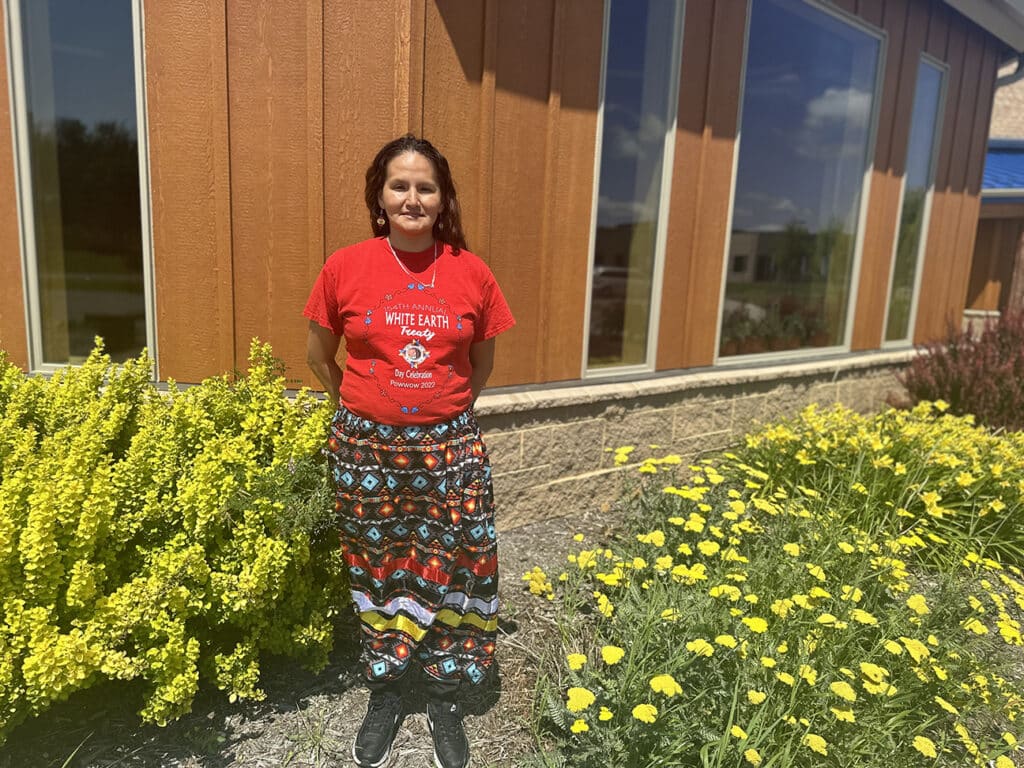
The skirts the women wear were made by a member of the community. Person’s is red, black and blue. Her wavy brown hair falls over a red White Earth Treaty Powwow 2022 T-shirt and beaded red, yellow and black earrings.
“I wanted to be at the building all the time,” Person said. “It was my safe place.”
And it still is. Person stayed in MOMS for two years, relapsing a couple of times until her partner agreed to join the program. When her counselors suggested it was time to move on, she agreed only when she found out she could stay with the treatment program as an employee.
“The cool thing here is to be sober,” she said.
Person has been sober since Dec. 27, 2016. Last April, she gave birth to her second child at the same hospital. This time, she said, the staff was much more welcoming.
•
A White Earth mother used opioids with her partner. The MOMS treatment program helped them get sober together.
As a teenager, Teah Lovejoy was opposed to substances: she didn’t want to smoke cigarettes, or drink. The only drug she took was Tylenol.
But by the time she was 20, she couldn’t get through one of her waitressing shifts without pain from rheumatoid arthritis, she says. Her eyes are warm, and she’s wearing a white and pink flowered ribbon skirt. Her hair falls to her waist.
Lovejoy’s doctor told her about a medication called Tramadol to ease her arthritis pain. He told her how safe it was, and she took it, as prescribed, for a year. When her prescription ran out, she found she could easily order more online.
“It was like I needed them,” Lovejoy says. “It seemed like when I didn’t take them, the pain was way worse than before I’d started taking them. I started taking more and more and more.”
She was addicted. And in 2014, when authorities changed the classification of Tramadol to a controlled substance, she could no longer order it online.
“When I couldn’t get them, that’s when I discovered withdrawals,” she says. “I was like, I feel like I’m gonna die (without it).”
Soon, she found her addiction problems compounding: Lovejoy discovered that her partner had started dealing heroin. And on a day when she couldn’t find anything else to control her withdrawal, she put a little bit of his stash on her tongue.
The heroin immediately stopped her withdrawal symptoms.
TEAH LOVEJOY, 35
Recovery Treatment Coordinator
Mother of four
Home town: Mahnomen
Tribal affiliation: Flandreau Santee Sioux Tribe in South Dakota
Seven years of sobriety
She wasn’t the only one who discovered his stash, however: Police raided their home and charged the couple with drug possession.
“We almost lost everything,” she says.
The couple feared Child Protection Services could send their three young children to foster care. When her partner went to court to deal with the charges, Lovejoy hid. For two and a half years, she ignored the warrants from the drug possession charge. When cops picked her up, her partner bailed her out. Eventually, he convinced Lovejoy to turn herself in.
“My significant other had always said, ‘If our using ever got CPS involved, and we were faced with the choice of losing our kids to foster care, we would be done with drugs.’ We’d get help and do everything we could to keep our kids out of foster care.”
After 60 days in jail, she relapsed the night she got out.
A court ordered Lovejoy and her partner to MOMS in October of 2015. Julie Williams, the MOMS coordinator, says she’s never understood why couples and relatives face so many barriers to seeking treatment together. All four of the women who shared their stories with Sahan Journal say that they didn’t recover until their significant others joined them in the process.
“My significant other and I both attended anger management, couples counseling, and individual therapy, and really started to grow together as a team and as individuals,” she says.
For Lovejoy, MOMS was the first time she had tried medication-assisted treatment. If she’d known about Suboxone and methadone, she says, she would have tried it earlier.
There were bumps along the way: she struggled with relapsing. One day, she returned home to find her family and all their belongings — furniture, groceries, clothes, toys — gone. Sign a contract to stop using for good, her partner told her, or he would file for full custody of the kids.
She did, and this time she also sought mental health therapy at MOMS. It turned out to be the final key to her recovery.
Success led to more success. She and her partner started their careers in 2017 and 2018 and became homeowners soon after.
“We created a warm loving home for our family. Our kids have a routine, structure, and they never have to worry about anything.”
Lovejoy has been sober since August 9, 2017.
The series is part of a reporting fellowship sponsored by the Association of Health Care Journalists and supported by The Commonwealth Fund.