
A new legal defense clinic at UC Berkeley’s School of Law will give students real-world opportunities to assist parents facing the removal of their children due to allegations of abuse or neglect.
The clinic, expected to open in 2025 or 2026, will be the first of its kind on the West Coast, training students “to represent indigent parents threatened by state intervention with the removal of their children,’’ according to a recently issued press release. Founders of the new Family Defense Clinic say it will also fill a current gap in legal services, by providing extra assistance on a range of challenges parents may face that cannot be handled by their court-appointed attorneys — from basic needs to cleaning up their records.
Pioneering attorney Martin Guggenheim, who founded the country’s first family defense clinic more than 30 years ago at New York University School of Law, called the effort “beyond important.”
“Berkeley’s desire is to do more than train future lawyers; it also wants to serve the community of which it is a part,” Guggenheim said in the press release.
Across California, Black, Indigenous and low-income families are overrepresented in the state’s child welfare system, state data show. In Alameda County, where UC Berkeley is located, Black children account for 10% of the population, but make up 43% of the open dependency cases, according to the law school.
Yet although indigent parents going through Alameda County’s child welfare system are paired with attorneys who represent them in court, the assistance is typically limited to the immediate foster care-related proceedings — even when their needs may far surpass the issues before the dependency court.
Guggenheim said the county’s low-income non-white population in particular, “has long suffered both economic and court-initiated injustices,’’ and, “has long been in desperate need of a robust family defender community.’’

The parameters of the UC Berkeley clinic have yet to be fully developed. But it’s expected to include a semester-long seminar on child welfare policies and practices, followed by fieldwork under the supervision of clinical professors, law school officials said.
Students will work with clients who may be struggling with trauma, substance abuse and mental health as they confront the potential termination of their parental rights. An incoming clinic director will help determine the scope of student work, and their tasks could include advocating for clients during CPS investigations, connecting them with social services and assisting with administrative proceedings to clear records of child abuse and maltreatment.
Alexandria Cinney, a staff attorney for the American Bar Association’s Center on Children and the Law, said very few law school programs focus on parent defense — and only about eight exist elsewhere in the country. In contrast, more than 60 law schools offer clinics to prepare students to represent children, including those in the juvenile justice system, an online resource from the bar association shows.
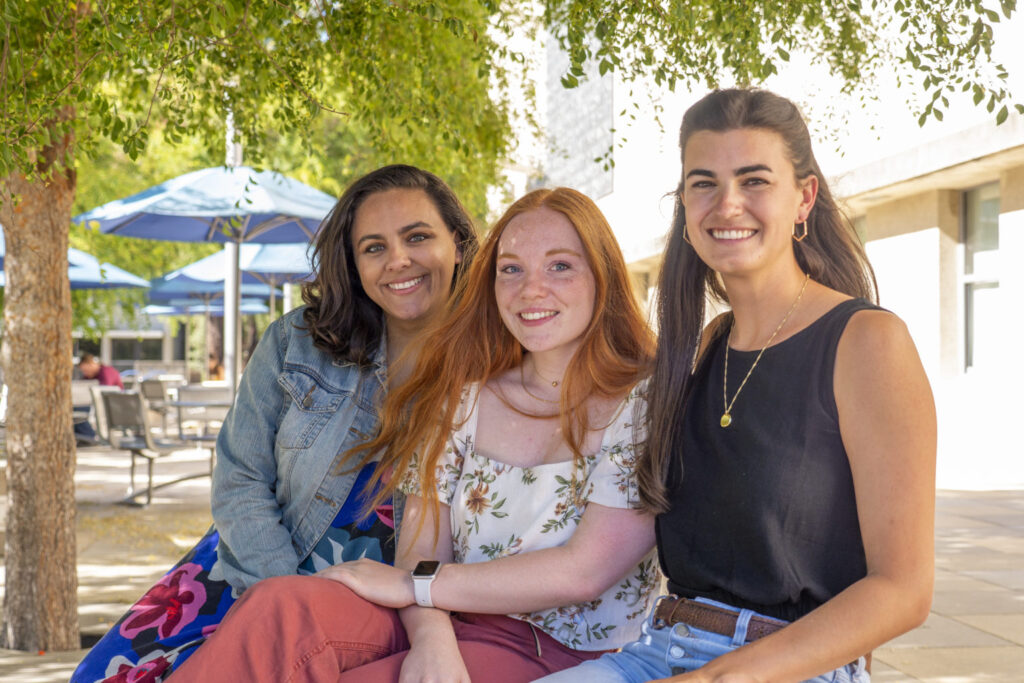
Advocacy efforts by three former Berkeley law students inspired the school’s new clinic.
In 2022, Greta Sloan, Justine DeSilva and Ariane Walter formed the Family Defense Project, noting the need for additional support for Bay Area parents impacted by the child welfare system. They also hoped to create an opportunity for peers to explore careers in the field of parent defense.
“We want to enhance representation for parents in the Bay Area … but we also want to shed light on all the civil rights violations and systemic injustice that is happening.”
—Greta Sloan, founder of UC Berkeley’s Family Defense Project
Since then, three cohorts of law students have gone through that project, assisting parents who are being investigated for maltreatment, creating know-your-rights training sessions, and conducting research into racial, socioeconomic and other biases in the child welfare system.
“It’s been pretty amazing how many of our classmates now know more about family defense, and how some people who would have gone directly into public defense or other jobs have actually changed career paths because of this,” Sloan said.
She added that those who enter the field of family defense see parent representation as inextricably connected to racial, economic and reproductive justice concerns. Children are often removed when families of color face unstable housing, rising child care costs, and challenges with mental health, substance abuse, grief or health, she said.
“We want to enhance representation for parents in the Bay Area,’’ Sloan said about the field of law, “but we also want to shed light on all the civil rights violations and systemic injustice that is happening.” Sloan now works with the New York-based Bronx Defenders.
The UC Berkeley Law School has six other clinics that provide law students with hands-on learning experiences, including programs focusing on environmental protection and the rights of people facing the death penalty. Dean Erwin Chemerinsky recently announced the law school will add five more clinical professors and three new clinics over a five-year period.
The new Family Defense Clinic will be modeled after Guggenheim’s work in New York, school officials said.
The now-retired lawyer helped create an interdisciplinary model of legal representation that pairs social workers and parent advocates with attorneys. In the New York City model, attorneys also advocate for clients in criminal and housing courts — a model of representation found to reduce the time children spent in foster care, according to a 2019 RAND Corporation study.
Eliza Patten, an interim director with the Oakland-based Legal Services for Prisoners with Children, and Guggenheim’s former student, said she’s thrilled his ideas are headed to the West Coast.
“There’s a very distinct unmet legal need in California for meaningful representation in dependency court, and having an institution as important as Berkeley participating will be a big step forward for parents here in the Bay Area and across the state,” she said.
BEFORE YOU GO… If you learned something from this article, pay it forward and contribute to The Imprint. Our work is funded by readers like you who are committed to unbiased journalism that works for you, not for the algorithms.