Aysha Schomburg’s recently concluded three-year tenure as one of the nation’s top child welfare officials is among the most historic: Child poverty and calls to Child Protective Services plunged to historic lows after the onset of the COVID-19 pandemic. The government rolled out its once-in-a-generation Family First Prevention Services Act to keep more families intact, and racial justice protests drew unprecedented attention to the disproportionate number of Black and Native American children taken into foster care.
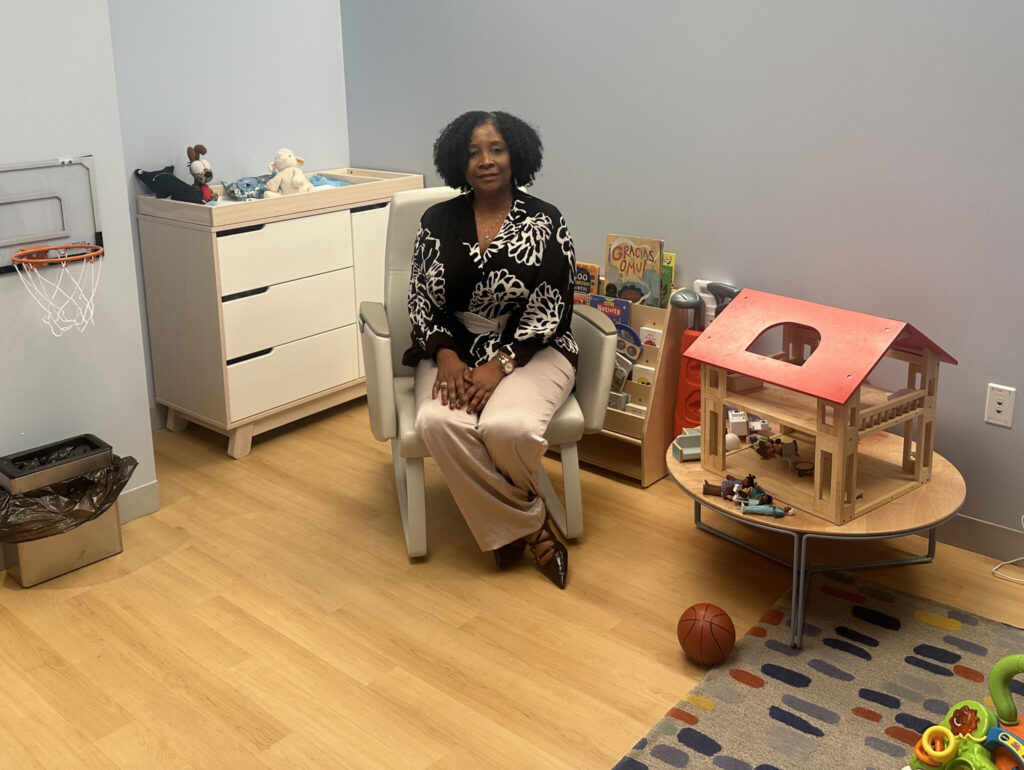
Now Schomburg — the former associate commissioner of the $10 billion federal Children’s Bureau from 2021 to early 2024 — is making her history outside of government. She has assumed the role of president and chief executive officer for the Manhattan-based New York Society for the Prevention of Cruelty to Children, which describes itself as the world’s first child protective agency. The organization was incorporated in 1875, and she’ll be its first new permanent leader in over 20 years, and the first Black leader in its history. Her appointment was announced in May.
The New York organization still bears a name reminiscent of the past. It was cofounded by a crusading animal rights activist and supported by Gilded Age barons like Cornelius Vanderbilt, with the goal of investigating child abuse and neglect allegations. With $36 million in assets, according to 2022 tax filings, the nonprofit now provides therapy services for children referred by the city and family courts.
The society also offers training to child welfare professionals around the country, as well as a support program for professionals who experience second-hand trauma while in the field.
The nonprofit that Schomburg now heads also holds a one-of-a-kind private archive containing records of more than 2 million New York City children the society has served over more than a century.
That aspect of Schomburg’s new role echoes her distinguished family legacy. Aysha’s great-grandfather Arturo Schomburg was an intellectual icon of the Harlem Renaissance, renowned for his archive of documents, photographs, artwork and objects collected from the global African Diaspora. His collection is now housed in Harlem at the Schomburg Center for Research in Black Culture.
“If half of Black children in this country will be the subject of an investigation by the time they are 18, society is failing.“
— Aysha Schomburg
Before coming to the Biden administration, Schomburg served as a senior administrator for New York City’s Administration for Children’s Services, working closely with other city departments including the Department of Education and Department of Homeless Services. She served the city during the chaotic early months of the COVID-19 pandemic and advised the child welfare agency on how to address inequities and racism in the foster care system.
In a recent interview with The Imprint, Schomburg reflected on her time at the Children’s Bureau. She also highlighted the Society for the Prevention of Cruelty to Children’s most recent focus on strengthening families. Offerings for parents and children include trauma recovery services, therapeutic supervised visitation, and training CPS workers across the country. She also described her plans to better support parent’s rights, enhance her organization’s diversity, and to center the voices of youth.
Schomburg advises those concerned about child welfare to evaluate the past for guidance.
“History can also be a roadmap. We can look back at it and avoid historical mistakes; we can look back and know what not to do and why,” she said. “In fact, in this very important profession where children are at the core, we absolutely must look back — keep history in front of us and commit to doing better.”
The following interview has been lightly edited for clarity and length.
What do you view as the biggest achievement of the Children’s Bureau during your tenure in the Biden administration?
I did a lot of traveling — I never wanted to leave a place without making time to talk to parents or youth who were particularly impacted by foster care in that community.
One parent said, let communities — rather than the federal government — determine how they want to spend the money. That really stayed with me at my first opportunity to actually utilize some federal discretionary funds. I feel really proud about the community-initiated funding opportunities, where we utilized a community-initiated Notice of Funding Opportunity, encouraging everybody to apply for this money and tell us how they’re going to use it. We were addressing racial bias in foster care and communities were definitely able to communicate specifically what was important to them. I’m really glad that we were able to get support for kinship caregivers across the finish line.
Other more prevention-related rules that were promulgated, included federal reimbursement for attorneys for families not yet impacted by foster care, who may be in housing court, for example. Housing is one of those issues that can bring children under the radar of foster care even when we don’t want that to happen. We know that it makes a difference when you have legal representation.
And we worked on affirming placements for LGBTQ+ youth in foster care — they deserve to be safe and affirmed.
Why did you make the decision to return? What interested you in the New York Society for the Prevention of Cruelty to Children (NYSPCC) as a next step — and how did your tenure in D.C. shape your worldview about child welfare and family support?
There’s been this huge shift looking at: What can we do from a prevention standpoint? And in order to make those changes, you have to be able to talk directly to the people who can tell you.
Two years ago, we partnered with probably 20 or 25 youth ambassadors from all around the country. The top three things they lifted up were mental health support, housing and financial literacy. My time in D.C. allowed me to have this sort of access to children and families all over the country, and to be able to learn from that.
And then to be able to come to New York City and to be at an organization that prioritizes that, and is willing to invest in how we do more of that was really important to me.
“Parents deserve to know their rights when there’s a knock at the door and there’s a potential for their children to be removed from their care… I think one day we will look back and say, why was that even a fight?”
— Aysha Schomburg
Your organization had a very long history of being an innovator in child welfare investigations, and in some ways creating the model of citizens’ vigilance towards their neighbors — an early analogue to “mandated reporting.” What lessons do you see in that history today, given your earlier response that you tried to make parents’ rights a priority at the Children’s Bureau, and that you see a broad shift towards prevention?
Yes, for sure — NYSPCC was the architect of reporting, although the “mandated” aspect of reporting during those early years is arguable. The original intent was to protect a child who was literally being abused — the child whose case was the impetus for founding NYSPCC was not about neglect, or some of these other reasons why children come to the radar of child welfare today, she was being physically abused and she needed help.
Over the years though, reporting has grown to include issues such as inadequate supervision and inadequate housing. These are issues that can be addressed by providing families with support such as high-quality, affordable child care and housing.
Mandated reporting has a life of its own. Many well-intended people may call the hotline because that’s the only way they know to help. In that case, we have to do more to make people aware of resources that are out there. That’s why I love the idea of ‘warmlines.’
Another very serious problem with mandated reporting is that it is clearly disproportionately affecting Black and brown children. We know this is true. What does that mean? That means that Black and brown children are more likely to have a run-in with child welfare, which could mean anything from an investigation — the dreaded knock at the door — to family separation and a life in foster care. If half of Black children in this country will be the subject of an investigation by the time they are 18, society is failing.
Your recent hiring at the New York Society for the Prevention of Cruelty to Children was described as “a transformative shift in the agency’s history.” What do you see as new focuses or services you intend to establish at the society, and do you and the board see any existing efforts as perhaps going away?
I’m the first Black person, or a person of any color, to lead this organization that for 149 years has only had white leadership. That is an important shift that I want to lift up as I’m coming into this work and thinking about our staff and our leadership reflecting the children that we serve — because this is not 1875 and the children that we serve are largely Latinx and Black.
One of the first moves I made here was to hire two more bilingual therapists, because we want to make sure that we are able to support the Spanish-speaking children and families and communities. We also need to hire more Black therapists because that makes a difference — cultural understanding, cultural humility all really play a part in how well the therapy can work.
What are you prioritizing? What are your top issues for this organization at the program level?
One of the things that I learned from our clinical therapists is that families are not necessarily just having one issue. Often there have been multiple challenges that have led to that traumatic event — there may be families that are coming here who are housing insecure. We see a lot of domestic violence in our families.
So I started thinking, how do we support families with some of those other issues? We can’t do it all ourselves. We’re located in the center of New York City, so we’re in a unique position to be able to serve families in more ways, and to be able to partner with people to do that.
So I reached out to the New York City Department of Social Services, particularly housing, the Mayor’s office, Safe Horizon, District Attorney’s offices in Manhattan, Brooklyn and the Bronx — because they are often the first point of contact when something traumatic has happened in a family, including domestic violence. They were really excited about partnering with us.
“Housing is one of those issues that can bring children under the radar of foster care even when we don’t want that to happen. We know that it makes a difference when you have legal representation.”
— Aysha Schomburg
We met at the convening of The Reckoning, where advocates and child welfare executives gathered to discuss the necessity of “narrowing the front door” to the child welfare system, and keeping more families intact. Now that you’re back to work in New York, do perspectives seem to have changed?
What really struck me was that people, including CEOs Kimberly Watson and Michelle Yanche, are willing to come to the table to hear these very difficult conversations. It feels like leadership in the New York City foster care space is really listening differently and committing to taking action and raising awareness about it.
New York has done great work with decreasing the foster care census over the past several years. When I first started in child welfare, there were 47,000 foster children in New York City. (Editor’s note: That number is now roughly 6,700, according to state data.)
But we still have those disparities, still have more Black children coming into care, particularly in New York. So we’ve still got a lot of work to do.
We talked about program-level goals. Do you have advocacy goals more broadly at the policy level that you want to pursue, or do you support any changes brought up at The Reckoning, such as the family “Miranda-rights” legislation?
One of the things that I wish I had been able to do before I left the federal government was to have the Department of Health and Human Services make a statement about parents’ rights.
Parents deserve to know their rights when there’s a knock at the door and there’s a potential for their children to be removed from their care. I feel very, very strongly about that. I think one day we will look back and say, why was that even a fight?