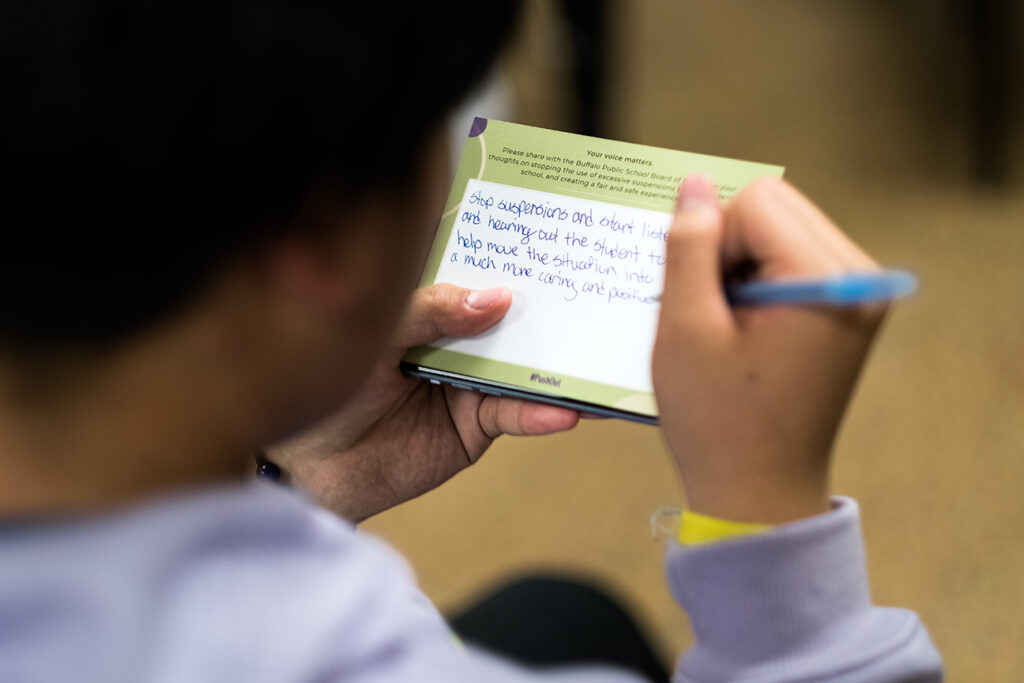
Buffalo’s public schools are disproportionately disciplining Black and brown students and students with disabilities, a yearslong investigation by the New York State Attorney General has found.
The civil rights investigation, which began in 2020, revealed that in some cases, Black students were more than six times more likely to be suspended as white students, and Latino students nearly four times as likely. Schools regularly issued suspensions for minor infractions such as tardiness or absences, which is against state law.
Students with disabilities, who make up 24% of the district’s student body, were nearly twice as likely to be suspended as students without disabilities, the attorney general found. They were also often sent home without formal documentation, which violated their due process rights.
On Thursday, the attorney’s general office announced it had reached a settlement with Buffalo Public Schools that will overhaul the district’s troubled disciplinary system. The Assurance of Discontinuance agreement outlines a four-year plan aimed at lowering suspension rates by requiring the district to carry out several steps, including removing vague reasons for suspensions in its Code of Conduct such as “disrespect” and “talking back.” It must also hire an ombudsperson to improve communication between students, families and staff.
In a statement to The Imprint, Buffalo Public Schools spokesperson Kim Tran said the district has been working on its own to reduce suspensions, and that officials “remain committed to being a district that embraces restorative practices and works to keep more of its students in the classroom.”
Under the terms of the settlement, the district, which serves 27,000 children, must provide suspension notices to parents in the family’s primary language, explaining in detail the circumstances for the disciplinary action.
“Every child deserves to feel safe and supported at school, and every family deserves to be heard and treated fairly,” Attorney General Letitia James said in a press release. “For too long, too many Buffalo students were denied that right. Today, we are taking a major step to bring accountability and justice to Buffalo Public Schools’ disciplinary system.”
The agreement also restricts the district from suspending the youngest students — kindergarten through the third grade — except in cases involving a serious safety threat. Quinn Martha, education strategist at the American Civil Liberties Union of New York, said suspending lower-grade students, who are just learning basic math and reading skills, can have detrimental consequences affecting their education for years to come.
“We see stark decreases in graduation rates. We see test scores fall behind, and students get closer to the school-to-prison pipeline,” Martha said. “That’s where students are criminalized for their behavior in school and then often criminalized later in life and find themselves in the criminal justice system.”
“Every child deserves to feel safe and supported at school, and every family deserves to be heard and treated fairly. For too long, too many Buffalo students were denied that right.”
— New York Attorney General Letitia James
Education advocates have long called attention to the prolonged effects of keeping children out of school, especially for what the attorney general called “minor misconduct.”
On Friday, Buffalo resident Rehma Kashindi, 18, said she was suspended at least five times throughout middle and high school for being late to class or “trying to advocate” for herself to teachers.
“The things I was suspended for were very trivial and very upsetting, because I did think that I was a good student,” said Kashindi, who is currently a college freshman. She described herself as a “quieter,’’ bookish student.
“It was really frustrating, especially since high school moves fast,’’ she said. “You miss one day, you’re at a great disadvantage, and that was really hard for me to deal with.”
Miscommunication and escalating tensions between students and teachers were the norm at her Buffalo high school, she said.
“I don’t think that anyone wants to be suspended or is looking for suspension,” she said. “They would much rather just be asked, ‘What happened? How can we solve this, and how can we move forward?”
That approach, known as “restorative justice,” is a practice that education advocates are increasingly encouraging schools to adopt over punitive methods such as suspensions.
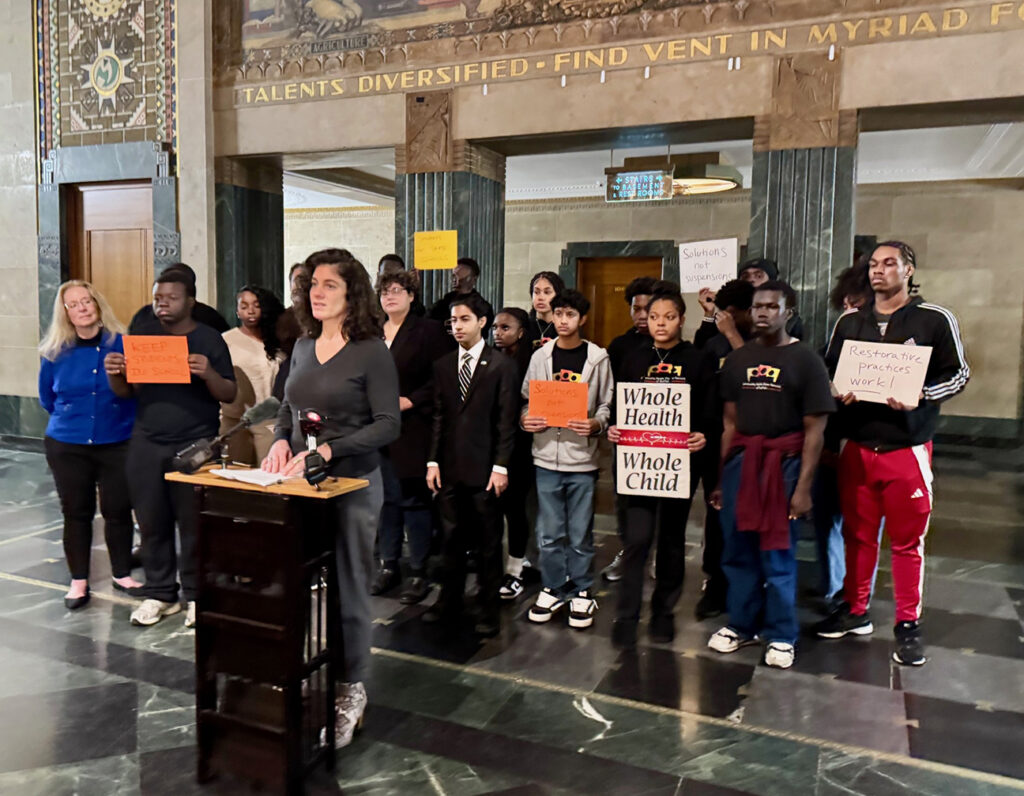
In 2022, The Imprint featured a group of Buffalo high school students who gathered to share their experiences regarding suspensions. The event was organized by the Erie County Restorative Justice Coalition, a group that has been instrumental in advocating for reduced suspensions and prioritizing communication and trust-building.
The coalition’s executive director, Dina Thompson, commended Superintendent Pascal Mubenga for embracing the new guidelines outlined in the settlement.
“It’s a roadmap of how to move forward,” she said.
A ‘civil rights crisis’
Buffalo’s public school district has had the highest number of suspensions in New York State for seven of the past eight years, according to state data. Child advocates say the city’s long history of racial segregation and high rates of child poverty lie at the base of the discipline disparity problem.
Nearly 90% of the district’s students are economically disadvantaged, the attorney general’s office reported. The investigation also revealed that Black students in Buffalo accumulated nearly 100,000 days of suspension from 2019 to 2023 — a “civil rights crisis,” Martha said.
“That number represents lost learning, lost opportunity, and real harm to the children and families in our community,” she added.
Though the attorney general’s investigation began in 2020, Buffalo parents and advocates said they had been trying to alert the school district about the issue for more than a decade.
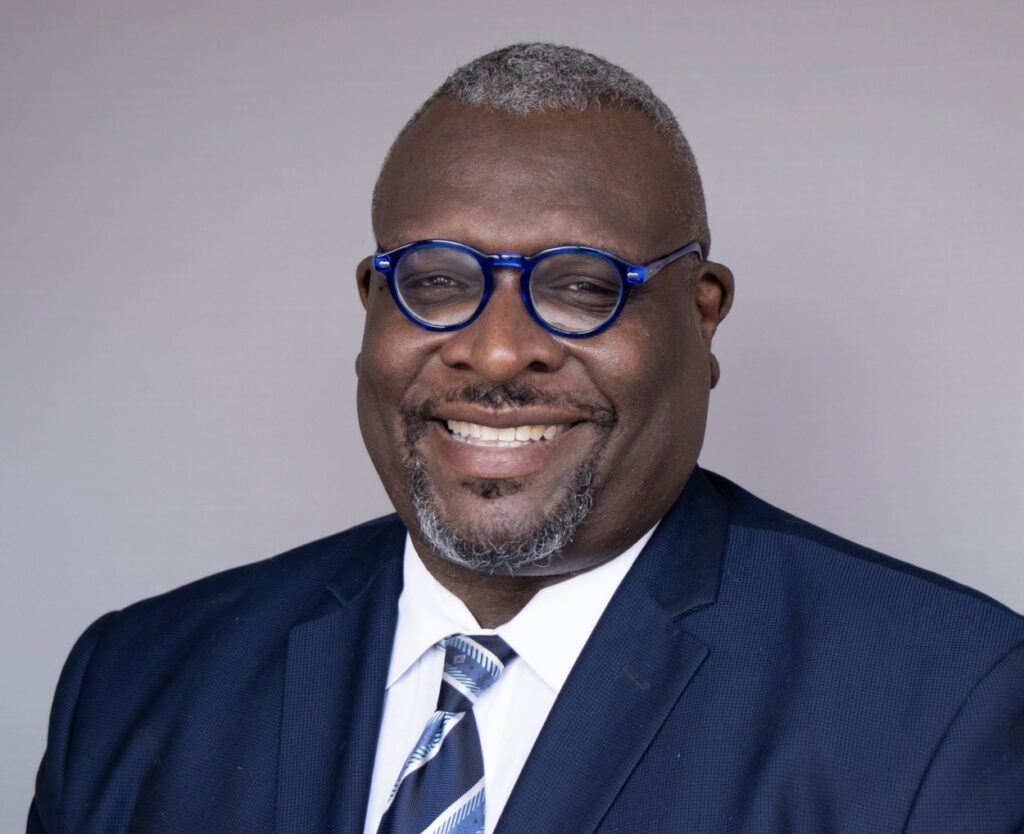
Education activist Samuel Radford said his group, the District Parent Coordinating Council, had complained about disproportionate suspensions during local community meetings as early as 2006.
Their concerns were often dismissed and called isolated incidents, he said, until 2010, when high school freshman Jawaan Daniels was shot at a bus stop on his way home after being suspended for roaming the halls at school. His mother hadn’t received any notice of his suspension from the district.
“It was a watershed moment,” Radford said. “We said, ‘How they’re doing these suspensions is putting our children’s lives at risk.’ So we mobilized and organized.”
In 2013, the school district implemented new rules regarding how school officials should handle suspensions. But problems remained. Implementation was poor, the attorney general’s investigation revealed. Students were still sent home without notice and denied due process protections. Multiple families told investigators that educators retaliated against parents who complained by reporting them to CPS, according to the report.
Thursday’s settlement signals hope for parents like Jessica Bauer Walker, who has spent years pushing for reduced suspensions in schools. Her eldest daughter, who is Black and has a disability, was suspended for a nonviolent interaction at school four years ago.
“It’s incredibly validating, because for the longest time, we were told that what our experiences were as parents and as students and as advocates were not real,” said Walker, a member of the parent advocate group Buffalo Suspension Coalition. “So to see that outlined through a thorough investigation from the Attorney General’s office, it means a lot.”