
“He’s like a rock star for our students,” said Sacramento State Guardian Scholars Director Linda Howe-Ram.
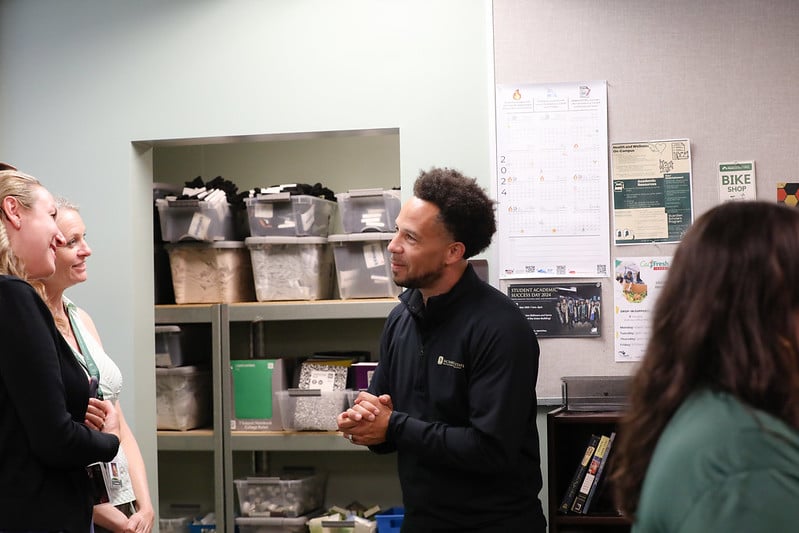
On many afternoons between meetings, you can find Sacramento State University President Luke Wood seated at a piano bench, tapping out a playful jazz melody or stirring rendition of Queen’s “Bohemian Rhapsody.”
He doesn’t just play for himself. Students flock to the piano, including a group on campus he has worked hard to nurture: budding scholars who grew up homeless or in the foster care system, now in the school’s Guardian Scholars Program. They might chat with the professor of education, or sing along when Wood pounds out The Beatles’ “Let It Be.”
It’s one of the students’ regular connections with Wood, a youthful-looking 43-year-old who is a unique college president they can relate to. He’s a former foster child who struggled in school but eventually made it to Sacramento State as an undergrad. When class let out, he slept in his car.
“They see a piece of their story in me,” Wood said in an interview with The Imprint. “But I also see a piece of my story in them. That’s the best part of being here.”
Since his appointment in 2023, Wood has worked to make his university “a magnet” for foster youth by expanding the Guardian Scholars’ center on campus and offering automatic acceptance to young people who have spent at least one day in the state’s child welfare system and meet admission requirements. He is now creating a residence hall and college expressly for foster students, mirroring similar offerings for Black and Indigenous students.
“Dr. Wood really wants students to find a home here, like he found his home here,” said Adrian Moore-Gonzalez, a former foster youth majoring in computer science and a student in the Black Honors College. “He inspires me to reach great heights, not just at university, but to reach those heights in life.”
Growing up in small-town California
Wood has never shied away from sharing the details of his upbringing.
His story of being adopted from foster care and becoming the president of his alma mater has been shared on television’s “Good Morning America” and “The Jennifer Hudson Show.”
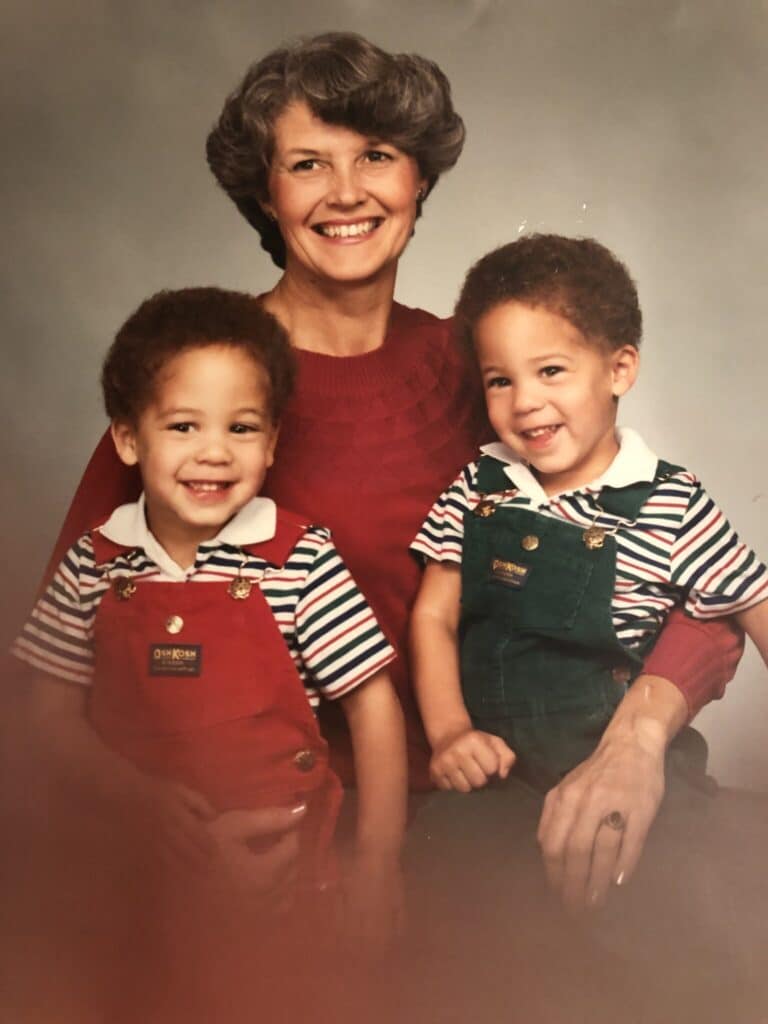
He and his twin brother Josh were born in Oakland in 1982 to a mother who struggled with substance abuse and mental health issues. She gave birth while incarcerated in prison. Days later, the Black boys were taken in and later adopted by a white Bay Area couple.
The family moved to McCloud — a town of about 1,000 nestled at the base of Mount Shasta — when the brothers started school. As avid square dancers, Wood’s adoptive parents were drawn to the slow pace of life in the old mill town and the fact that it hosted a renowned venue that regularly drew traveling bands and “callers,” who direct dances.
Wood often says he is one of “350 siblings,” which is the total number of foster children who lived with the family over the years. Most stayed briefly before being reunified with relatives.
Some stayed longer. At times, they arrived with visible signs of abuse, such as cigarette burns, and shared grim stories of exploitation at the hands of their parents. Many of his foster siblings were medically fragile, or lived with disabilities.
That environment had a profound impact on Luke, his twin brother Josh said. Typically, the two would delight in the arrival of a new foster child by rushing off to play in the backyard. But Luke worried about their well-being after they left their foster home.
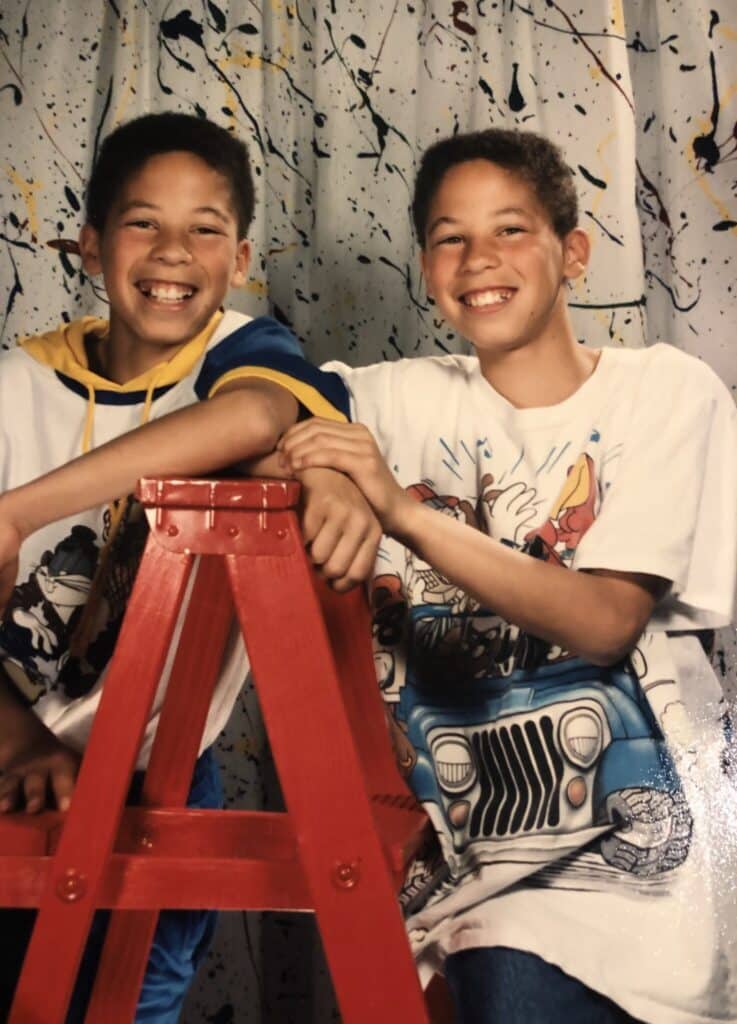
“Please take care of him and don’t hurt him,” a young Luke admonished one boy’s grandmother who had stepped in as his caregiver.
“Something like that can’t help but have a massive effect on your life and how you view the world,” Josh Wood said. “It helped prepare him, frankly, for the complexity of being a university president, and being able to connect with completely different people in an authentic way, and coming from a place of actual care.”
The family’s home became known as “the United Nations” for the diversity of foster children who came to stay in the largely white small town.
In some ways, it was a peaceful place to grow up, the brothers said. The town had just one gas station and no stoplights. Luke explored the backcountry of McCloud as a Boy Scout, and the siblings grew up playing music in church.
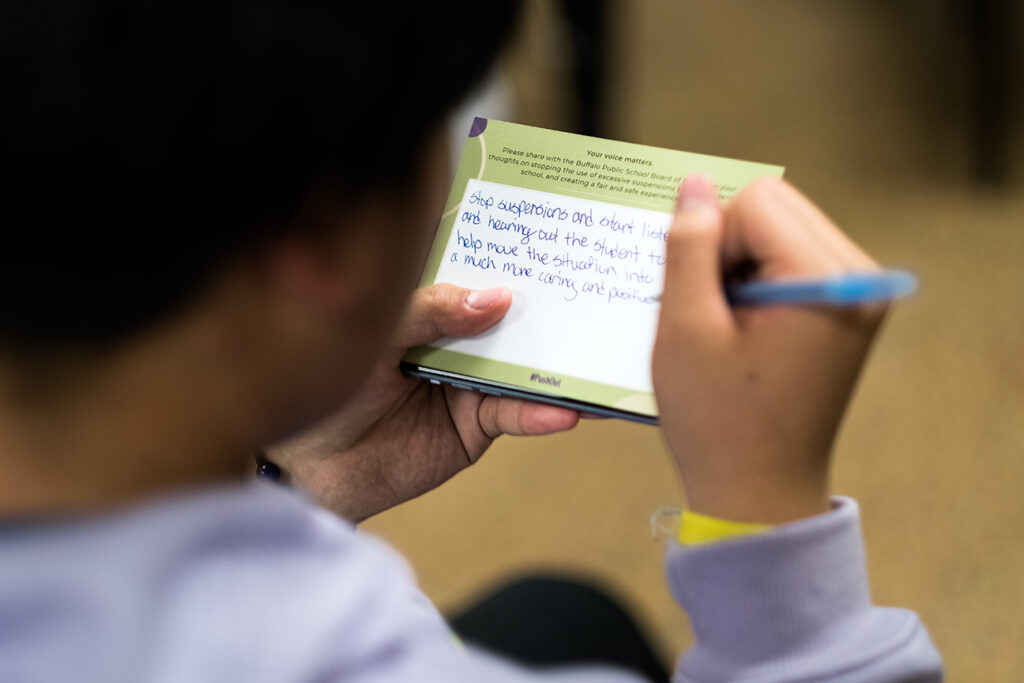
But the two were also picked on and taunted with racial epithets as the only two Black people they knew of in town, they recalled. The brothers wanted to feel connected to school. But a fifth grade teacher would pick on them for minor issues, such as turning around in their seats. Luke was suspended 42 times that year, he said. Administrators dubbed a table outside his classroom where he was sent as punishment “Luke’s desk” because he spent so much time there.
That experience would stay with Wood for years. In 2022, he shared it publicly to urge passage of a state law that requires schools to notify attorneys for foster children when they’re disciplined at school.
That was a pivotal point in Wood’s emergence as a leading voice for foster youth in California.
Helping foster youth see college as a viable option
Wood credits his sixth grade teacher Roger Guggenheimer — still known to Wood and his family as Mr. G. to this day — as recognizing and nurturing his talents. Instead of becoming alienated from school, Wood found a lifelong love of writing, and with Mr. G.’s help, he attended camps for young writers and had his short stories published.
“If he had not had Mr. G. in sixth grade, who totally turned things around, I’m not sure where he would be today,” said Luke’s mother, Karen Wood.
That support helped him on the path to college. Luke and Josh both ended up at Sacramento State, where they quickly made a name for themselves. The two brothers played alternative rock and funk with their band, Freestate, and got involved in campus politics. One year, both successfully ran on the same ticket, with Josh as president and Luke as vice president.
“When I see these students here, I just don’t see them as students in the same way as my other students. I truly see them as my brothers and sisters. And I want to make sure that there’s an institution that’s standing up and saying to all the foster youth across our state and across our country: This is the place that actually wants you and is willing to do the support that’s necessary to ensure you succeed.”
—Sacramento State University President Luke Wood
Despite their prominence on campus, the siblings struggled to make ends meet. The adopted family’s financial struggles grew after the father was incarcerated. Luke often slept in his car when he couldn’t find a couch to crash on. Josh took advantage of the student body president’s office when he too became homeless that year.
Luke remembers having to scrounge up enough money to eat. He often attended campus events just for the meals they provided.
But as a student leader, he fought for others’ interests — such as improved retention policies and the importance of campus diversity — and confronted school officials in sometimes-heated meetings.
Wood vowed that one day he would become president at Sacramento State. To pursue that goal, he earned two master’s degrees and a Ph.D. from Arizona State University in educational leadership and policy studies before becoming a scholar and administrator at San Diego State University.
“Some people laughed when he said it at the time,” Josh Wood said of his brother’s aim of becoming president. “But he’s been dedicated to that goal for the past 20 years.”
Making Sac State a magnet for foster youth
Located alongside the sinuous banks of the American River about a 15-minute drive from the California State Capitol building, Sacramento State is among the largest public universities in California, with about 31,000 enrolled students.
Since he was appointed in 2023, Wood has made foster youth enrollment a key focus. About two years ago, the school had about 100 students in its Guardian Scholars program, a number that has more than doubled during Wood’s tenure. Ultimately, Wood said, his goal is to increase that number to 300 and to ensure that graduation rates for this group exceed that of the rest of the student population.
Last year, after hearing their campus digs were in poor condition, he relocated and refurbished the office serving Guardian Scholars and Project Rebound, a program serving formerly incarcerated students. They now gather in the campus center alongside the office of the president and vice presidents of the university. There’s ample space for study or rest. A supply closet is stocked with canned food, pasta, clothing, luggage and toiletries.
“Dr. Wood really wants students to find a home here, like he found his home here. He inspires me to reach great heights, not just at university, but to reach those heights in life.”
—Adrian Moore-Gonzalez, student and former foster youth
Beyond immediate needs and free notebooks, counselors are on hand to discuss how to qualify for food stamps or find an affordable apartment.
Late last year, Wood announced Sacramento State would guarantee admissions to any foster student who meets the university requirements, starting with the fall 2025 semester. Under his leadership, Sacramento State also partnered with the United Way to create a guaranteed income program. Ten former foster youth are now receiving $500 monthly to cover expenses that can derail their education, such as the costs of auto repairs, housing or food.
Wood says efforts are meant to increase the likelihood that young adults without family support will remain enrolled at Sacramento State — and graduate with their peers.
“When I see these students here, I just don’t see them as students in the same way as my other students,” Wood said. “I truly see them as my brothers and sisters. And I want to make sure that there’s an institution that’s standing up and saying to all the foster youth across our state and across our country: This is the place that actually wants you and is willing to do the support that’s necessary to ensure you succeed.”
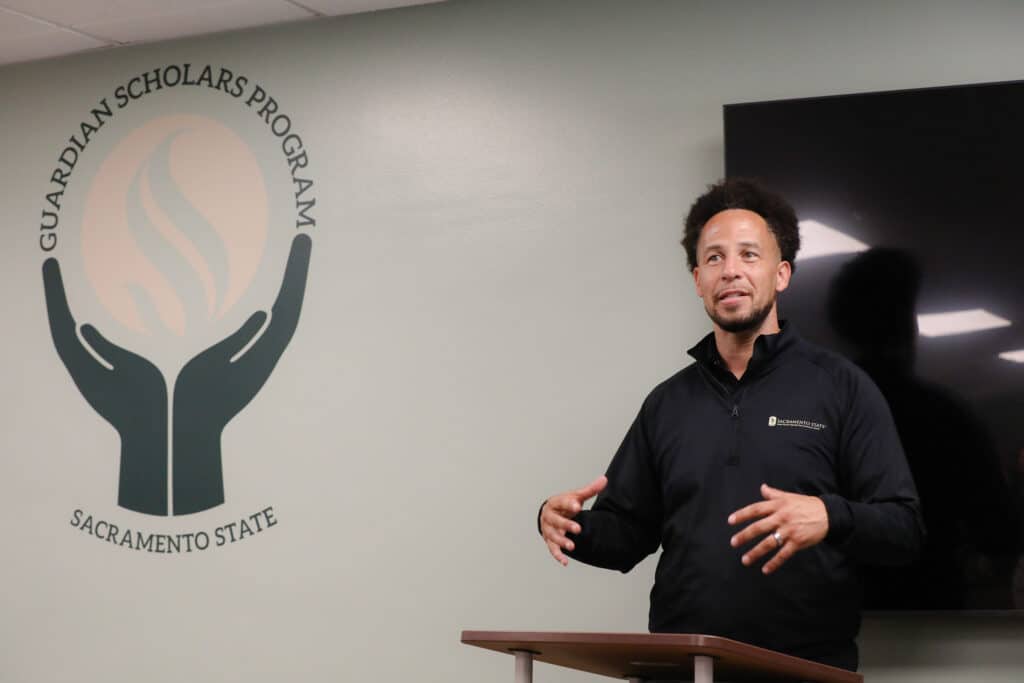
A comprehensive 2025 study that reviewed educational outcomes in the child welfare system over the past 20 years found that between 8% and 12% of former foster youth graduate from college, about five times less than the general population.
So attracting applicants — and retaining those who do enroll — is critical, said University of Southern California education Professor Royel Johnson, author of the book “From Foster Care to College.”
Wood’s investments and messaging are especially important to high school and transfer students considering the university, Johnson added. Applicants want to know that they’ll have the support they’ll need, such as campus housing during school holidays when other students go home to their families, and a sense of community.
“When a president of a university is explicitly calling for students from foster care — and showing that there’s no shame associated with having those experiences, it begins to normalize access and usage of resources and supports that we know are going to be so important,” Johnson said.
The future of foster youth at Sacramento State
Wood’s plan for students who’ve spent time in foster care would replicate the 2024 launch of the university’s Black Honors College, designed for all students interested in Black history, life and culture. A similar plan for Native American students was announced last November.
These programs are now under threat nationwide by a second-term President Donald Trump, who has taken aim at diversity, equity and inclusion programs on college campuses. Executive orders issued during his first week in office targeted these programs in both the public and private sectors. But Wood — a prominent defender of critical race theory — is not backing away from his goal of creating culturally distinct spaces within his large urban university.
His goal is to nurture “micro-communities” so that when underrepresented students come to Sac State, “they don’t feel like they’re a guest in someone else’s house,” Wood said. “They feel like they’re home.”