
It’s been a chaotic year in the youth-services field. In Donald Trump’s second presidential term, the Administration for Children and Families lost half its staff, parents and children faced hunger under America’s longest government shutdown and a new federal budget will slash health and social services and youth violence prevention programs.
Now, providers around the country are looking ahead at what they face in 2026.
One of those forward-thinking organizations is Two Feathers Native American Family Services, based in Humboldt County, California. Since 2002, the Big Lagoon Rancheria-based nonprofit has provided services to prevent Indigenous children in Humboldt County from entering foster care.
Aided by state funding announced by Gov. Gavin Newsom in May, Two Feathers will expand its offerings in the new year, opening two new “wellness centers” in Northern California that will address mental health and substance-use challenges among tribal youth.
The centers will also help young people approaching adulthood find jobs and stable housing, said Virgil Moorehead Jr., a Yurok and Tolowa tribal citizen and executive director of Two Feathers.
Working across Humboldt County, Two Feathers offers a holistic approach to its services, designed to “wrap around” self-identified Native kids in the environments where they live.
To prevent youth violence, addiction and suicidal ideation, the organization offers family counseling, as well as reconnecting young people to their tribal cultures, including traditional teachings in medicine, food, and conflict resolution.
The needs are stark for both Native and non-Native kids: California Healthy Kids survey data suggests young people in Humboldt County begin using substances at an earlier age than youth overall in the state. The county also has the highest rate of drug abuse among Indigenous youth, a California Rural Indian Health Board report found.
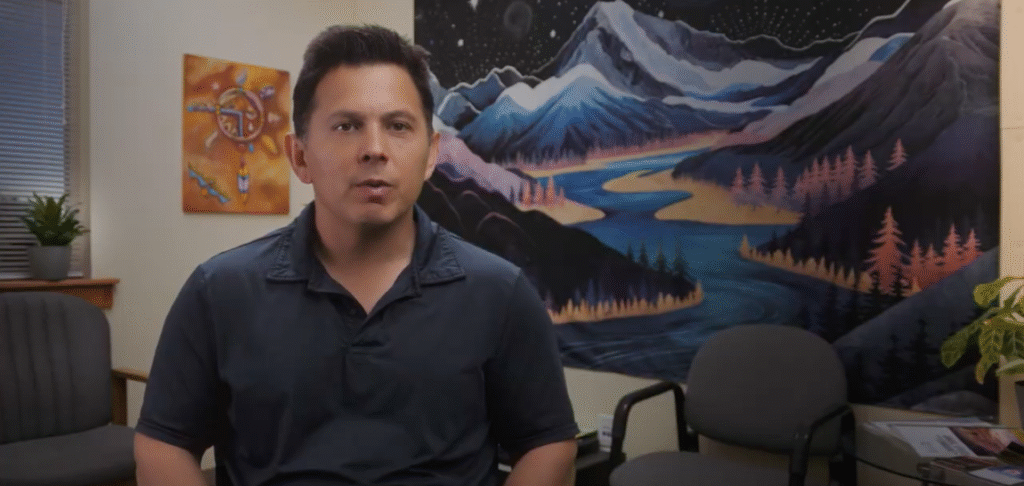
Angelica Mata, a member of the Yurok Tribe, spoke in a Two Feathers video about her experiences with the program, and her recovery from childhood substance abuse. She is now a youth ambassador for the organization, with a long-term goal of obtaining a PhD in social work.
“Being super connected to Two Feathers I felt like has helped me a lot because it made me feel like, ‘OK, there’s other kids who have went through some of the same things as me,” Mata said in the video. “Things that they’ve said to me to inspire me, has helped me a lot, and helped me realize like, ‘OK, I’m not alone, there is worth going on and there is worth moving forward.”
Moorehead Jr., 44, also approaches his job from personal experience. He described his background, and the rewards and challenges Two Feathers faces, in a lengthy interview with The Imprint.
This conversation has been edited for brevity and clarity.
You have been leading Two Feathers since 2018, so I wanted to start at the beginning of your story with this organization. What made you decide to work here, and were there things in your personal life that inspired you to pursue a career in child welfare and mental health?
I have a lot of the same or similar lived experiences as the youth we work with. I was expelled from school, but was able to sign a contract to stay in so I could go to college. I also was justice-involved and struggled with substance abuse throughout my early 20s. Many of the issues we work on, with youth involved in multiple systems, I was also one of those youth. When I was in high school I thought I would be a probation officer — I’ve always had that mindset of helping others and wanting to prevent things I went through.
How important is it for people in roles like yours to have that lived experience?
The power of lived experience and having people that look like you and have similar experiences as you help to be able to connect with the youth, that’s one of the things that has really helped Two Feathers. To use an example, I was in college prep. Even though I was expelled, my father was the chairman and I had a little bit more resources than some of the friends I was hanging out with. I was still getting into trouble, and I was the only Native often in college prep. But I also was hanging out with a lot of the kids and grew up with a lot of the kids that were justice-involved or in the foster care system.
Sometimes, including in Native communities, they are separated by socioeconomic class. I could have been hanging out with the kids in college prep, the more middle class or upper class students, but I didn’t. All of my closest friends and family were not college prep — they were the ones that now are many of the youth we work with at Two Feathers.
That gave me a real unique perspective, but more importantly, it allowed me to coach the other people at Two Fearthers to connect with those youth that are often the most vulnerable and under-resourced.
November concluded the longest government shutdown in American history. I’m wondering if you are feeling any residual effects of the shutdown, financial or otherwise?
It’s not good, especially these federal cuts. I would say if this last year is any sign for what’s coming in the next three years, we’ll have to probably cut 30% of our workforce. Because what the federal government did is they cut off or didn’t put out these Substance Abuse and Mental Health Services Administration grants. They kind of just closed SAMHSA to a certain extent, but some of these tribal-specific grants — like one called Native Connections for Substance Abuse for Youth Mental Health — they just haven’t renewed. Another one called Circles of Care we applied for, and that wasn’t as competitive because it’s specifically for tribes, they just didn’t look at it.
It’s multiple examples. Sixty percent of our funding has been from the federal government, so all these grants getting cut, and then also not being renewed or funded, really has been concerning. It’s a complete hammer to our funding. And one of the things I’ve noticed is, it’s not just the financial negative impacts, but it’s impacted the psychology of all of our communities.
In what way?
We serve all tribes locally and all people that self-identify as Native. We put forth the idea about seven or eight years ago. So we’re traveling like an hour to other reservations for providing services, because even though we’re a different tribe, we work with all Native youth. In all that time, we’ve never had issues about tribe-to-tribe relationships and politics. Now, we’re having issues. Certain tribes are saying, ‘Oh, you’re taking our money’ — because it’s so competitive now because of the federal cuts.
So when I say it’s impacting our psychology, it’s putting an ‘us versus them’ more, it’s putting us in the scarcity-survival mindset — which is really disheartening because we’ve been making a lot of progress in creating synergy and creating these systems through collaboration and working across tribes. What I’ve noticed is that these cuts impacted our ability to work together.
Can you describe the particular regional challenges or nuances in Indigenous child welfare work in Northern California compared to the rest of the state, if any, particularly when it comes to substance use and mental health?
To start, it’s the story of rural California. Humboldt County is very rural. One of the issues to succeed in mental health and substance abuse and child welfare is, how do you get to the families? Eight out of 10 youth that we serve, especially those that are systems-involved, we’re thinking about transportation. Gasoline prices up here, cars, all those things — if we’re not picking them up they’re not showing up, more often than not.
That rural part of Humboldt County is very unique and distinct and offers a lot of barriers. One of the things I think has been a barrier and that might not be as good as it sounds, is there are so many federally recognized tribes in the area. Even just the top biggest tribes, they all have different departments — eight different tribes, eight social service divisions. The Yurok Tribe alone has four or five different departments working with youth. That’s like 20 different organizations or departments that lead to incredible competition, and potentially at least some watering down of programs because of that incredible diversity.
Two Feathers serves people who self-identify as Indigenous and don’t necessarily need to be members of federally recognized tribes. In what ways is that distinction relevant to your work — did you decide on an expanded definition simply to be able to serve more kids, or were there other reasons going into that?
Two Feathers started as a consortium of three tribes: Blue Lake, Bear River and Big Lagoon. And then Bear River and Blue Lake fell off and then it was just Big Lagoon. My dad always said — when he would go to his parents and family and say ‘Hey we’re going to do this for Two Feathers’ —they would always say ‘If it’s going to help kids, do it.’
It expanded to self-identification based on needs, based on who’s reaching out. Other tribes weren’t serving those from out of the area or those who are disconnected from the tribe, and we weren’t going to come from a place of ‘no.’ Within many of the local native traditions and teachings, adoption was normal and that includes a non-Native child, so that philosophy and approach has just naturally developed into that. Lately, we’ve also been doing more work with non-Natives — we aren’t doing direct services like mental health, but we’re not telling them ‘no.’
We host an annual Halloween event and everybody is invited. We do drop-in Native American Club groups at the McKinleyville middle school and there’s about 80 kids that come, Native and non-Native. It comes from a really simple statement — what we’re trying to do is impact Native American youth and the environments around them.
I’d like to talk about your ACORN Youth Wellness program, which has since grown and become a signature program for Two Feathers. What is driving that growth? And can you give specific examples about why and how the program activities you use help prevent substance use and mental health challenges for Native youth?
We started as a staff of five, now we’re a staff of 40 and we have 50 youth employees — so a staff of 90. ACORN was the first major program of the California Department of Public Health, Reducing Disparities Project and it helped put Two Feathers on the map.
We have to meet the youth where they’re at. The youth were saying they wanted to learn about their cultural practices and traditions, so that’s what we did with this program. We used the principles of the Flower Dance, which is the girls’ coming-of-age ceremony that is practiced with all the tribes locally, and a stick game for the boys which is kind of like lacrosse but has a lot of cultural significance.
So it’s using those two practices and then conventional social, emotional and social esteem practices to engage the kids. That combination to teach local cultural practices helps make it fun and engaging. You’ve got to first engage the kids, and then you can get to the mental health and substance use programming. We always say, if you don’t have trust and connection with the kids, you don’t have a youth program.
BEFORE YOU GO… If you learned something from this article, pay it forward and contribute to The Imprint. Our work is funded by readers like you who are committed to unbiased journalism that works for you, not for the algorithms.