
Indigenous children and families reporter Nancy Marie Spears, a citizen of the Cherokee Nation, reported this story as part of The Imprint’s new partnership with the Global Indigenous Reporting Network at The Associated Press. The network aims to lift and center Indigenous voices through insightful, multiformat and digital-friendly storytelling that features underrepresented perspectives.
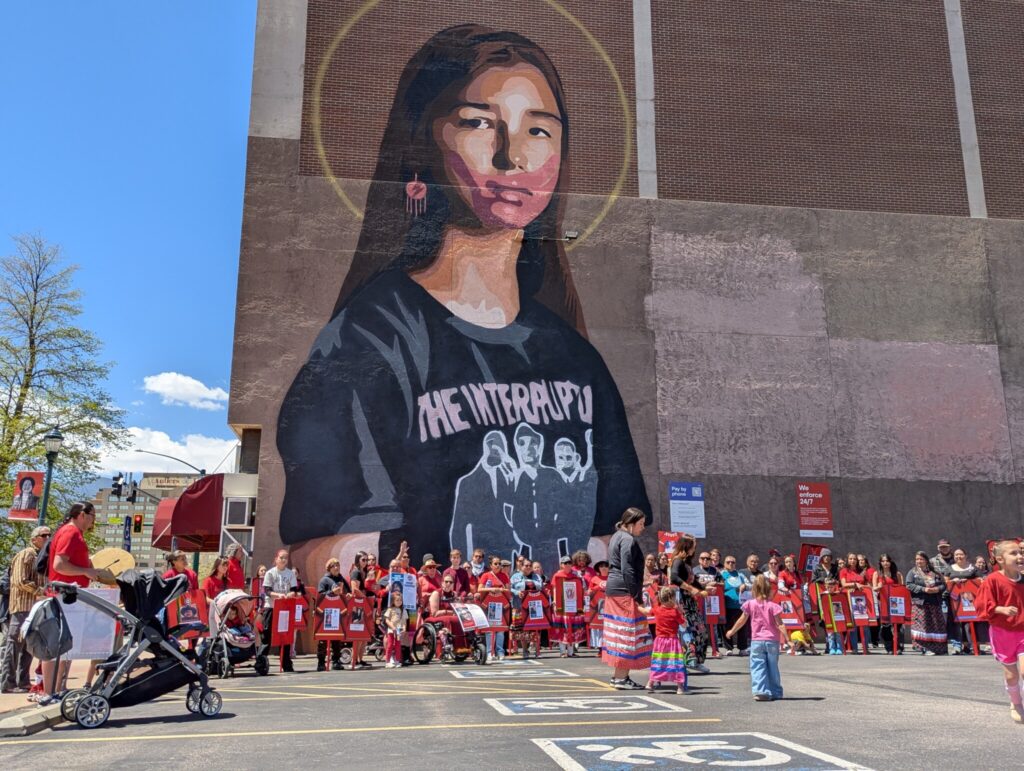
Indigenous people across the country have raised their fists, their poster boards and their voices for an undeniable message in recent days: They will not stand silently by while their relatives are killed or disappear.
In Colorado Springs, the May 5 National Day of Awareness for Missing and Murdered Indigenous People was marked early. Dozens gathered on Saturday chanting: “No more stolen lives on stolen land!” Thunderous buffalo skin drumming boomed out across North Nevada Avenue for the annual prayer walk and rally, one of hundreds of similar events nationwide.
As the march concluded, Denise Porambo spoke into a microphone of surviving her daughter’s murder.
“It hurts every day,” she said, her voice breaking.
Porambo’s daughter, Destiny Jeriann Whiteman of Towaoc on the Ute Mountain Ute Reservation, was murdered last August at age 24, so the pain is fresh. Destiny’s son has just turned 1.
“I believe in God,” Porambo told the somber gathering. “And that’s the reason why I’m still standing here.”
Shay Arcella-Bohman, who is Cherokee and Shawnee, lost her mom. She was murdered when Arcella-Bohman was 17.
“We talk a lot about those we’ve lost,” said Arcella-Bohman, who works at the Colorado Office of the Liaison for Missing and Murdered Indigenous Relatives. “But I also just want to mention the people who are left behind and how hard that can be for all of us.”
Then she sang “Orphan Child” into the microphone in Cherokee, a song she grew up singing as a child.
The Native-led Sweetgrass Advocacy nonprofit and the Missing and Murdered Indigenous Relatives Task Force of Colorado organized the Saturday event. People of all ages attended, with signs taped to baby strollers and wheelchairs.
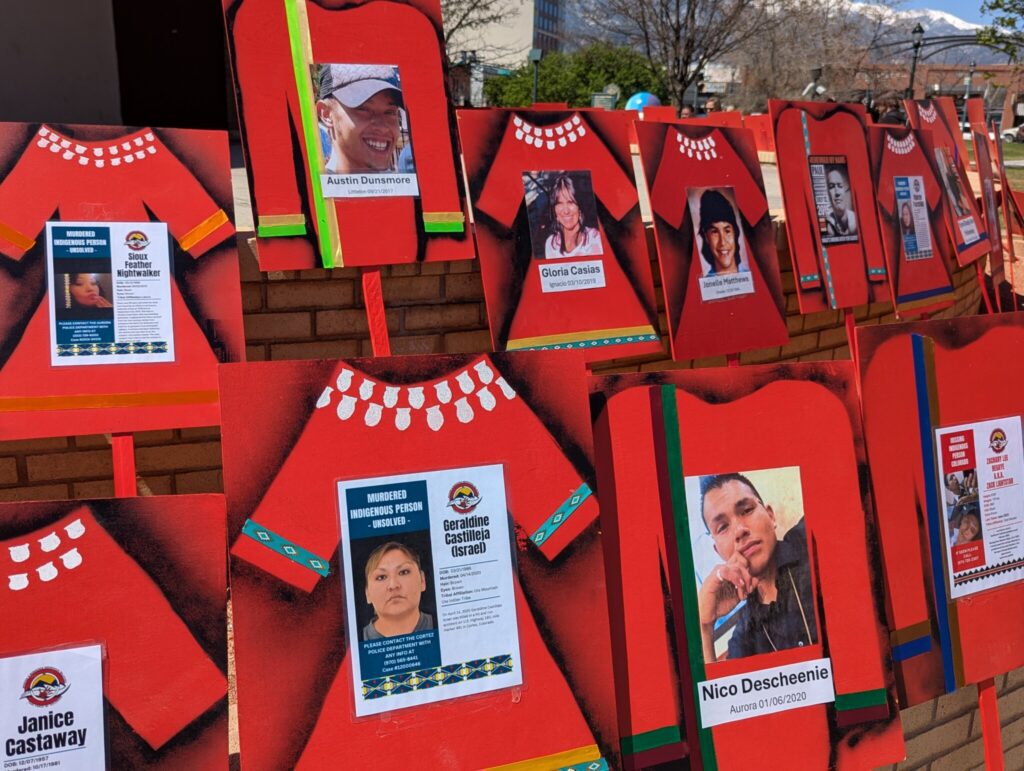
Marchers carried particle-board placards painted red, the color representing solidarity, and bearing photos of the faces of lost relatives. Setting out from Acacia Park, the assembled paused near the place where Joseph Talahytewa, an Indigenous adoptee, was beaten to death in 1996 by three men with two-by-fours. An elder, Dave Red Owl, stood in front of a poster honoring him, saying a prayer, and offering a bundle of tobacco.
Video | Associated Press
At the prayer walk’s final stop, attendees gathered in front of downtown’s Take Back the Power mural, a portrait of Indigenous artist Gregg Deal’s daughter. A red handprint is painted over her mouth and a halo circles her head.
In Colorado, more than one Native person goes missing per week, according to the state’s Missing and Murdered Indigenous Relatives Task Force. And as of Feb. 3, there are four missing children.
RELATED COVERAGE: Indigenous People Honor and Raise Awareness for Relatives Who are Missing or Have Been Killed
To address this, in December 2022, Colorado launched its Missing Indigenous Person Alert system, so that law enforcement can coordinate quickly with tribes and families when an Indigenous person goes missing. More than 200 alerts have been issued since the alert system was established less than four years ago.
On Saturday, Denver City Council member Stacie Gilmore appealed for greater resources. Colorado’s Missing and Murdered Indigenous Relatives Task Force is one of at least 10 such groups across the country.
“We have an epidemic and it has gone on since the founding of the United States,” Gilmore said.
In her state, the task force “is very, very effective,” she added. “But they need an entire staff, they need lawyers and investigators, and they need more folks from the foster care system and within police departments to proactively make sure we’re not encouraging people to run away or go missing or allow others to prey on them.”