
In a sweeping rebuttal to New York’s child welfare agency, the state’s highest court has permanently blocked a program allowing volunteers to temporarily “host” children from struggling families — an arrangement that bypasses the courts that oversee the formal foster care system.
The unanimous 7-0 decision reversed two lower courts’ rulings, and rejected arguments made by the state’s Office of Children and Family Services, the respondents in the case. The agency’s now-annulled model was originally inspired by a national Christian nonprofit based in Illinois; its leader describes his church-reliant host home program as a “social movement.”
“Respondents created the Host Family Home program to offer parents an alternative means of temporarily placing out their children in times of difficulty,” wrote Associate Judge Anthony Cannataro of the Court of Appeals. “The governing law does not permit them to do so.”
Cannataro’s opinion called the state agency’s arguments for the host home regulations “specious” and “unpersuasive” — even describing them as an attempt to “evade” the Legislature’s “carefully designed foster system.”
The plaintiffs in the case included three of New York State’s leading legal aid providers for children, represented by a Manhattan-based corporate law firm. They called the high court’s decision “a major victory for children and families across New York.”
“The Court made clear that the State cannot separate families without due process and the protections required by law,” their joint statement said. “This decision honors longstanding laws and policies that prevent children from being unnecessarily separated from their families and protects the rights of children and parents.”
The Office of Children and Family Services did not respond to a request for comment by press time.
“Respondents created the Host Family Home program to offer parents an alternative means of temporarily placing out their children in times of difficulty. The governing law does not permit them to do so.”
— Judge Anthony Cannataro
Children and Family Services first proposed its Host Family Home regulations in early 2020. Court records show Safe Families for Children’s local leaders had meetings over the prior three years with state agency leaders to advocate for permission to operate.
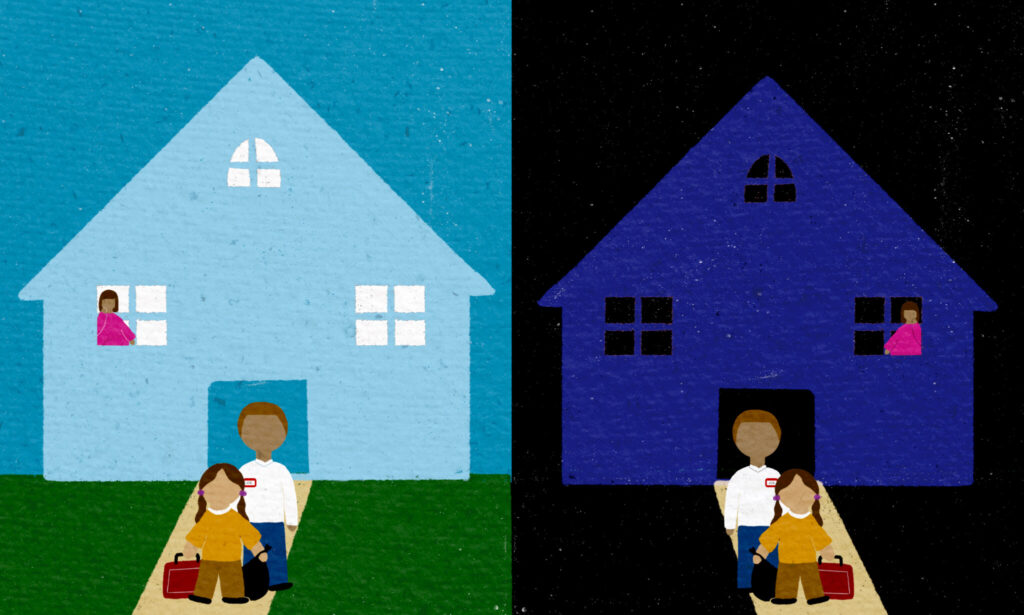
The state rules finalized in 2022 would have allowed struggling parents to place their kids with volunteer caregivers, vetted and overseen by nonprofits but not licensed as foster parents. The informal arrangements could be used, for example, during hospitalizations, military deployments or bouts of homelessness, according to Safe Families.
Launched in Chicago in 2003, the organization’s website says it has since placed 77,000 children in host homes, and provided children “1.4 million bed nights of safety.”
The model has been widely praised, with its founder David Anderson being received at the White House, and Safe Families earning a Compassion Award last year from the evangelical news outlet Christianity Today.
But, as The Imprint reported in an in-depth 2020 report, long-established stakeholders in the formal child welfare system erupted in protest after New York’s child welfare agency released its regulations allowing the group to operate in the state.
The president of the American Bar Association, ranking New York family court judges, county child welfare commissioners, and advocates for children and parents wrote letters to the Office of Children and Family Services, objecting to its proposed rules. One longtime advocate for New York’s kinship caregivers called the host home model “a hydra-headed quasi-foster care monster, with all of the hallmarks of foster care but none of the legal protections the law demands.”
In 2022, the plaintiffs filed suit in a Rensselaer County Supreme Court, alleging the program “removes critical safeguards for both children and parents.”
In a phone interview and emails in 2020, the Safe Families founder and executive director David Anderson acknowledged that his group had met relatively little resistance from state regulators prior to its arrival in New York, where his model of care was viewed more skeptically. Anderson said in an interview the opponents misunderstand the vital social impact of his innovation.
“The Lord gave me the idea of Safe Families for Children,” he once said. “The idea is, how do you build this as a social movement versus just a program? It’s built on the idea of trying to make the safety and protection of our children all of our responsibility, not just the child welfare system.”
Safe Families for Children did not reply to numerous phone calls and e-mails Thursday requesting comment. Its New York chapter’s founder, Laura Galt, told The Imprint last year she received “around 1-5 requests for hosting a month, and have not been able to host in the 8 years that we have received these requests in NYC.”
The Office of Children and Family Services (OCFS) once called its host family homes program a “bold, new initiative.”
The Court of Appeals found it perhaps too bold.
Judge Cannataro ruled that “none of the statutes” cited by the state’s attorneys “indicate that the legislature shared OCFS’s policy preference for the placement of children in Host Homes rather than in foster care.”
The plaintiffs’ statement released Thursday — which included the New York City nonprofits Legal Aid Society and Lawyers for Children, and the Legal Aid Bureau of Buffalo, represented by the private firm Proskauer Rose LLP — said that any government-overseen program that involves removing children from their homes “must include” legal representation for all parties, as well as court oversight.