Two years ago, amid growing scrutiny, Minnesota and states across the country reexamined a longstanding child welfare practice: When the parents of kids in state custody die or become disabled, their rightful survivor benefits are funneled into the cost of the foster care system that cares for them.
Youth advocates have decried the practice and want it stopped. They say the money should be set aside in individual accounts that can be tapped for children’s special needs, or to help young adults leaving foster care without family support or steady income.
In January, after months of surveying foster youth and child welfare agencies and compiling best practices, Minnesota’s Department of Children, Youth, and Families produced a 161-page report outlining its findings. The informational report to the Legislature identifies hundreds of Minnesota foster youth who are paying into the foster care system rather than having their parents’ money set aside for them — funds that amount to millions of dollars in revenue.
The report is advisory in nature and makes clear that the next steps are up to state lawmakers.
But it recommends “requiring county agencies to preserve federal cash benefits for all or a portion of children and youth in foster care” and calls for the creation of accounts for those currently receiving such funds. The department also recommends that county agencies be prohibited from becoming “representative payees” for foster youth in instances where they may reunify with family.
Before making any changes, however, lawmakers must resolve a number of key “decision points” outlined in the report. They include deciding which federal benefits should be preserved, whether all eligible foster youth should have savings accounts — or only those close to transitioning to adulthood — who should have access to preserved funds, and how and when foster youth should be made aware of their benefits. The report also highlighted concerns around potential misuse of the funds, or financial exploitation of foster youth who receive them.
“It is incredibly complicated,” the department’s Commissioner Tikki Brown wrote in a letter to legislators prefacing the report. “Each time an answer was developed for a question, one or more new questions would arise. This issue is like the proverbial onion — each layer reveals another.”
In a statement sent to The Imprint, the head of a prominent advocacy group for foster youth in the state praised the report’s initial findings, while urging swift reaction. For years, Foster Advocates has called for an end to the use of federal benefits to fund child welfare agencies.
“Foster Advocates has sought an immediate end to federal benefits being stolen from Fosters since 2022, with the ultimate goal of all federal benefits owed to eligible Fosters to be collected and saved for their future,” interim executive director Ariana Chamoun said in an email.
Chamoun called the report and a state law passed last year that requires notification of youth and families “a critical step,” but added more needs to be done. “We know this is a complicated issue, and that doesn’t mean we should do nothing, she said. “It is possible for Minnesota — right now — to join other states and stop this harmful practice, while we keep working on the longer-term steps to do right by future Fosters.
Minnesota findings
At its core, the state’s report addresses questions around how money should be preserved and distributed to a foster child with a parent who died or became disabled and, as a result, receives one of several federal benefits: Supplemental Security Income; Social Security Disability Insurance; Retirement, Survivors, and Disability Insurance; veterans benefits; and railroad retirement benefits.
Working with private consultants, Brown’s department spoke with more than 250 individuals and organizations, including child welfare agencies, representatives of tribal nations and current and former foster youth.
Surveys showed that in 2022, the most recent year data was available, about 600 foster youth in Minnesota received federal benefits of any type, representing about 9% of all foster youth. County child welfare agencies received a total of $2,791,130 as representative payees for these foster youth. The median collected per county that year was $27,591, with $21,086 being spent toward the cost of care.
The report also highlighted problems in transparency around the funds. More than 20% of counties were unable to provide the number of foster youth receiving federal benefits in 2022.
The foster youth receiving the benefits known as SSI were even less aware. Over a third said they were not sure whether they were eligible for federal benefits. Only 19% “strongly agreed” that they were aware of how their representative payee used their federal benefits.
“The sole reason these foster care agencies exist is to protect and serve the welfare of vulnerable children. How is taking resources from those children possibly protecting their best interests?”
—Daniel Hatcher, University of Baltimore law professor
But foster youth were unequivocal on how they’d like those benefits to be used: 95% said they “somewhat” or “strongly agreed” that they’d like to have the money invested in a savings plan.
Young people who have not been reunited with families or adopted leave the foster care system between the ages of 18 and 21, and most have few, if any, resources to become financially independent. An established savings account could make a world of a difference.
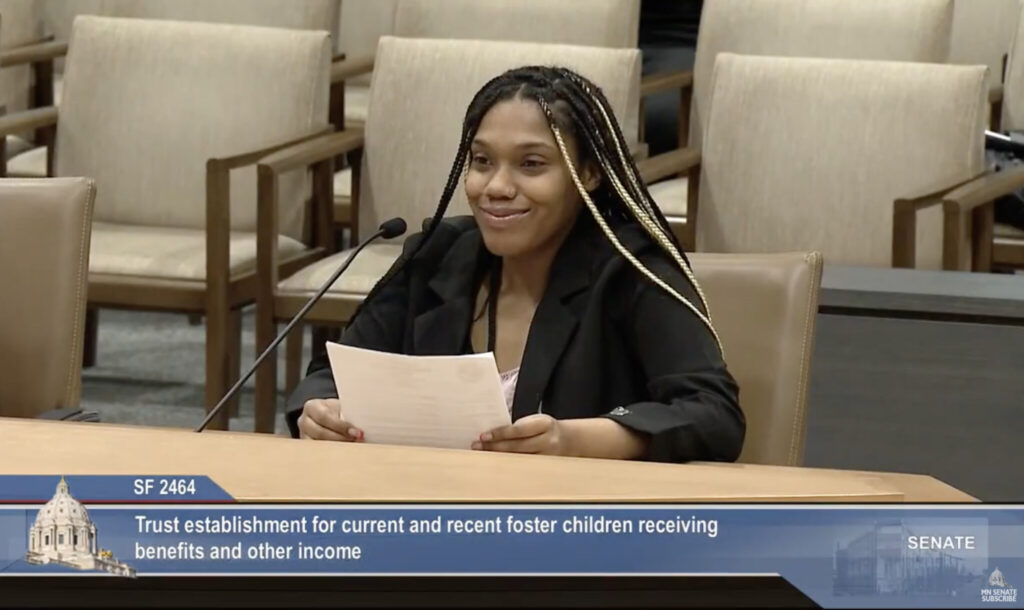
In March 2023, Foster Advocates community board member Ada Smith testified in front of the Minnesota Senate Committee on Health and Human Services about her experience with federal benefits after her mother passed away when she was 13. For two years, Smith lived with her older sister, and they survived on their mother’s benefits.
At 15, Smith entered foster care, and ended up homeless for the next three years as she became a mother herself. Smith said she was told she couldn’t draw on the benefits her mother’s death entitled her to, because “it would be considered double dipping.”
Now a mother of three, Smith reflected on how that money could have helped her in a tough time.
“This would have meant housing for me and my child. This would have meant child care for me and my child,” Smith, now 26, told the Star Tribune last month. “Every good house has a foundation. This would have been stability for me and my child; this would have been the foundation.”
A timeline for new policies covering such survivor benefits has not been established, principally because there are questions lawmakers need to resolve, the child welfare commissioner says.
“It’s hard to say how long it may be before Minnesota counties can no longer spend federal benefits on foster care,” Brown said in a statement to The Imprint.
‘It’s just not that complicated’
Controversy over such use of SSI benefits became public four years ago. A 2021 Marshall Project and NPR investigation found that in almost every state and Washington, D.C., foster care agencies routinely and legally applied to Social Security to become foster children’s financial representatives and then took the money, usually without notifying the child or their family members.
Since then, some remedies have been proposed or enacted.
Minnesota is among roughly half of states that have introduced or passed legislation or policy reform measures to stop the practice. Some of these measures have stalled.
Minnesota’s 2023 legislation was introduced in both chambers and would have established a benefits trust for eligible foster youth, managed by the Office of the Foster Youth Ombudsperson. The larger intent of the bill did not pass, and lawmakers instead authorized the two-year study that resulted in this year’s report.
Last year a more modest bill did become law. It requires counties to notify a foster youth or their family member if a child welfare agency becomes a payee on benefits, and if the child is at least 13 years old. It also states that agencies can only use the funds to care for the child, instead of commingling them in a general fund.
“We know this is a complicated issue, and that doesn’t mean we should do nothing. It is possible for Minnesota — right now — to join other states and stop this harmful practice, while we keep working on the longer-term steps to do right by future Fosters.”
—Ariana Chamoun, interim executive director of Foster Advocates
The recent report from the state’s Department of Children, Youth, and Families recommends screening all foster youth statewide so that accounts can be set up. It states: “The Legislature should require county agencies to screen children and youth in foster care to determine whether they currently receive, or may be eligible to receive, federal cash benefits; apply for or help a child’s parent or guardian apply for federal cash benefits for children and youth in foster care who may be eligible; and establish preservation accounts.”
But Daniel Hatcher, a law professor at the University of Baltimore who is an expert on child welfare policy, said although Minnesota is ahead on numerous other child welfare reforms, it remains “behind the curve” on the SSI issue, since it has not yet stopped the seizure of benefits outright.
The motivations to maintain the status quo, however, are not necessarily insidious, he added. Hatcher said many states are not fully aware of the issue, and it can be difficult to pin down which department or agency is responsible. But that does not absolve state and child welfare leaders from fixing the problem.
“There are issues with any type of program or policy that an agency implements — they have to be worked out,” Hatcher said. “But it shouldn’t stop the agency from doing the right thing. It’s just not that complicated.”
Hatcher pointed to Kansas as an example. Last month, Gov. Laura Kelly signed an executive order barring the Kansas Department for Children and Families from using foster youths’ federal benefits for their care, with a plan to set up individual accounts. She was the first governor to issue such an executive order.
Others, including Arizona and Washington, D.C., have passed comprehensive reforms.
From a legal perspective, Hatcher said that children have no obligation to pay for their own care. And under federal law, states are required to provide and pay for foster care services.
“But take off the legal hat and just think about it from a moral perspective,” he said. “The sole reason these foster care agencies exist is to protect and serve the welfare of vulnerable children. How is taking resources from those children possibly protecting their best interests?”