

An immigration judge has denied bond for a well-known foster youth advocate who faces deportation and has been locked up in a Southern California detention center for the past six months.
Despite pleas for his release by state lawmakers, local activists and family members, the Wednesday court ruling determined that Axel Pecero, a 25-year-old father of one, remains a flight risk.
“It’s upsetting, but also expected, given what’s going on right now,” said Evelyn Rodriguez, a former foster youth and a member of the Los Angeles County Youth Commission. If Pecero is ultimately deported, Rodriquez added, “we will be losing an invaluable part of our community.”
Pecero’s troubles began Aug. 6, when he was returning to his hotel after a work conference on youth with substance and behavioral health issues. Burbank police officers stopped him and found he had an outstanding warrant for failing to appear in court for a years-old traffic citation.
Immediately after he was released from a Burbank police station, officers with the U.S. Immigration and Customs Enforcement took him into custody amid an unprecedented immigration crackdown in the Los Angeles area. He was taken next to the Adelanto ICE Processing Center, located nearly 90 miles east of downtown Los Angeles. The notorious privately-owned facility — located in the Mojave Desert north of the San Bernardino Mountains — is the largest immigration detention facility in California and inaccessible by public transportation.
The Imprint detailed Axel’s story, and the broad effort among child welfare advocates to win his release, in a two-part series published in November.
His case advanced on Tuesday at the Adelanto detention center, in a spare courtroom with white concrete walls and three rows of wooden pews.
An Imprint reporter attended the hearing, but was allowed no pen, pencil, notebook or paper to document the proceedings. Those items, along with cellphones and recording devices, could not be brought into the barbed-wire encircled, locked facility.
Appearing clean-shaven, Pecero wore a navy blue, jail-like uniform provided to detainees who are designated low-risk. He and his lawyer, who appeared remotely on his behalf, asked Judge Curtis White to allow Pecero to remain free during his deportation proceedings to be able to provide care for his 4-year-old son Ajay, who he calls an inspiration.
Pecero was eligible for a bond hearing under a California court ruling allowing noncitizens detained for more than six months during deportation proceedings to have a chance for release under certain conditions.
Judge White also heard arguments from the government’s attorney, who described Pecero as a potential public safety threat and flight risk due to arrests in 2021 and 2025.
Pecero’s pro-bono counsel Noah Montague, an attorney with the immigration legal services firm Al Otro Lado, had informed the judge that none of Pecero’s arrests ended in convictions, and he said his client would attend all future deportation proceedings while caring for his son.
Nine community members, including several former foster youth and other advocates, attended the hearing. Because talking was prohibited in the courtroom, Pecero made eye contact with several fellow advocates when he entered, forming the symbol of a heart with his hands.
After about 20 minutes, the hearing drew to a close as Judge White announced he would return a decision the following day, and Pecero’s supporters filed out through a heavy courtroom door.
In three weeks, the judge will determine whether he will be sent back to Mexico — the country he left at age 3 to travel to the U.S. with his grandmother. But if he were freed on bond, Pecero could have fought his case from home, rather than an ICE detention facility.
For a few moments after his Tuesday court appearance, Pecero and his brother Isaac stood together. They clasped each other tightly, murmuring words of affection before the siblings had to walk in separate directions.
Isaac Pecero told his brother that he loved him, and promised him a happier future.
“I told him, ‘You should come home,’ and how we’re all going to welcome him with open arms when he gets home,” Isaac Pecero said. “We all deserve to be together.”
Recent analysis of immigration data by The New York Times and the Cato Institute found that few immigrants picked up in ICE operations last year were detained because of serious criminal convictions. Like Pecero, roughly 57% of immigrants arrested during the high-profile enforcement surge in the Los Angeles area last summer had no criminal charges. Just 6% of those detained had a conviction for a violent crime — a rationale the Trump Administration has long cited as a reason for the ongoing nationwide crackdown.
Immigration-related arrests ballooned by 600% during Trump’s first nine months in office, according to a recent report by the American Immigration Council. And the Trump administration has set new legal precedents and executive orders that limit the ability of immigration judges to release detainees on bond. As a result, releases dropped by 87 percent from January to November 29, the report notes.
A three-judge panel of the U.S. 5th Circuit Court of Appeals handed the Trump administration a legal victory on Friday, ruling that the vast majority of immigration detainees are subject to “mandatory detention,” and may be held without bond hearings even if they don’t have a criminal record and have lived in the U.S. for years.
In an October interview with The Imprint, Pecero said his life was on track before his arrest, after several rocky years following his high school graduation. During that time, he ended up living in his car and at homeless encampments.
He was also arrested and involved in two “cite-and-release” cases that continue to have consequences for his immigration case. In 2020, a joyriding incident led to four misdemeanor charges, including being in possession of a stolen vehicle, court records show. And in 2021, Pecero was charged with a misdemeanor at Los Angeles International Airport for driving without a license. A warrant for failing to appear in court for that incident led to his August arrest. However, Pecero has no criminal convictions in these cases, as his attorney reminded the court.
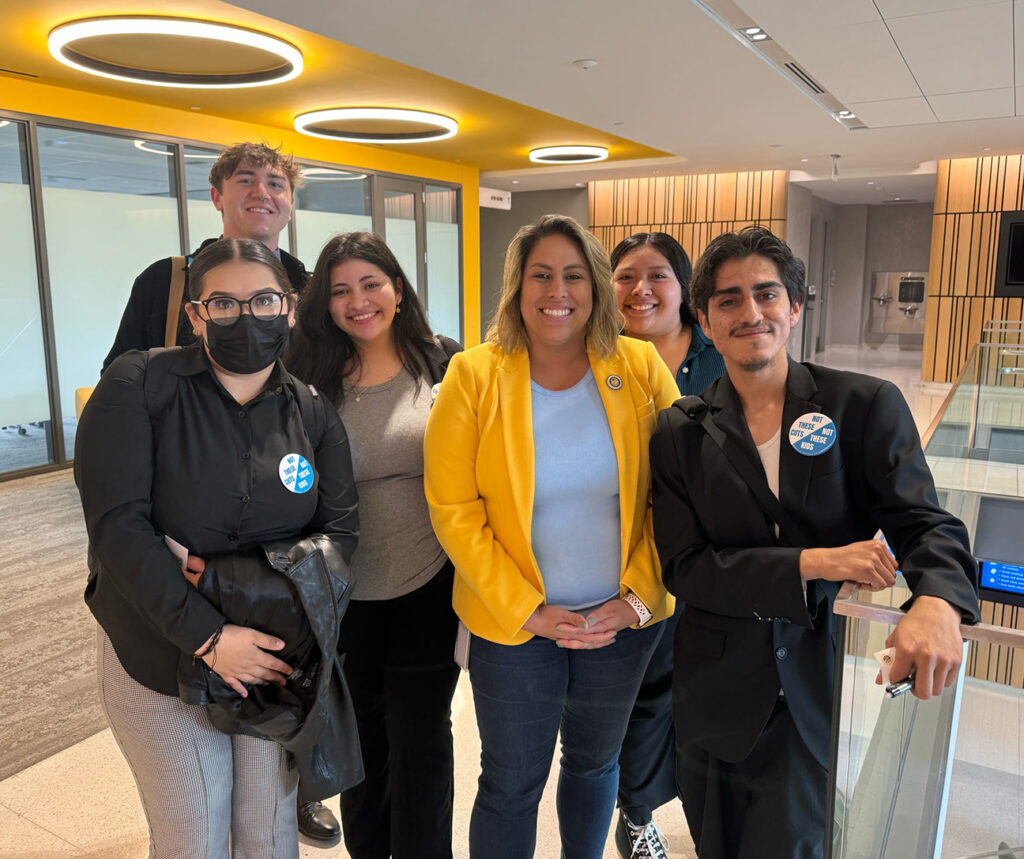
In recent years, he had embraced his role as an advocate for young people involved in the foster care and juvenile justice systems. He has testified before the California Legislature in support of relative caregivers and programs that assist youth in California’s child welfare system. Pecero also shadowed Los Angeles Rep. Sydney Kamlager-Dove in Washington D.C. as part of the National Foster Youth Initiative’s 2024 Congressional Leadership Academy. He has rallied outside of Los Angeles County’s troubled juvenile hall, and testified about youth justice issues at public hearings.
Last year, dozens of letters of support were submitted to the court on his behalf, including some from foster youth and state officials in California.
“Losing Axel would be a tremendous, destabilizing loss that risks a repeated cycle of trauma for those who already carry scars from separation in the foster care system,” former foster youth Jasmine Genevieve Gamez wrote.
Pecero’s next court date is scheduled for March 4. His effort to avoid deportation now hinges on whether he can qualify for legal relief, requiring him to prove in court that he is a “person of good moral character” and that his removal would cause “exceptional and extremely unusual hardship” to his young son.
At a court hearing last month, Pecero said he is scared to return to Mexico, where he fears he may be falsely targeted as a wealthy foreigner who doesn’t fit in. He would also be out of his son’s life during crucial developmental years.
“I came here at the age of 3, and all I’ve ever known is being in America,” Pecero told The Imprint in a telephone call from Adelanto last year. “I really do feel like I belong here. I can’t imagine going back to Mexico and not being in my son’s life.”