
About 10 years ago, Los Angeles residents Georgie Smith and Melissa Goddard wanted to expand their family. They considered the options for having their own biological child, but also set out to learn all they could about adoption and foster care.
While volunteering with foster youth, the couple met Barry, a young man in his early 20s transitioning out of Los Angeles’ state care. He had just secured his first apartment with a Section 8 voucher and asked if they could help him move. He had few belongings and the rental apartment itself was barren — not even a fridge or stove.
“I saw him living on the floor,” Smith said. “I was just like, ‘No, this can’t be.’”
So the couple turned to social media, asking for the types of items parents send children off to first apartments with: a table and chairs, a softly used couch, kitchen items and wall hangings. Donations poured in, friends lent trucks, and Barry’s empty apartment became a home.
When Barry’s friends from foster care saw his new place, they wanted to know: Could Smith and Goddard do the same for them? The couple couldn’t say no. After that, word about them only continued to spread.
“All of his friends that were coming out of transitional facilities, aging out, reached out to me for help, thinking that this was a service that existed and it didn’t,” Smith said.
That experience sparked an idea that has grown into a unique service for Los Angeles foster youth moving out on their own for the first time: A Sense of Home, a nonprofit that transforms empty colorless apartments into fully furnished, thoughtfully designed habitats. Like an Extreme Makeover: Home Edition for former foster youth, the remodels are carried out by volunteers who swoop in with truckloads of donated furnishings and then pull apartments all together in a matter of hours.
Their mission, Smith said, is to shift young people’s notion of “home” from scarcity and survival to comfort and care.
“A roof over their head is not enough,” she said.
‘A corrective experience’
In most states, foster youth aging out of care have access to housing programs up to age 21 and in some cases, a couple years longer. After that, housing assistance becomes more spotty. Many former foster youth are eligible for vouchers to help subsidize rent, but otherwise, they are largely on their own to secure a place and furnish it.
A Sense of Home offers something different but equally important, Smith said. The nonprofit is built around the idea that you can give someone a place to live. But creating a space they can be comfortable in and proud of reinforces their sense of worth and security, which is particularly important for young people who may have never experienced those feelings before.
Regina Brodell, a 29-year-old doctoral student at the University of Southern California, called her 2023 home creation a “corrective experience.”
Brodell entered kinship and foster care at age 11 after her single father received a late-stage cancer diagnosis. He was frequently hospitalized and she and five siblings were often separated and moved from home to home.
Brodell said people who grew up as she did have a hard time “knowing what is a home.’’
“When you’re in the system like I was, I got so good at knowing, like, this is not a home, this is not a welcoming space,’’ Brodell said. “You just learn to survive in it, but your compass gets really calibrated to know that’s not home.”
The apartment A Sense of Home designed for her, she said, showed her she could have something different — something more — for herself.
“It’s the first time I’ve ever said, ‘OK, Regina, you can breathe. You can let your soul catch up with itself in this space. And this is where you can be creative and you can heal,” Brodell said.
This year, A Sense of Home reached a milestone: 1,200 homes created for youth formerly in foster care since 2015. Smith and Goddard intend to expand into more cities throughout the country, with a New York City launch planned for later this year.
“I thought that at some point maybe the requests would stop coming in, but it grew and it grew and it grew,” Smith said.
About 40 former foster youth are currently on the waitlist for a home creation, said a spokesperson for A Sense of Home.
Following the devastating fires in Los Angeles County, the nonprofit also launched another program to help anyone who lost their homes. The waitlist for this service stands at 1,200, according to its website.
The nonprofit has become a darling of celebrities who have thrown lavish fundraising galas for it. Netflix CEO Ted Sarandos hosted an event at his home last autumn, and Drew Scott, one of the famed twins from the “Property Brothers” house-flipping TV series, is on its board of directors. Volunteers, many of them former foster youth, sometimes find themselves working shoulder to shoulder with A-list stars like Bradley Cooper.
Los Angeles city leaders have also taken note. At an April meeting of the county’s Commission for Children and Families, the director of LA’s child welfare system, Brandon Nichols, spoke about the powerful self-reckoning he experienced after volunteering with A Sense of Home. He recalled meeting a young mother and her “cute as a bug” son Jasper, and moving them into their new apartment.
“It’s the first time I’ve ever said, ‘OK, Regina, you can breathe. You can let your soul catch up with itself in this space. And this is where you can be creative and you can heal.”
— Regina Brodell, former foster youth
The nonprofit’s approach to caring for transitioning foster youth caused him to reflect on how his department serves young people struggling with housing insecurity, he said.
“I think we — the executives, the folks that live in ivory towers and make decisions — need to see the impact of our work and we need to meet with the people we affect,” he said.
Changing lives in 90 minutes
What began with just two dedicated people driving U-Hauls on early weekend mornings now has a staff of 17, a volunteer pool of thousands, on-call interior designers and a warehouse full of donated furniture and decor. The nonprofit has an annual budget of $2.8 million made up of grants and contributions from philanthropic foundations and high-profile donors like Khloé Kardashian, Google and HBO.
Clients are referred by the Los Angeles Department of Children and Family Services, local nonprofits, transitional housing programs, and law firms such as the Children’s Law Center of California and Alliance for Children’s Rights. Many former foster youth reach out directly after hearing about the program from friends.
Sometimes a young person has already secured housing when they seek out A Sense of Home’s services. In other cases, Smith’s staff helps them obtain housing vouchers through the city’s Housing and Urban Development Department’s Foster Youth to Independence housing assistance program. Then they connect them with a landlord that will rent to them.
Before any furnishings are selected or decor decisions are made, incoming residents are asked about what inspires them and brings them a sense of peace.
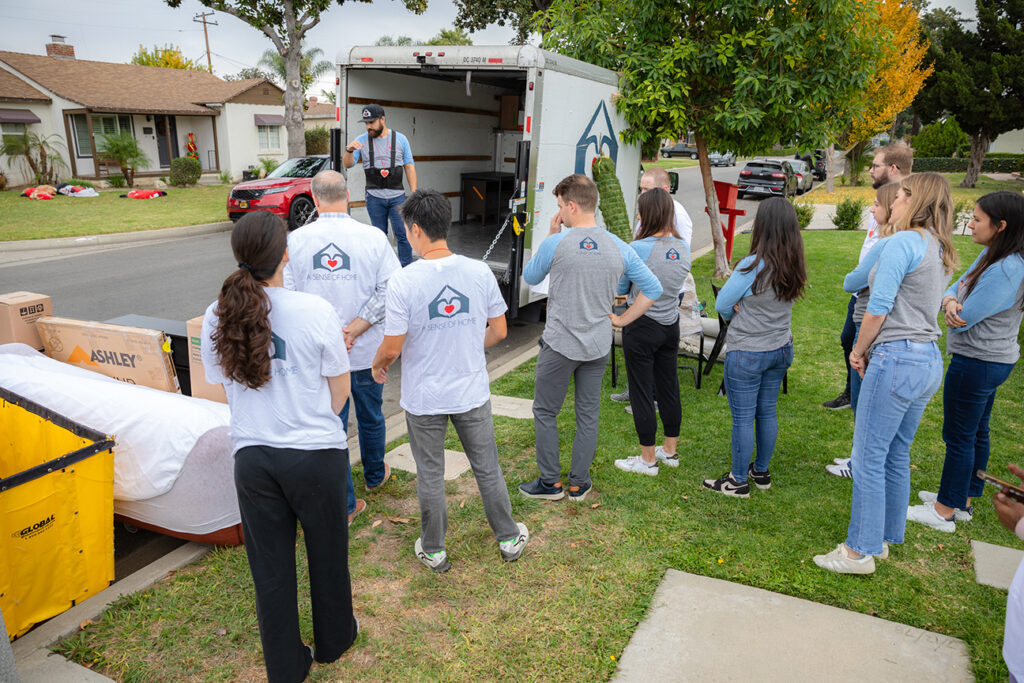
The answers to these questions guide designers as they gather furniture and map out rooms. Once a resident has keys in hand, the transformation occurs in a 90-minute flurry of activity. Moving trucks arrive and volunteers — often former foster youth who return to help others after their own “home creations’’— unload beds and linens, couches and dining tables, bookcases, kitchenware, nightstands and area rugs. Residents with children receive cribs or small beds, desks or toddler-sized coloring tables, as well as new toys, books and board games. High chairs, strollers and car seats are provided for the littlest ones.
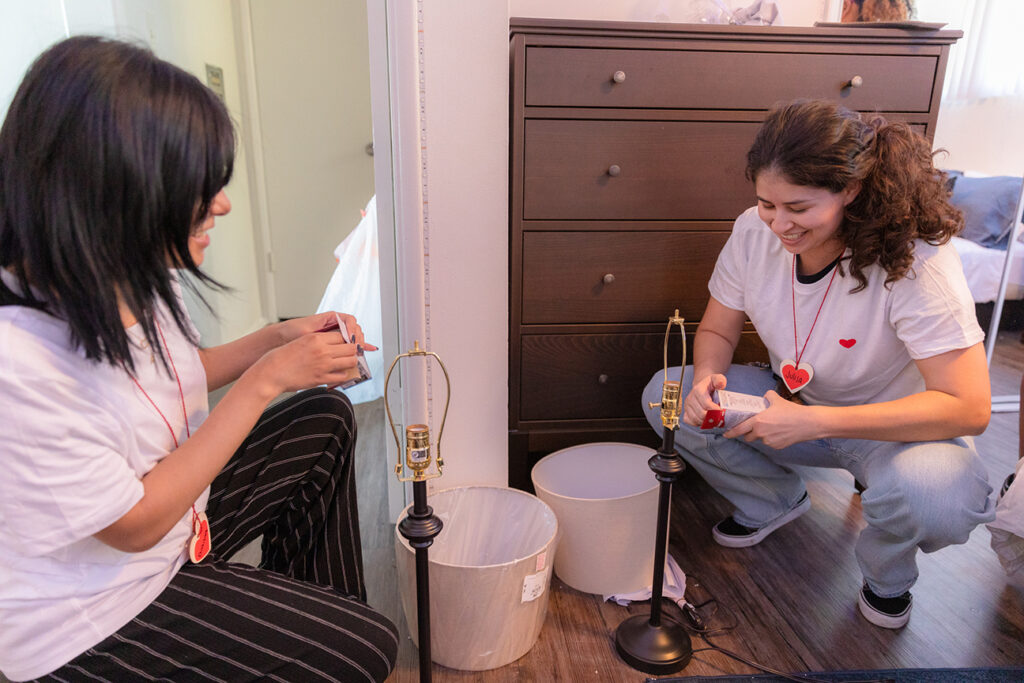
The team makes sure each apartment is equipped with a stove and fridge, as well as a microwave, blender, toaster and television. After that, volunteer designers troop in with curated pieces to round out the rooms: curtains to add warmth, artwork for the walls, candles, potted plants and vases for flowers.
“We really believe in the home being something comforting and should be somewhere you want to be and feel safe,” said Brittany Zwickl, a partner at the Los Angeles design company Studio Life/Style, who volunteers with A Sense of Home.
Then, like a made-for TV moment, comes the big reveal — when the resident finally crosses the threshold into their new home. Jaws drop. Tears flow.
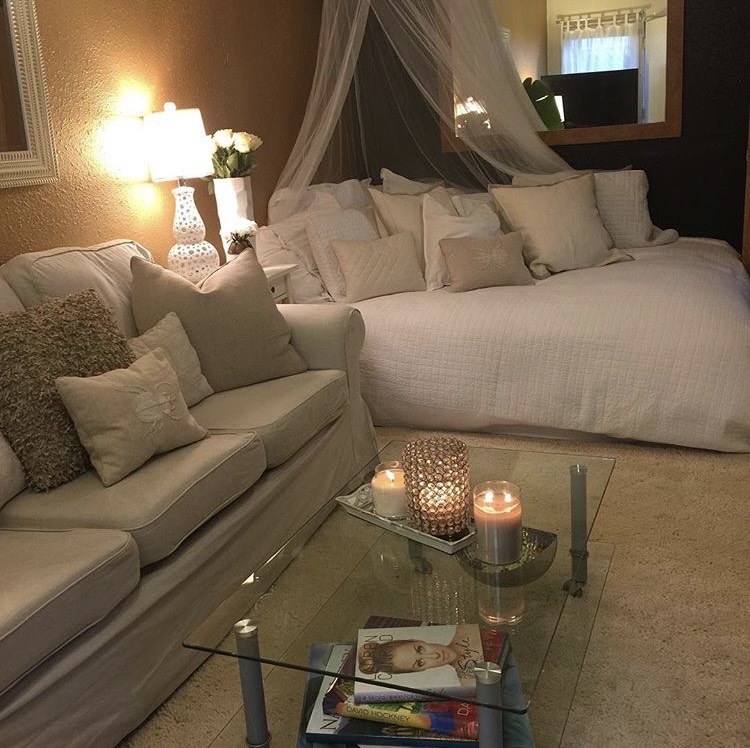
Yolanda Elam, a friend of Barry — Smith and Goddard’s first beneficiary — was also one of the earliest recipients of a home creation. She told her team in 2015 that she wanted everything in her new apartment to be clean and white and calm — the very opposite of the dark, cluttered, unsafe homes she grew up in.
And, she told them unabashedly, she wanted to feel like a princess. During her big reveal, she was delighted to find her new studio occupied by a very princess-like bed swathed in a canopy of tulle.
Up until that moment, Elam had never had a room of her own. She had never had her own things. She’d been in foster care since age 13 and had battled homelessness, too. At most, in temporary foster homes, she’d decorate the wall above her narrow bed — when she had a bed of her own — with a single photo of her and her sister, who she’d been separated from in the system.
“My attachment to the homes was, I didn’t know how long I was going to stay there, so it was like, let me not get too comfortable,” said Elam, now 35, and currently working as the business development director for A Sense of Home. “You’re in someone else’s space, touching other people’s items, and you’re oftentimes in strangers’ homes.”
At each home creation, volunteers leave a jar stuffed with “love notes” — affirmations and encouragement residents can unfold on tough days so they always remember there’s a community rooting for them.
Brodell knows these feelings. They followed her out of foster care and into adulthood where the apartments or rented rooms she lived in were just places to eat and sleep.
“I never took the time to make something look, you know, beautiful or warm or homey, nothing like that — I didn’t allow myself to build that attachment,” Brodell said.
But in 2023, after hearing about A Sense of Home from a foster youth organization, she reached out for help.
After learning Brodell spent her earliest years in a small desert town on California’s border with Mexico, the home creation team hung a Joshua tree print on her wall and placed a molcajete — a traditional Mexican mortar and pestle — in her kitchen.
“Seeing that piece in the kitchen,” she said — something she grew up with — “was like, wow, that must have taken a lot of thoughtfulness.”
Listening closely to young people about what they need, want and remember is at the core of A Sense of Home’s approach, Smith said. Equally important, she said, is what her nonprofit provides outside of furniture and interior design services.
The organization connects participants to low-cost therapy and offers up to $19,000 in annual individual educational scholarships. They also host wellness activities for alumni such as yoga and meditative sound baths, financial literacy skills trainings and a yearly back-to-school bash where they can stock up on school supplies and catch up with old friends.
But perhaps the best thing that’s sprouted is a peer support group among the former foster youth who volunteer, Smith said. As they work alongside each other building a bed or painting a wall, the young people swap stories and share advice. And at each home creation, they leave behind a jar stuffed with “love notes” — affirmations and encouragement residents can unfold on tough days so that they always remember there’s a community rooting for them.
Smith and her partner never ended up adopting. But, she said, the growing group of young people who they’ve helped — and who remain in the program and their lives — have become like family.
In that sense, she said, “We have all of these kids who we’ve kind of adopted.”