
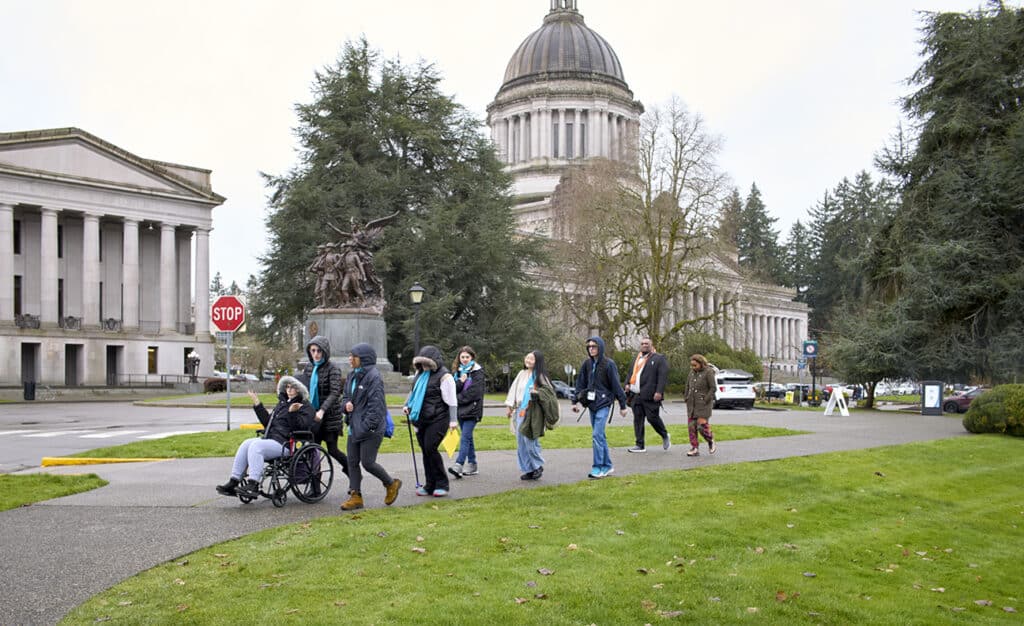
During Washington state legislative hearings last winter, former foster youth Courtney Hageman, 21, testified about reaching the end of her time in foster care. She lived with a church friend, her only option at the time.
But having to depend on someone else for housing felt precarious, and the consequences of any misstep constantly weighed on her, she told lawmakers.
“I felt the need to hide my trauma and the life-pausing panic attacks I was having,” Hageman said. “I was terrified of losing my place to live if I didn’t have their approval, which led to delaying essential treatment.”
Lydia O’Taylor spoke during those hearings about how she overcame homelessness, but knew several other unhoused young people who died on the streets.
“It’s a long road to stability rather than a single step,’’ O’Taylor said. “I have been forced to compete with other homeless youth for my placement in housing and services, including other foster youth.”
For two years in a row, after hearing such testimony, Washington lawmakers have considered — but failed to pass — legislation aimed at addressing housing instability among young adults in extended foster care.
Taken from their families and raised by the state, these youngsters reach adulthood without guardians or adoptive parents. At 21, they’re on their own. Advocates who have pushed for this legislation say securing affordable housing is the most daunting challenge they face.
Having access to stable housing provides foster youth “the opportunity to heal from trauma and grow into capable adults,” Hageman testified in the state senate’s Ways and Means Committee’s January hearing.
In this Pacific Northwest state, housing can be unaffordable even for the gainfully employed: According to tallies by the Washington Center for Housing Studies, social workers, firefighters, nurses and teachers also struggle to afford housing.
Last January, the state’s Board of Health reported that of the 1,039 young adults who remained in Washington’s foster care system until age 21 last fiscal year, 219 were homeless or unstably housed — almost one-fourth of that total population.
The Senate bill introduced by Sen. Claire Wilson in late 2025, along with a companion bill from Rep. Jamila Taylor in the House, would have required the Washington Department of Children, Youth, and Families to create a two-year pilot program that would provide rental assistance and cover housing-related fees for up to 50 foster youth aged 18 to 21.
“We are urging you to do your job and ensure that we are housed.”
— Charles Smith, the Mockingbird Society
Lawmakers had previously considered a similar, more permanent housing assistance program, but rejected its $10 million price tag. The scaled-back proposal offered this year would have cost an estimated $2.5 million if implemented in 2027, said Charles Smith, director of public policy and advocacy for the nonprofit Mockingbird Society.
But the bill did not advance out of committee during Washington’s 2026 legislative session.
Bridget Doyle Williams, a spokesperson for Wilson’s office, cited the state’s short legislative session and ongoing budget shortfall as reasons behind the bill’s failure to advance, but said the senator “hopes to revisit this issue next session.”
Advocates vow to fight on
Foster youth and their advocates at the Mockingbird Society say they are undeterred and plan to continue to push lawmakers to take up the housing proposal next session.
“Young people are truly leading this effort and saying to legislators, ‘We’ve been patient with you, we brought this bill forward to you in 2025, we heard your request to skinny the bill down — we’ve done that. Now we are urging you to do your job and ensure that we are housed,’” Smith said.
As for next steps, Smith said he and the Mockingbird team are staying in touch with Wilson to refine the bill ahead of the next session. In the meantime, he said, needs remain high.
“When Washington chooses to keep young people in its care, it takes on the responsibility for their safety and stability,” Smith told The Imprint. “Yet today, too many young people in that very system are still experiencing homelessness.”

Under Washington’s Extended Foster Care program, young adults have continued access to health care, case management and help accessing food assistance and other resources.
They are also eligible to receive “supervised independent living” payments from the state. The stipend provides up to $860 a month for rent and other expenses, but that amount often fails to keep up with the steep costs of living, advocates say.
Federal housing vouchers are another form of assistance available to foster youth transitioning into adulthood. But to access those, young people are required to leave extended foster care to avoid “double dipping’’ into federal and state dollars, Smith explained.
Under the legislation that had been proposed, young adults in the pilot program would not have had to leave extended foster care to access the housing support.
Assistance would have been based on the fair market rent where foster youth lived, and would have required recipients to pay no more than 30% of their adjusted gross income toward rent.
What life looks like with support
During her testimony, Hageman told lawmakers that she believes she would have been able to “attain so much more’’ in life had her housing situation felt safe and secure while she was approaching the end of her time in foster care.
“I know this because after getting that support from other outside sources, I’m on the other side of it now — getting straight As and working a job that gives me hope,” she said. “The problem is most kids inside this broken system don’t have anything near the privilege of the outside supports that I had to help me get through this. So too many of us end up back in the system or on the streets.”
Before moving to Washington, Jonas Rios struggled to support himself after remaining in extended foster care in California, his home state. Every month, his $900 rent and $50 phone bill swallowed the roughly $950 in “supervised independent living’’ payments he received. He could not afford food.
“I didn’t have anything to eat,” Rios, now 24, said in an interview.
Today, he is a college student studying molecular bioscience, and as a chapter member of Mockingbird Society, he shares his experience to inform policies that affect foster care. Just as in California, Rios has found that the resources available to young adults in Washington’s child welfare system aren’t enough to sustain independent living.
Learning how to meet adult responsibilities without parental support — while also navigating the high costs of housing and other living expenses — can be overwhelming, he said.
“If I had parents, I would ask them to teach me how to drive so I can get my lessons. I wouldn’t have had to pay hundreds of dollars for that. I would have had that support and guidance,’’ Rios said. “I would have been able to stay with my parents until I built my credit. But for foster youth, this isn’t an option. I had to build my credit while I was homeless, and so that meant trying to figure out getting a job.”
Rios hopes Washington can move forward with a solution to help house young adults in extended foster care as soon as possible.
“We’re not going to stop advocating for this because it’s a need,” he said. “We’ve all seen it.”