
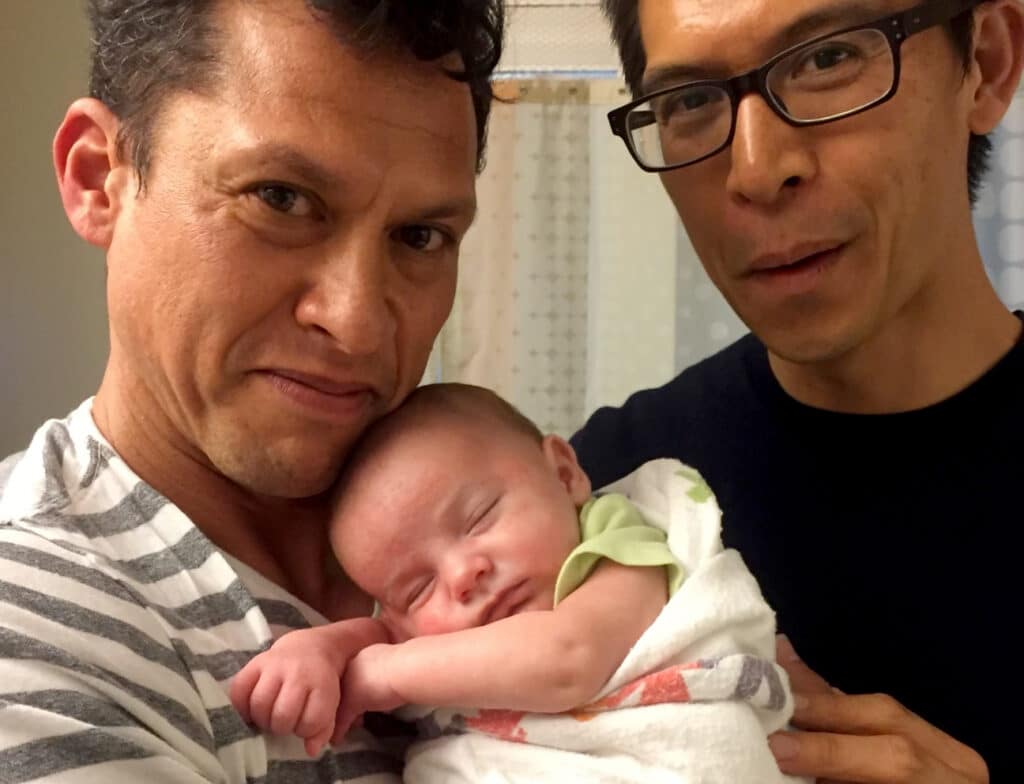
At the height of the pandemic, Ed Center and his husband’s 10-year-old adoptive son Hoku had been inside for days, sullen and addicted to YouTube. Hours-long tantrums followed requests to turn off the iPad or to take a bath. Some episodes escalated into violent outbursts with the boy breaking plates and punching holes in the wall.
The pair were desperate for help in 2021, when a worker at an adoption assistance center suggested a crisis hotline for foster and adoptive parents. So the next time a meltdown felt out of control — a tussle had ensued at teeth-brushing time — Center dialed (833) 939-3877, for the Family Urgent Response System.
One hour later, a counselor walked in the door to their San Francisco home, her own toothbrush in hand. She challenged Hoku to see which of them would be able to finish brushing their teeth first, the beginning of a gentle unwinding. As the relieved parents looked on, she calmed the boy down and put him to bed.
“For a long time, we were caught in a downward spiral,” Center said. “At that moment, it felt like we were no longer alone.”
For the past three years, the Family Urgent Response System has provided in-person help like this to current and former foster youth and their caregivers throughout California during family conflicts and mental health crises. Young people living in homes with families, residential facilities or independent apartments are eligible, as well those who have recently reunified with their parents.
The goal is to stabilize foster care placements, and prevent hospitalizations and calls to police. A mobile-response team is located in all 58 counties in the state, 24 hours a day, seven days a week. At night, when challenging situations often unfold, social workers don’t usually answer their phones and few other mental health professionals are available on-call.
But with California mired in a deep budget deficit, dozens of state programs are slated for elimination. Gov. Gavin Newsom’s $292 billion spending plan released in January proposes zeroing out the annual $30 million investment in the hotline known as FURS.
As a result, more than 1,000 advocacy groups, child welfare agencies and community-based organizations are sounding the alarm. They’re being told the desperately needed program could be dismantled as soon as next year.
“If we weren’t able to take these calls, they would be going to 911, law enforcement, fire — creating much more havoc for the foster kids and families who are already dealing with instability and trauma,” said Gabriel Skydancer, a veteran Los Angeles County Department of Children and Family Services social worker and director of its urgent response team.
Skydancer said in his county, FURS interventions are successful most of the time in stabilizing foster care placements. As a result, fewer foster youth end up in shelters and on the streets.
Skydancer described one example of note. On the drive to school, a foster youth leaped out of a moving car and into traffic. His grandmother was terrified, and had no idea where he had gone.
Skydancer’s team was dispatched, and when they finally found the high school senior, they discovered why he had run off: The teen was embarrassed. He only had two pairs of pants and three shirts, and his only pairs of shoes had holes in them. As a result, he was being bullied at school.
The urgent response team learned that although his grandmother had taken him in, a family member had been intercepting the benefits she was owed to care for the boy. The team helped transfer the monthly payments to the teenager’s current caregiver, helping better support the high schooler’s needs. FURS staff provided him with new clothes and shoes, and shortly thereafter, he was back in school.
“This is so much more than a hotline,” Skydancer said.
“If we weren’t able to take these calls, they would be going to 911, law enforcement, fire — creating much more havoc for the foster kids and families who are already dealing with instability and trauma.”
— Gabriel Skydancer, director of Los Angeles County’s FURS team
Since its 2021 launch, the Sacramento-based FURS hotline has fielded more than 11,000 calls. Sometimes hotline operators can help resolve a situation over the phone. Other times, calls are transferred to a waiting mobile response team run by a nonprofit or local government agency. About 25% of calls require an in-person “urgent” response to events such as the sudden onset of a serious psychiatric disorder, or a family argument turned violent.
Other issues may seem minor, but can be tough to resolve without help, and can escalate into deeper crises: conflicts arising over house rules, the inability to access services for learning disabilities and desperate efforts to maintain contact with siblings separated by the child welfare system.
State officials say it’s too early to tell whether the FURS program is making a difference in foster children’s lives. So far, there is only limited outcome data. Analysis by the advocacy group Children Now found the percentage of children who move three or more times in California’s foster care system has dropped by 20% since FURS began. It now stands at an all-time low of nearly 27%, the group has reported.
The California Department of Social Services plans an in-depth study of how the service impacts placement stability, reentry into foster care after children have been reunified with parents, and whether kids end up in the juvenile justice system.
But those efforts are on hold, given the program’s uncertain prospects amid the state’s budget woes. Newsom’s January budget addressed a $38 billion deficit, a financial hole that has deepened since the beginning of the year. According to the state’s nonpartisan Legislative Analyst’s Office, the state’s shortfall now reaches $73 billion.

An April plan by California’s Democratic leaders would reduce the deficit by $17.3 billion through a combination of spending cuts and deferrals. But far more cuts will be needed to balance the budget by the June 15 deadline, analysts say.
In budget hearings, state officials from the Department of Social Services have stated that the Family Urgent Response System can be cut because there are alternatives for youth in crisis, state-sponsored mental health apps and consultations with “wellness coaches” through the CalHope program.
But Susanna Kniffen, senior managing director of child welfare at Children Now said FURS is not replicated by other state-funded programs. Mobile responders are trained to understand the unique dynamics involving foster youth and their caregivers, and they appreciate that minor issues can easily escalate.

“What’s different from FURS is that a team will go in no matter what the issue is, no matter what level it rises to,” Kniffen said. “You don’t have to have a certain acuity to get help.”
So far, state legislators in both chambers have vowed to preserve the program.
At a hearing last month, Assemblymember Corey Jackson — who chairs a budget subcommittee on human services and once worked in a group home for foster youth — said he opposed cuts to the FURS program, as well as the gutting of other vital social services.
“As long as I’m chair, we are not going to repeat the mistakes that we did in the Great Recession,” Jackson said, referring to the 2008 economic downturn. “We are going to do everything that we can to make sure that we protect our most marginalized and vulnerable populations.”
The idea to create a Family Urgent Response System first surfaced about a decade ago, as California child welfare leaders pondered how to reduce the state’s reliance on institutional care. After many placements collapsed, many foster youth ended up in group homes. Young people also wanted relief from feeling they could be tossed out of foster homes whenever a caregiver changed their mind, ending up back in social workers’ cars on a ride to yet another placement.
The trauma of placement disruptions is well known among researchers. A 2021 article published by the Children and Youth Services Review found that foster children who are shuttled through multiple homes are more likely to struggle with school and mental health. The longer a foster child remains in the care of the state, the more difficult it is to achieve permanent living situations like adoption, guardianship or reunification, the study found.
“A team will go in no matter what the issue is, no matter what level it rises to. You don’t have to have a certain acuity to get help.”
— Susanna Kniffen, Children Now
In 2021, Hoku shifted from being a happy, mischievous boy, to a kid who rarely ventured outdoors. Disturbing behaviors grew more common, his parents said, such as when he painted “I hate my dad” on the walls. One day, the 10-year-old took a Sharpie to every family portrait in the home and blacked out his face.
That was particularly painful for Center, who along with his husband, had adopted Hoku and his brother from foster care when they were infants.
The behavior was tantamount to saying, “I don’t belong in this family,” Center recalled in an interview. “I had worked so hard to build this family and to make it a place where my kids know that they’re loved unconditionally and belong. So that was a real gut punch.”
Then a Family Urgent Response Team, run by Seneca Family Services, began showing up.
Team members calmed Hoku down during moments of intense “dysregulation,” at times through something as simple as chatting with him about his beloved cat, Cheezypuff. They gave Center and his husband tips for managing difficult behavior — how to stay calm, and seeing his son’s violent behavior as communicating his pain rather than actual hatred — and connected the family to “wraparound” services. Eventually, rage-filled tantrums that once lasted for hours ended in 20 or 30 minutes.
Center conceded things at home still aren’t always easy. Now 13, Hoku has entered the ups and downs of adolescence, but the family is bolstered by weekly home visits by therapists.
Hoku had once stopped going to school but he’s since gone back — and the family has been able to return to favorite activities that were once too difficult to navigate — such as bike rides and trips to the arcade.
Center said he’s glad he never had to call the police or send Hoku to a psychiatric hospital. Without the mobile response team, things might have ended differently. And on behalf of his family and others, he implored lawmakers to maintain the funding for FURS.
“If we had had to wait a year, I would not be talking to you,” he said. “My family would not be together anymore.”