
In a public hearing Monday, Audrey Brannen shared with a panel of Georgia lawmakers about an all-too-common scenario she sees in her role as a complex care coordinator for the Georgia Division of Family and Children Services: a parent disappearing from the life of a child who’s been institutionalized due to psychiatric crisis.
Describing a teen she called Chelsea, Brannen said she was prone to violent outbursts and incidents of self-harm. She had threatened family members and lashed out at police officers called to the house when her behavior became too overwhelming and dangerous for her parents to safely manage.
After Chelsea was admitted into residential care, staff urged her parents to visit, join therapy sessions and prepare for her eventual return. But after one visit, they never returned. That’s the way Chelsea, now 14, and hundreds like her across Georgia, have entered the foster care system.
“After months or even years of trying, families give up, they throw their hands up and say they cannot do it anymore,” Brannen testified.
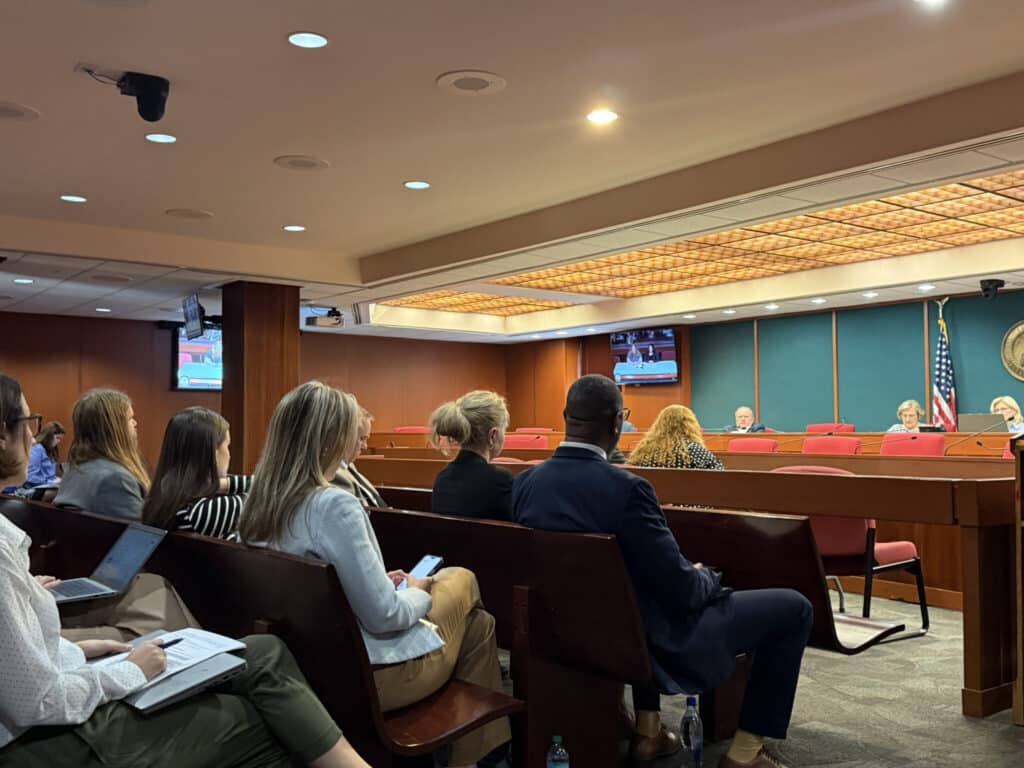
Precise numbers are not yet available, but the state’s child welfare agency estimated that 500 kids across Georgia currently require “complex care” services. Chaired by Rep. Katie Dempsey, the House Study Committee on Abandoned Child Placement Following Hospital Discharge held its first meeting Monday to address the growing issue of “relinquishment” — cases where children in mental health treatment are voluntarily turned over to the state because their parents lack the resources to care for them.
During the five-hour meeting, child welfare workers, mental health providers and youth and family advocates described how difficult the situation has become. There are too few beds in treatment facilities, and gaps in post-discharge care leave parents uncertain of whether they can bring children who may need around-the-clock assistance back home.
“Every day, it feels like we are fighting a forest fire with a squirt bottle,” Brannen said.
A federal research brief earlier this year found that between 2017 and 2019, as many as 25,000 children nationwide entered foster care under similar circumstances, known as parental relinquishment. The Imprint’s ongoing coverage of the issue has revealed hardships felt by children, parents, siblings and strained government and private agencies nationwide. In Minnesota, voluntary relinquishment accounts for 11% of foster care placements, and in Texas they account for 6%, according to state statistics.
In Georgia, Dempsey said her goal for the committee is to better understand why parents reach the breaking point, “whatever the reason is, not to judge it,” and to provide better support for the children left behind.
“They’re changed from when they first arrived,” Dempsey said of children who enter foster care after being given up by their parents. “They have a new crisis going on, new challenges to deal with that they didn’t arrive with.”
Other representatives from Georgia’s Division of Family and Children Services stressed at Monday’s hearing that although they sympathize with parents’ predicaments, foster care was never designed to be a mental health provider. The state simply lacks the resources to serve them, leaving hundreds of children competing for a handful of psychiatric residential beds.
Dana Carroll, deputy general counsel for the Division of Family and Children Services, said under Georgia law, removing children should only happen when they are at risk of harm due to parental abuse or neglect. But that’s not what is happening here, she said. Carroll said many parents relinquishing their children don’t actually want to give them up, or to forgo their parental responsibilities.
“These parents do not know what else to do,” Carroll said. “And what we’ve done at that point is take away the parents’ right and ability to make decisions for their child.”
At Hillside in Atlanta — one of Georgia’s few psychiatric residential treatment facilities treating some of the state’s most vulnerable youth — the challenges are apparent. More than half of the residents have attempted suicide at least once.
“Every day, it feels like we are fighting a forest fire with a squirt bottle.”
—Audrey Brannen, complex care coordinator with the Georgia Division of Family and Children Services
As of Monday, 90 children were in treatment at Hillside. Most had been admitted directly by their parents, said Hillside’s CEO Emily Acker. Parents with kids in the program have the opportunity to participate in post-care planning, which can include intensive in-home therapy after the child leaves the facility — if they do return home.
Amy Rene, Hillside’s vice president of community programs, described the challenging situations of parents who aren’t able to participate — and then fail to pick up their kids when it’s time for discharge. That’s one example of when child protective services steps up instead.
Rene recounted how her agency worked with one single mother, on the verge of eviction, to avoid that outcome.
“Mom drives a taxi at night,” she said. “She has two other kids that she’s taking care of. She can barely pay her bills, so she had a really difficult time engaging in family therapy.”
By restructuring therapy sessions around the mother’s schedule and helping her navigate juvenile court when her son got into fights at school, Hillside was able to stabilize the situation.
“This youth is still very at high risk for out-of-home placement,” Rene said. “This youth is still at high risk for needing mental health care, but he is stable.”
Both psychiatric care providers who testified acknowledged a difficult truth: They can often identify early on which families are at risk of relinquishing their child. Their struggle is how to best head it off.
Hillside created a dedicated “complex discharge planner” role to coordinate family engagement and smooth transitions home. Children, for example, spend trial overnight visits home to practice coping skills before they are fully discharged. However, insurers often do not reimburse this kind of role because it is not considered “medically necessary,” Acker said.
Rep. Sharon Cooper pressed hospital leaders to explain what happens when parents abandon their children in their care. They said they try to maintain contact with patients’ families. But if parents fail to engage, the only option left is calling child protective services.
Even still, hospital administrators testified Monday, it can take weeks before anyone can legally make decisions on the child’s behalf, and hospital staff are typically unfamiliar with the family court system. Meanwhile, meaningful ongoing treatment for the child is at a standstill.
“That’s too long without a guardian,” said Corey Jackson, CEO of Atlanta’s Laurel Heights Hospital, a pediatric behavioral health facility. In such scenarios, “we can’t do anything, we can’t get additional medication.”
From 2023 to 2025, Jackson said his hospital cared for 69 abandoned kids, which cost the facility $700,000.
Costs aside, there are profound effects on the children. Jackson pointed to studies showing that developing brains are impacted negatively by abandonment, resulting in emotional dysregulation, low self-esteem and attachment disorders.
That damage is visible, said Sonya Rice, business development director for Laurel Heights. Children left behind by their families will regress, act out and become withdrawn. Clinicians turn into their “surrogate” caregivers.
“We see them with their heads down, not participating in therapy or activities,” she said. “The therapists, teachers, and staff surround them, almost adopting them, just to lift them up.”