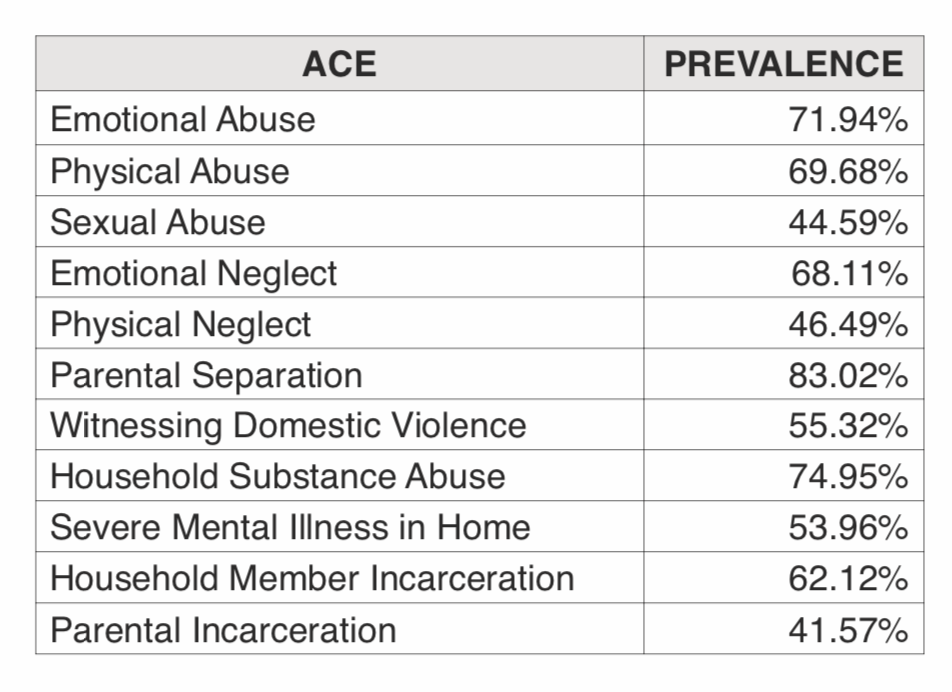
Ninety-four percent of children sentenced to adult time experienced multiple traumas in their early years. Eighty percent of girls survived sexual abuse, a large percentage overall are commercially trafficked.
Yet in all but 10% of cases, this childhood trauma was not even considered in court when minors were tried for crimes.
These are the findings in a new report detailing the “childhood-trauma-to-prison pipeline.”
The report by the Washington, D.C.-based nonprofit Human Rights for Kids — which investigates harms to children in the justice, immigration, child welfare and education systems — was published late last year, when The Imprint spoke to the group’s child rights researcher and report co-author Aiden Lesley. His work is based on surveys of more than 2,200 people across the country who are incarcerated in adult facilities for crimes they were convicted of as minors.
“If you care about children who have been victims of physical and sexual abuse, human trafficking, and neglect, you have to care about the kids who end up in our adult criminal justice system,” Lesley and co-author Suzanne La Pierre, the organization’s co-founder and president, wrote. “They are the same kids.”
Lesley, who joined Human Rights for Kids in 2022, leads all research projects for the nonprofit, generating data and educational materials to inform policymakers and the public about the experiences and needs of children in the justice system.
“If you care about children who have been victims of physical and sexual abuse, human trafficking, and neglect, you have to care about the kids who end up in our adult criminal justice system.”
— Aiden Lesley and Suzanne La Pierre, report authors
His earlier research includes an analysis of the 32,000 people serving prison sentences for crimes committed as children and the impact of state “Raise the Age” laws aimed at keeping minors out of adult criminal court.
In a Dec. 4 interview, Lesley discussed what he learned from those answering his survey from behind bars, why childhood trauma should be considered in criminal cases, and why he remains hopeful despite federal efforts to defund youth violence prevention programs and dial back justice reforms.
This conversation has been edited for brevity and clarity.
You and your co-author recommend policies that require judges to consider the childhood trauma of minors being tried as adults. What does that look like in practice? And do you think judges in the adult courts have the understanding needed to do that?
Whenever you have a kid who’s arrested, it’s having some form of screening — asking the question, “How did we get here?” When you have those screenings, then you can start to say, “OK, does this kid need substance abuse treatment? Does this kid need treatment for trauma and PTSD? Do we need to start asking questions about a potential trafficking issue here?” When that happens, you get options. And when it comes to judges, they like having those tools available.
It’s about giving judges those options. One we talk about is deviation from mandatory minimums. If you have a kid who’s being charged in adult court for an offense that has a mandatory minimum, then their hands are tied. So when you have cases like that, but you give judges those tools, it’s our position that they usually tend to turn to those options and to use them — or at least to try using them and to find the ones that work.
I noticed a mention in the report that child maltreatment is the strongest indicator for recidivism. Can you talk more about that connection?
When you have kids where being treated poorly by society is the only thing that they know, why should they have a reason to feel that they owe anything to their environments? There was somebody who sent a letter who basically said, “I wasn’t born bad, but the systems and the people that were there and were supposed to care for and protect me didn’t, so I wasn’t able to develop.” They felt that they weren’t able to develop the skills and the coping strategies and just the general outlook on life to be well-adjusted.
And when they land in the adult system, it’s usually just kind of a perpetuation of that trauma and that abuse. Nothing’s changed. We’re not putting them on a better path. We’re not letting them heal and learn the skills necessary to come out of prison and be able to put their life together.
You found that children are far more likely to be sexually abused in adult prison or jail compared to juvenile facilities. We at The Imprint have reported a lot on sexual abuse occurring in juvenile facilities. Is that stemming from higher rates, in general, of sexual abuse in adult facilities, or is it a symptom of the power imbalance when children are incarcerated alongside adults?
I think it’s a combination of both. I see a lot of those stories about abuse in youth facilities, and what you see is that it comes at the hands of staff. When you bring the kid into the adult system, you have that too — but then you also have the grown adults that the kids are incarcerated alongside; someone who is both far physically larger and stronger than those kids and someone who likely is a more of a hardened criminal. That creates the exact power imbalances that you’re talking about within the confinement of the prison or the jail.
The Prison Rape Elimination Act prevents kids from being held in the same environments as adults in prisons. So usually the kid just gets held in adult jails until they turn 18, or they get held in indefinite solitary confinement. That creates issues that make kids so much more vulnerable to victimization.
So, solitary confinement is sometimes used as a protective measure in these settings, but you wrote about the devastating effect this has on children during this crucial developmental time in their lives. Can you describe what you learned about those impacts?
Fundamentally, what it comes down to is, when you have kids who are experiencing this severe trauma, it’s causing actual impact on their brain development.
These are things that aren’t minor either. Typically it’s in the frontal lobe, so what we’re talking about are things like high-level executive decision-making, things like actually thinking through the consequences of your actions, thinking about how something can affect more than just you.
“It starts by admitting the reality: A lot of these kids have committed serious offenses, offenses that have left very real victims. Nothing that we’re talking about is trying to discount any of that. We’re not talking about eliminating accountability. What we’re talking about is public safety.”
— Researcher Aiden Lesley
Something that really stood out to me in the report was the Mendota Juvenile Treatment Center in Wisconsin. You describe it as an ideal intervention for serious, violent youth offenders — the kind who, when a layperson pictures a kid being charged as an adult — they’re thinking of these kids. Can you talk a little bit about what’s going on there, and why you think its program hasn’t been more widely implemented?
Their model, which they call decompression, is about giving kids the choice — basically presenting kids with better choices and letting them choose that better path themselves. It’s about ensuring accountability — recognizing, hey, this is what happened, but here’s what we’re going to do.
You’ve got to be keeping up with your schoolwork, you’ve got to not be attacking staff, you’ve got to not be fighting with other kids. It’s incentive-focused, to give kids the opportunity to be in a better environment. And usually when they get that opportunity, they take it. And what it also shows is this message of: We are actually invested in your success — we will actually reward you for that success.
This isn’t a small investment. And on its face, I think that may scare some people off. But the reality is, they have a much lower recidivism rate with their kids compared to the standard. Programs like this actually end up saving money.
The Trump administration has worked to roll back a number of juvenile justice reforms, including “second chance laws” to give people who received lengthy sentences as children a chance for an earlier release. How does that square with your findings?
After 20, 25 years, if the kid was locked up under 18, they’ve spent more time in prison than they have been on the outside. So the objective is, if you have a person who has matured and who has done the work to address why they ended up in adult court in the first place — and has done the work to put themselves in a position where that is never going to happen again — those second-look provisions give them the opportunity to try and prove that.
It’s not a “get out of jail free” card. Those petitions get denied all the time.
But when those lifelines exist, it actually gives opportunity for people to have something to work for. We had responses from people in states where these second-look provisions don’t exist, and they said, “Why should I care about reforming myself? Why should I care about getting job training? Why should I care about getting my education if I’m not getting out?” When you have those provisions in place, then you have an incentive toward actually rehabilitating.
How concerned are you about this and other attempts by the Trump administration to return to a more punitive approach to youth justice?
I won’t deny that some of the efforts in D.C. to roll back efforts aren’t concerning. They certainly are. But when it comes to state legislatures and even the federal government, we have seen progress all across the political aisle.
This calendar year, we had legislative successes in Hawaii and Arkansas. For us, that’s telling — that when you have people who are really willing to ask these questions and to start having these conversations, this is something we can find answers to across the political spectrum.
With people in power like U.S. Attorney for D.C. Jeanine Pirro referring to youthful offenders by saying, “I know evil when I see it, regardless of the age”— what do you say to push back on that?
It starts by admitting the reality: A lot of these kids have committed serious offenses, offenses that have left very real victims. Nothing that we’re talking about is trying to discount any of that. We’re not talking about eliminating accountability. What we’re talking about is public safety.
A lot of the people that echo that rhetoric say it in the name of public safety. So when you’re talking about what furthers that goal, is it better to commit to a system that is more likely to make sure that that kid commits an offense again when they come home, or to put them in a position that — when they come home you can ask them about what happened — they can say, “That’s the biggest mistake of my life, and I’m going to make sure it never happens again.”