
Crime is at a 30-year low in Washington, DC. Yet echoing the past, the fear-inducing rhetoric has heated up.
The same day President Donald Trump’s emergency order declaring a “crime emergency” in Washington D.C. expired this week, his administration pushed a package of bills through Congress that upend the district’s hard-fought youth justice protections.
Following a vote Tuesday, the House advanced legislation that would allow children as young as 14 to be tried as adults. It also reversed prior law that extended access to the juvenile and family court system through age 24.
The Trump-appointed U.S. Attorney Jeanine Pirro explained her rationale for more punitive approaches in a statement to CNN:
“I know evil when I see it, no matter the age,” she said, “and the violence in DC committed by young people belongs in criminal court, not family court.”
Another bill headed for the House floor and championed by Pirro would repeal Washington D.C’s 2016 Incarceration Reduction Amendment Act. The pioneering “second look” law allows those convicted of serious crimes as youth to petition the court for a sentence reduction after serving at least 15 years.
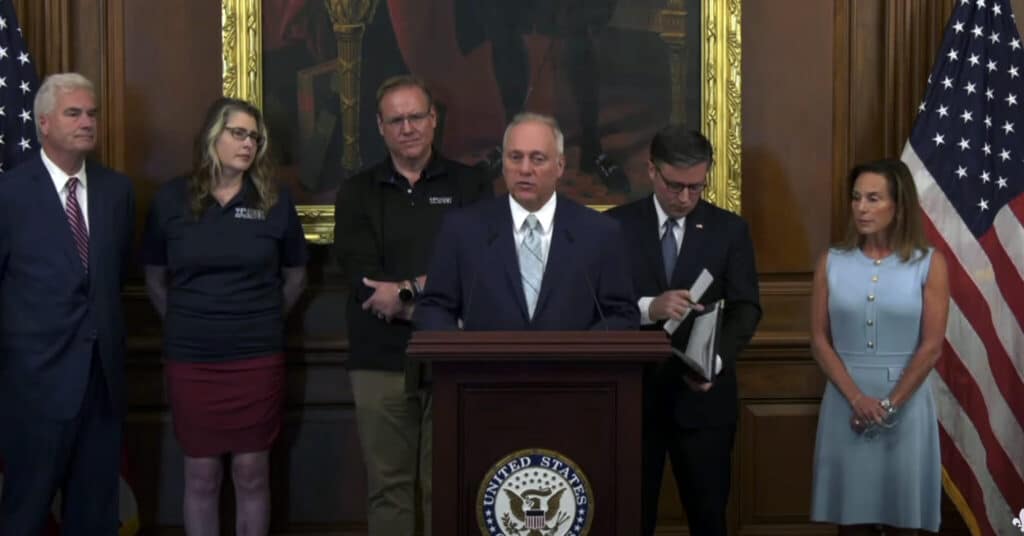
House Majority Leader Steve Scalise is pushing the bills.
“In order to lower crime in our nation’s capital, we must acknowledge the threat these young people are posing to public safety,” he said in a written statement. “Teenagers who commit serious and violent crimes such as murder, sexual abuse, and armed robbery must be held accountable for the pain they inflict and the danger they pose by being tried as adults.”
Historically low crime stats, familiar false claims
The political push for more punitive laws stands in stark contrast with irrefutable crime statistics.
Arrests of people under 18 years old have dropped by half in D.C. over the past 15 years, according to The New York Times. Nationwide, youth arrests peaked in 1996 and have declined since then by roughly 75%. This downward trend holds true for serious and violent offenses as well as petty crime.
With these facts as backdrop, President Trump has warned of “caravans of mass youth” on a “rampage through city streets at all times of the day.”
The president, who once said in a campaign speech that he could “stand in the middle of 5th Avenue and shoot somebody” and wouldn’t lose voters, called out DC teens as “roving mobs of wild youth.”
“The collective classification and presumptions about Black children are real. You saw it in DiIulio’s language of the ‘90s and you see it in Trump’s language today.”
— Kristin Henning, Georgetown University law professor
For anyone old enough to remember the 1990s, this language may sound familiar. Those were the years when Princeton political scientist John J. DiIulio predicted a wave of underage youth would stalk the streets with “no respect for human life and no sense of the future.”
“The black kids who inspire the fear seem not merely unrecognizable but alien,” he wrote in The Weekly Standard in 1996.
His predictions were later decisively discredited as racist tropes, and the youth crime wave he predicted failed to appear. But such rhetoric had enormous real-world consequences.
Politicians used the fear-mongering to pass laws in every state that sent large numbers of children to be prosecuted and sentenced as adults. By the early 2000s, 250,000 teenagers a year were charged in adult court, according to the Sentencing Project, a research and advocacy nonprofit.
Decades of stubborn advocacy against mass incarceration and the criminalization of youth of color — led in part by the formerly incarcerated youth and their advocates — eventually paid off. Dramatic revelations in adolescent brain science revealed the unique vulnerabilities of youth, and, relying on that research, a series of Supreme Court decisions limited the most extreme adult sentences for youth.
Decades later, the number of teens charged as adults each year has dropped by more than 80%, national statistics show.
Now — months into an unleashed second-term Trump presidency — longtime youth justice experts fear that unless the new bills fail in the Senate, more D.C. youth will be sent to adult prisons, where there are few if any chances for treatment and rehabilitation. They nonetheless remain cautiously optimistic that even amid the threats, state-level reforms across the country will remain in place because public sentiment has shifted, actual crime is at record lows, and activists are pushing back.
Liz Ryan, who led the federal Office of Juvenile Justice and Delinquency Prevention for the Biden Administration, said three decades of advocacy and research have created a “stronger infrastructure” of legal and advocacy groups prepared to push back against efforts to try more youth as adults.
But she added that the threat appears greater now.
“In the ‘90s, I didn’t see helicopters flying overhead and police cars on the streets and a war zone-type atmosphere,” Ryan said.
Shortly after Trump was reelected this year, Ryan’s former office gutted funding that supported efforts to prevent gun violence, protect runaways from trafficking and eliminate rape in youth prisons.
Vincent Schiraldi — who has led youth justice systems in Washington, D.C. and Maryland and probation and corrections departments in New York City — noted the scope and novelty of the current threat.
“As fabricated as these moral crises can often be,” he said, “this one is setting a new standard for fabrication.”
And it’s all too familiar, said Georgetown University law professor Kristin Henning, who worked as a public defender in D.C. in the late 1990s.
“Politicians grasp onto and exploit the high-profile incidents to satisfy their agenda,” she said. And then as now, Black children are unfairly targeted and maligned. More than 93% of youth arrests in DC involve Black children, according to the Sentencing Project, and Black youth are vastly over-represented among children charged as adults.
“The collective classification and presumptions about Black children are real,” Henning said. “You saw it in DiIulio’s language of the ‘90s and you see it in Trump’s language today.”
The progression of the recent DC crackdown
The push to “crack down” on youth crime in D.C. began in August, when President Trump seized on the attempted carjacking of a young DOGE worker to declare a “crime emergency” in the District — despite the fact that crime there is at a 30-year low. Federal agents and National Guard troops flooded into city streets.
A Washington Post analysis of arrests made during the month-long “emergency” found that federal enforcement was concentrated in the District’s “poorest, least white” neighborhoods. Those arrested were “overwhelmingly” young Black men. While weapons charges comprised the largest category of arrests, a significant number were for minor offenses such as open containers of alcohol, smoking marijuana in public, fare evasion and driving without a license.
“As fabricated as these moral crises can often be, this one is setting a new standard for fabrication.”
— Vincent Schiraldi, juvenile justice reform advocate
Schiraldi believes the overheated language emanating from Republican leaders is unlikely to unravel decades of youth justice reform in states across the country. Instead, it lowers the odds that new reform measures will be taken up.
“The more national guard troops that get called out, and the more photos of 19-year-old DOGE workers that get plastered around, that does make people afraid,” he said. “It’s not good for reform and is good for ne’r-do-well moral panic-related legislation.”
A shift in public opinion
Robert Barton, co-founder and executive director of the nonprofit group More Than Our Crimes, joined other D.C.-based advocates at a 10-hour House Oversight Committee hearing where the bills were introduced on Sept. 10.
Barton is concerned about the bills’ potential impact on youth in D.C., where the justice system operates under a unique combination of local and federal control.
But he said he believes that decades of advocacy and research have shifted public opinion in ways that will make a return to the widespread prosecution of teenagers outside of D.C. difficult.
His life speaks to this transformation. In the mid-1990s, Barton, then-16, was charged as an adult with first-degree murder. He was sitting in a car outside the building where the crime was committed, but ended up sentenced to 30 years to life.
Barton was released in February of this year as a result of the Incarceration Reduction Amendment Act and has since made advocating for others his life’s work.
In the 1990s, he observed, getting “tough on crime” was a bipartisan priority, and those like himself had little access to the halls of power. Today, he said, he is able to walk into a lawmaker’s office and be greeted with respect.
“There’s a deeper understanding of a juvenile’s actions now than there was back then,” he said, “and more empathy towards juveniles.”
Indeed, a 2024 survey of victims of violent crime by the Alliance for Safety and Justice found that most reject long sentences. Three out of four said they believe that the most effective way to reduce crime is to create more jobs and housing rather than impose long sentences. Seven out of ten support sentencing policies that allow judges to consider individual circumstances rather than being forced to impose mandatory minimums, and two-thirds support spending on prevention and community investment over increased spending on enforcement and punishment.
Meanwhile, eight of 10 D.C. residents polled by The Washington Post opposed the Trump administration’s efforts to federalize the D.C. police and send troops into city streets. The same number say they feel safe in their own neighborhoods.
‘The threats are very real’
Still, life has changed perceptibly in D.C. in a very short time, said Tara Libert, executive director of the D.C.-based Free Minds Book Club, which works with D.C. youth and adults who are or have been incarcerated.
The presence of National Guard troops on district streets and the inflammatory statements from the White House have unsettled residents who could become targets, particularly the formerly incarcerated who are her colleagues.
“People are changing their behavior. They’re just going to work and coming home,” Libert said. “The threats are very real.”
Despite this, Free Minds members — including several who were released under the now-endangered second-look law — are fighting to keep it in place. They’re showing up at D.C. Council meetings and congressional hearings, writing letters to the editor, and “risking a lot by sharing their stories so that people can see their humanity despite the dehumanizing rhetoric,” Libert said. “They’re not going to leave their brothers and sisters behind the walls when they were able to come home.”