
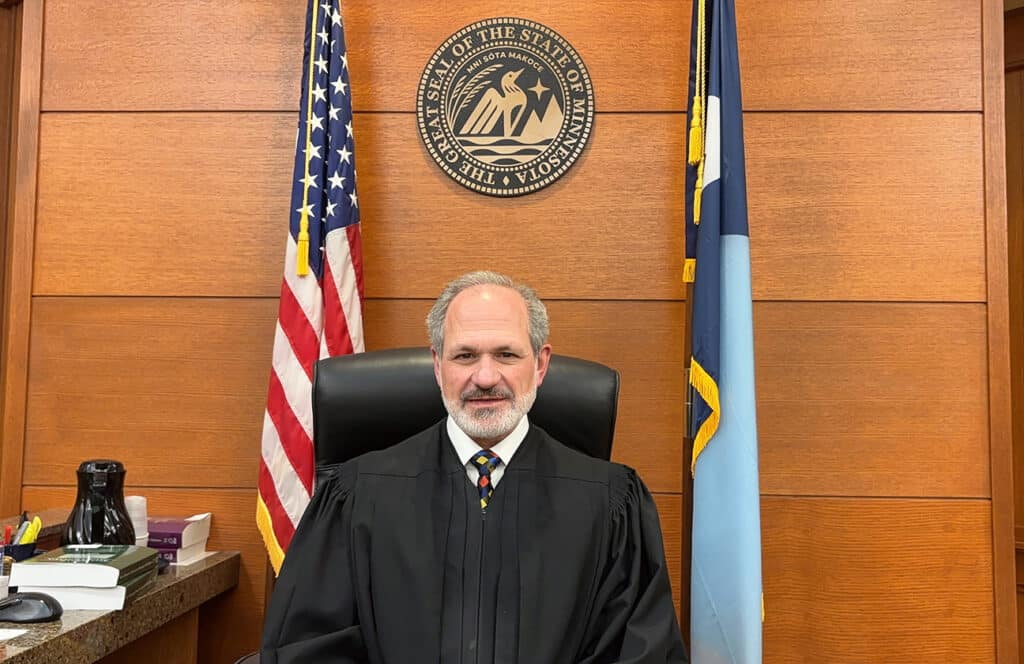
When he began running child welfare hearings in rural Mower County near the Minnesota-Iowa border, District Court Judge Jeffrey Kritzer would first listen to social workers and lawyers to find out what was going on with a family. Then he’d turn to the person appointed to advocate for the child. The last people he’d check in with were the parents.
Over time, following training by the National Council of Juvenile and Family Court Judges, he came to question this approach. If the goal of these hearings is to help children reunite with their parents, he thought, then that’s who he should begin with: the parents. Since then, he’s worked to give parents a stronger voice and keep them engaged during hearings because he believes that courts cannot care for children without also caring for their guardians.
He offers parents a type of encouragement that he calls “supportive accountability,” while also making sure they accomplish what they need to so they can live with their kids again.
“It’s just such a good feeling I get from seeing families reunited,” he said in an interview with The Imprint. “We have an opportunity, not only to save a child from losing a parent forever, but also an opportunity to help the parents become the parents their kids so need and deserve. Those are the kind of opportunities that get me out of bed in the morning.”
Today, Kritzer is the third judicial district’s lead judge for the Children’s Justice Initiative, a federally funded program meant to improve outcomes in child welfare cases. He has also led training sessions for judges, most recently at the National Conference on Juvenile Justice in Minneapolis.
In his Austin, Minnesota courtroom, Kritzer runs hearings quite differently from when he was first appointed to the bench 12 years ago. To build trust, he lets parents speak before anyone else. Though court cases are often held virtually in Minnesota these days, Kritzer insists on holding them in person whenever possible.
He encourages other judges he trains to go beyond the allotted time for hearings if they haven’t finished addressing everything that needs discussion. At times, his own hearings have lasted hours, continuing even after the courthouse closed.
His new approach is supported by the National Council of Juvenile and Family Court Judges, which reports findings that engaged parents are more likely to attend court dates and be reunified with their children.
Kritzer has also gained valuable insights into how separating biological families can affect kids through his experience as the father of three adopted children from Kazakhstan.
In a conversation with The Imprint this month, he outlined his approach to keeping families connected and how to best handle child welfare hearings.
This interview has been lightly edited for length and clarity.
Can you describe the typical dynamic in your courtroom — how do initial conversations with parents go?
Most parents will walk into those hearings thinking everybody’s against them. They’re probably in the throes of addiction. Most of them just had their kids taken away. And the people that they’re going to the courtroom with are the people who did that.
I look directly at the parents and say something like: “No one is here to punish you. The goal of every person in this room is to reunify your child with you, as long as we can do it safely, but we can’t do it without you. You’re the most important person in this room because you’re the most important people in the world to your kids.”
It’s amazing what you’ll see change in the parents. They’ll come in with this, either very defensive, or very nervous body language. And then, when they hear those words, you can see them relaxing. I can’t imagine any other case type where I’d be making a statement like that outside of child welfare.
“We have an opportunity, not only to save a child from losing a parent forever, but also an opportunity to help the parents become the parents their kids so need and deserve. Those are the kind of opportunities that get me out of bed in the morning.”
— Minnesota District Judge Jeffrey Kritzer
You allow parents to speak first during hearings. Why?
The way I did it at first would be how we would normally handle an adversarial hearing. You start with the petitioner, the plaintiff — which would be the county and the social worker — and the last people I would hear from are the parents. It creates an adversarial feel.
The parent, in this case, is forced into a position where they have to respond and defend themselves. Whereas if you start with the parents, they’re the ones who get the first chance to speak, and then everybody else has to respond to them. It also reemphasizes to the parents and everybody else that the parents are the most important people in the room.
Is there ever any pushback to your methods from other judges?
Judges have told me that if they try to talk directly to a parent, question the parent directly, the attorneys will go ballistic. That’s not the way it should be in child welfare cases.
Is the concern that a parent might incriminate themselves?
I think that’s what it is. And that would be a legitimate concern, for example, in a criminal case. That’s the thing about attorneys — that’s what they’re used to. They’re used to protecting their clients. But the truth is, in child welfare cases, yeah, they might say something that is not good, but I’m not going to hold it against them.
For example, if they admit they relapsed. I’m not going to say, “Well, then it’s all over.” The response is going to be: How did it happen? Have you talked to the social worker about what you’re going to do to avoid it from happening in the future? You get people set up with a safety plan. It’s supportive.
During the pandemic, when family court hearings were held virtually, we reported on the potential benefits and downsides to this. Remote hearings can offer flexibility, easing the travel burden on parents and minimizing time off work. Others have said online hearings can be unfair because a bad camera angle or Wi-Fi issues mean a person might be seen in a negative light. Can you explain why you prefer hearings to happen in-person?
If you meet in person, it sends the message that this is important. We care enough to meet in person and talk about this. If it’s done remotely, it looks like you’re just trying to make it as convenient as possible. I’m not saying that’s actually what’s going on in a judge’s head, but that’s the impression that you get.
You’ve said there have been times when you’ve felt frustrated with parents in your courtroom, but expressing that feeling can backfire. Can you explain that?
What happens is they stop trusting you. You become just like every other person who’s told them that they’re bad parents or that they’re no good or whatever it might be. They won’t listen to you, and they won’t talk to you.
Most of these parents have had a lot of trauma in their lives themselves. So when you speak harshly to them or chastise them in a harsher way, it just triggers all the effects of all that trauma.
Here at The Imprint, we regularly hear from people about their experiences entering foster care. These are heavy conversations you’re involved with regularly. Are some cases hard to hear, and do the details of these families in distress affect you?
I know judges say it — and it’s true — this job, it’s kind of like an endless parade of all the worst things people do to each other.
It’s odd. When I do this kind of work, especially child welfare work, it truly energizes me. It doesn’t traumatize me. I just see such an opportunity to try to help people. I don’t dwell on or think much about what happened in the past, except to the extent that it can help me determine how to help this family move forward.